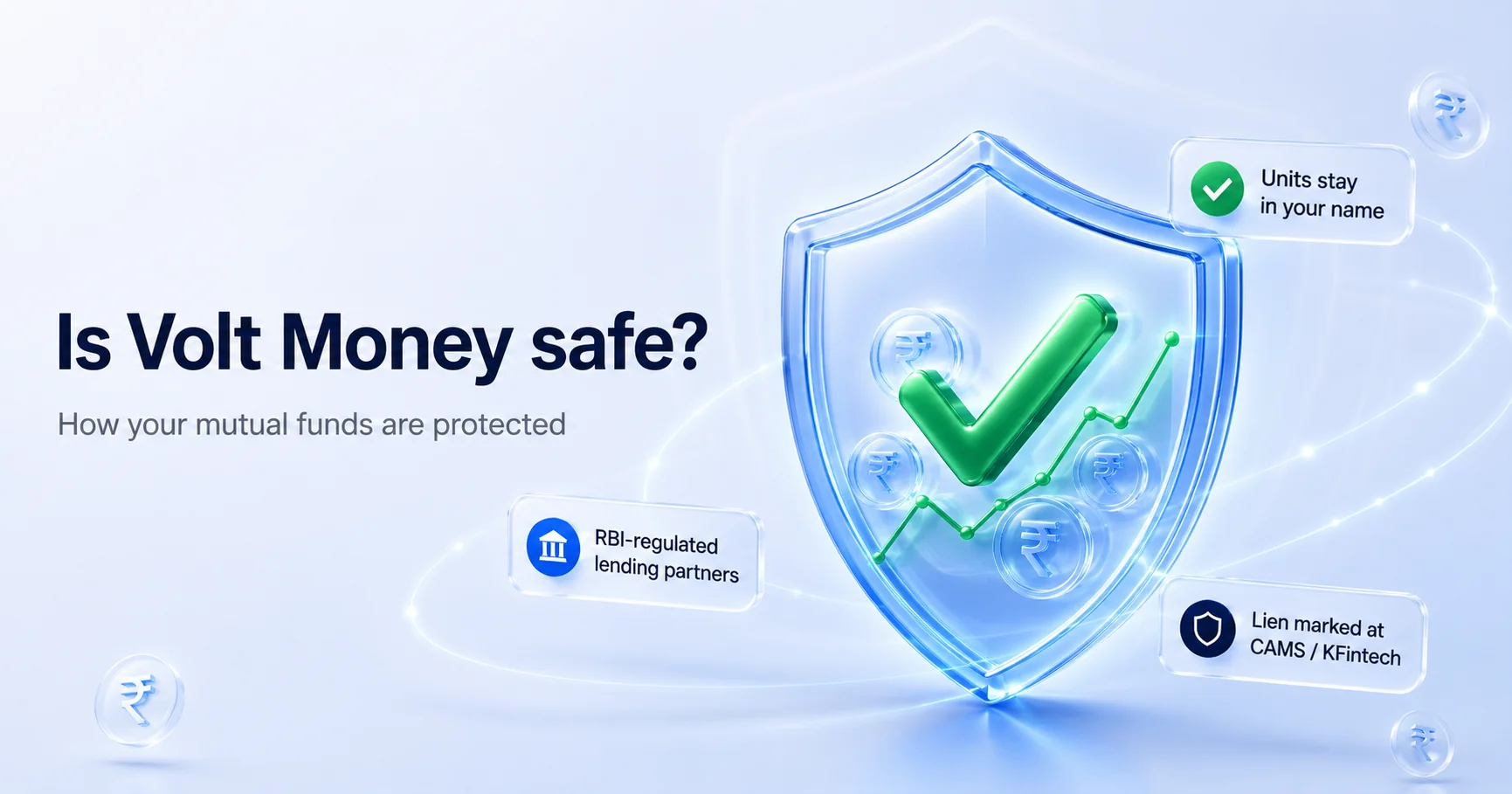
Before you pledge your mutual funds for a loan, one question matters more than the interest rate: is your money safe? It is a fair thing to ask. You spent years building this portfolio, and handing it to any platform deserves a proper answer, not a marketing slogan.
The short version is that a loan against mutual funds is one of the safer ways to borrow, because your units never leave your name. Here's exactly how Volt Money is regulated, where your funds sit while a loan is open, and what protects you at each step.
Who lends the money, and how the lending is regulated
Volt Money is a digital lending platform for loans against mutual funds and securities. The loans are provided through RBI-regulated lending partners (banks and NBFCs, such as Bajaj Finance), and the pledge is created through the official mutual fund infrastructure. That matters, because it means the loan sits inside the same regulated system that governs your investments, not outside it.
Three things follow from that. Your units are pledged, not sold. The lien is recorded by the registrar that already holds your folio. And the loan agreement you accept spells out the rate, charges, and terms in a Key Facts Statement before any money moves.
Company and regulatory details
Check your credit limit on Volt Money. Free, takes 15 seconds.
Check your limit →Volt Money is a digital lending platform operated by Salter Technologies Private Limited. CIN: U64920MH1996PTC099483. Registered office: 1184, 2nd Floor, 5th Main Road, HSR Layout, Bengaluru, Karnataka 560102, India. Loans are provided by RBI-regulated lending partners (banks and NBFCs), including Bajaj Finance. Lien marking and folio records are handled through SEBI-registered registrars CAMS and KFintech, with identity verification via DigiLocker.
For any complaint or query, you can reach our Grievance Redressal Officer: Mr. Kapil Nagal, Digital Lending Grievance Redressal Officer, grievance.officer@voltmoney.in, in line with RBI's digital lending guidelines. For first-level support you can reach our customer service team at support@voltmoney.in or +91 80711 74410 (Monday to Saturday, 9:30 AM to 6:30 PM). Full licensing and partner details, along with all applicable rates and charges, are set out in the Key Facts Statement and loan agreement before you borrow.
Your mutual funds stay in your name
This is the single most important safety point. When you take a loan against your mutual funds, you do not transfer ownership of your units to anyone. They stay in your folio, in your name. What happens is a lien is marked against them at the registrar (CAMS, KFintech, or through MFCentral), which simply blocks you from redeeming or switching those specific units while the loan is open.
Because the units are only lien-marked and not redeemed, they remain invested through the loan period and continue to participate in market movements. The lien blocks redemption, not market-linked gains or losses. It only pauses your ability to sell, and it is released the moment you request an unpledge, which is instant and free of charge.
Do You Need to Trust Volt Money With Your Mutual Funds?
Not in the way most people assume.
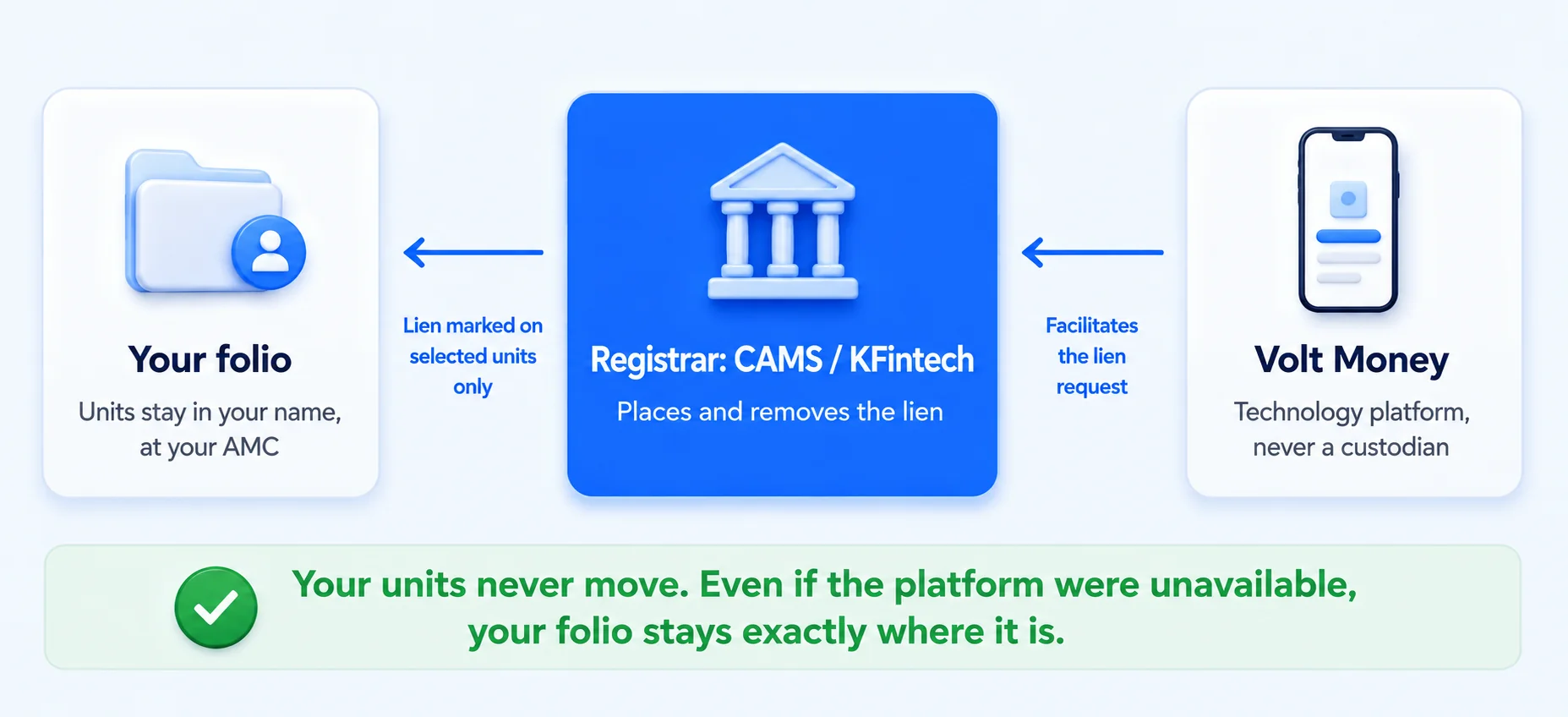
Volt Money never takes custody of your mutual fund units. Your investments remain exactly where they are today, in your existing folio with your mutual fund company (AMC). The platform simply connects with the registrar that already maintains your investment records (CAMS or KFintech) and facilitates the creation of a lien against the selected units. The registrar, not Volt Money, is responsible for placing and removing that lien.
In practice, Volt Money acts as a technology platform rather than a custodian of your investments. It verifies your identity through DigiLocker, checks your loan eligibility, and connects you with an RBI-regulated bank or NBFC that provides the loan. At no stage are your mutual fund units transferred to Volt Money or held by the platform.
This means that even if Volt Money's platform were unavailable, your mutual fund units would continue to remain safely in your existing folio because ownership never changes. The lien simply restricts redemption of the pledged units while the loan is active, and once the lien is removed, you regain full control over those units.
Backed by the same institutions that already hold your investments
Volt Money connects to the same institutions that already run the mutual fund and depository system in India, including CAMS, KFintech, NSDL, CERSAI, and DigiLocker. These are the registrars and infrastructure providers behind your existing investments, which is why the lien can be created and released cleanly without your units ever leaving the regulated ecosystem.
How Volt Money verifies you (without ever seeing your documents)
The whole journey is digital, but it runs on identity and consent checks rather than shortcuts:
- Eligibility check: you enter your PAN and see your approved limit in about 15 seconds. This is a soft check with no impact on your CIBIL score.
- OTP-based KYC through DigiLocker: your identity is verified using government-backed DigiLocker with a one-time password, so your documents are pulled securely rather than uploaded loosely.
- Bank account addition: you add the account where the money is sent and from which interest and repayments are debited.
- Pledge and lien marking: the lien is placed at the registrar against your chosen units.
- KFS and loan agreement: you review and accept the Key Facts Statement and the loan agreement. There is no Aadhaar-based digital signing and no wet signature.
You never upload your physical documents to a stranger, and you never visit a branch. What you need ready is only your PAN number, an Aadhaar-linked mobile number, and your bank account details.
Is a loan against mutual funds risky for the borrower?
It carries a few risks worth knowing, and being honest about them is part of what makes it safe to use. The main one is a margin call. Because your limit is a percentage of your fund value, a sharp market fall can reduce your borrowing base, and you may be asked to add funds or pledge more units to stay within the limit. Interest also accumulates on the amount you draw, so an unpaid balance grows over time. And while the lien is in place, you cannot redeem those units.
None of these are hidden. You borrow well within your limit, you pay interest only on what you actually withdraw, and you keep an eye on your utilisation. Used that way, a loan against mutual funds is a controlled, secured line of credit rather than a gamble.
Why this is often safer than selling or an unsecured loan
Selling your mutual funds to raise cash is final. You give up the units, you may trigger capital gains tax, and you miss any future growth. An unsecured personal loan does not touch your investments, but it charges 14% to 30% p.a. and leans heavily on your credit score.
A loan against mutual funds keeps your portfolio intact, charges interest from 9.99% p.a. only on what you draw, and does not require a credit score at all because it is secured by your units. If you are weighing it against cashing out, our guide on loan against mutual funds vs selling your investments walks through the numbers.
Want to see it for yourself, safely?
Check your credit limit on Volt Money. Free, takes 15 seconds. Check your credit limit
The bottom line
Volt Money is safe in the ways that matter most: your units stay in your name, the loan runs on RBI-regulated lending and official registrar infrastructure, KYC is government-backed, and every charge is disclosed in the Key Facts Statement before you commit. The risks that exist, mainly market-linked margin calls, are transparent and manageable. For most investors who need cash without breaking their portfolio, it is one of the more sensible and secure options available.
Rates, limits, and charges are subject to change and are set out in your Key Facts Statement before you borrow.