When you sell a mutual fund for more than you paid, the profit is a capital gain, and it is taxable. How much tax you pay depends on two things: what kind of fund it is (equity or debt), and how long you held it. Get those two right and the rest of the rules fall into place.
This guide breaks down short-term and long-term capital gains on mutual funds for 2026, the rates that apply after the 2024 Budget changes, and a worked example. It also covers the one option most investors forget: you can often raise the cash you need without selling and without triggering any of this tax at all.
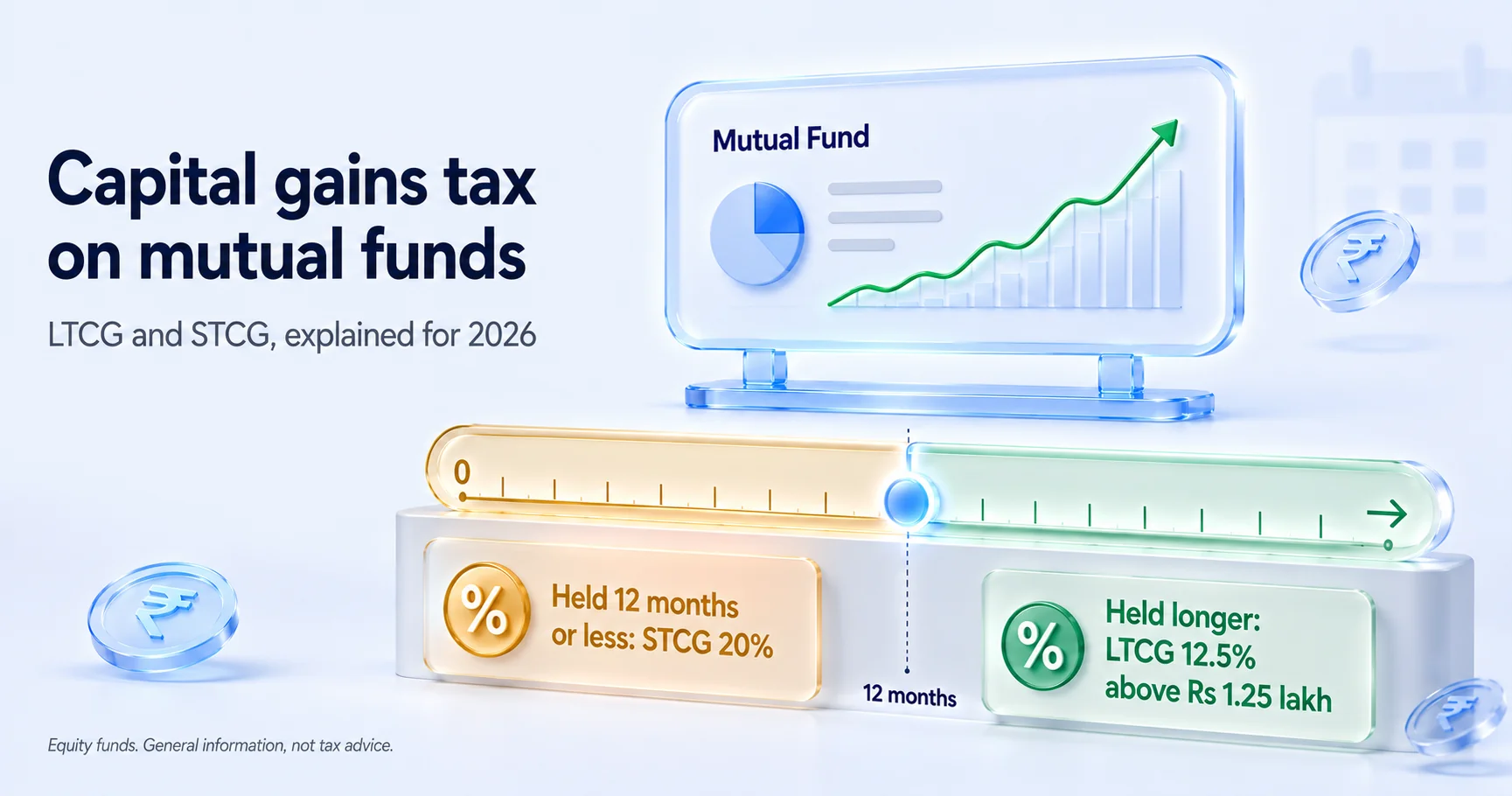
Short-term vs long-term: it comes down to holding period
Capital gains are split into short-term (STCG) and long-term (LTCG). The line between them depends on the fund type:
- Equity funds (65% or more in Indian equities): held for 12 months or less is short-term; held for more than 12 months is long-term.
- Debt funds (units bought on or after 1 April 2023): gains are taxed at your income tax slab rate regardless of how long you hold them. There is no long-term benefit for these units.
The rules for hybrid funds follow their equity share, so a fund is taxed like an equity fund only if it holds at least 65% in equities. Always check the fund category before assuming a rate.
The rates for 2026
Check your credit limit on Volt Money. Free, takes 15 seconds.
Check your limit →These reflect the rules in force after the July 2024 Budget, which apply through FY 2025-26:
| Fund type and holding | Type of gain | Tax rate |
|---|---|---|
| Equity, held 12 months or less | STCG | 20% |
| Equity, held more than 12 months | LTCG | 12.5% on gains above Rs 1.25 lakh a year |
| Debt (bought on/after 1 Apr 2023), any period | Slab-rate gain | Your income tax slab rate |
| Debt (bought before 1 Apr 2023), held over 24 months | LTCG | 12.5% without indexation |
Source: the July 2024 Union Budget capital gains changes, in force from 23 July 2024. Rates shown exclude any applicable surcharge and the 4% health and education cess, and are general information only. PIB press release
Two points that catch people out. For equity funds, the first Rs 1.25 lakh of long-term gains in a financial year is exempt, and only the amount above that is taxed at 12.5%. For debt funds bought on or after 1 April 2023, there is no long-term rate at all: the gain is added to your income and taxed at your slab, whether you held it for one month or five years.
How your gain is actually calculated
Your capital gain is simply what you sell the units for minus what you paid for them. Buy 100 units at Rs 20 and redeem them when they are worth Rs 35, and your gain is Rs 15 a unit, or Rs 1,500 in total. When you have invested in instalments, as with a SIP, units are counted on a first-in, first-out (FIFO) basis: the earliest units you bought are treated as sold first, and each lot's own holding period decides whether that slice is taxed as short-term or long-term.
A worked example
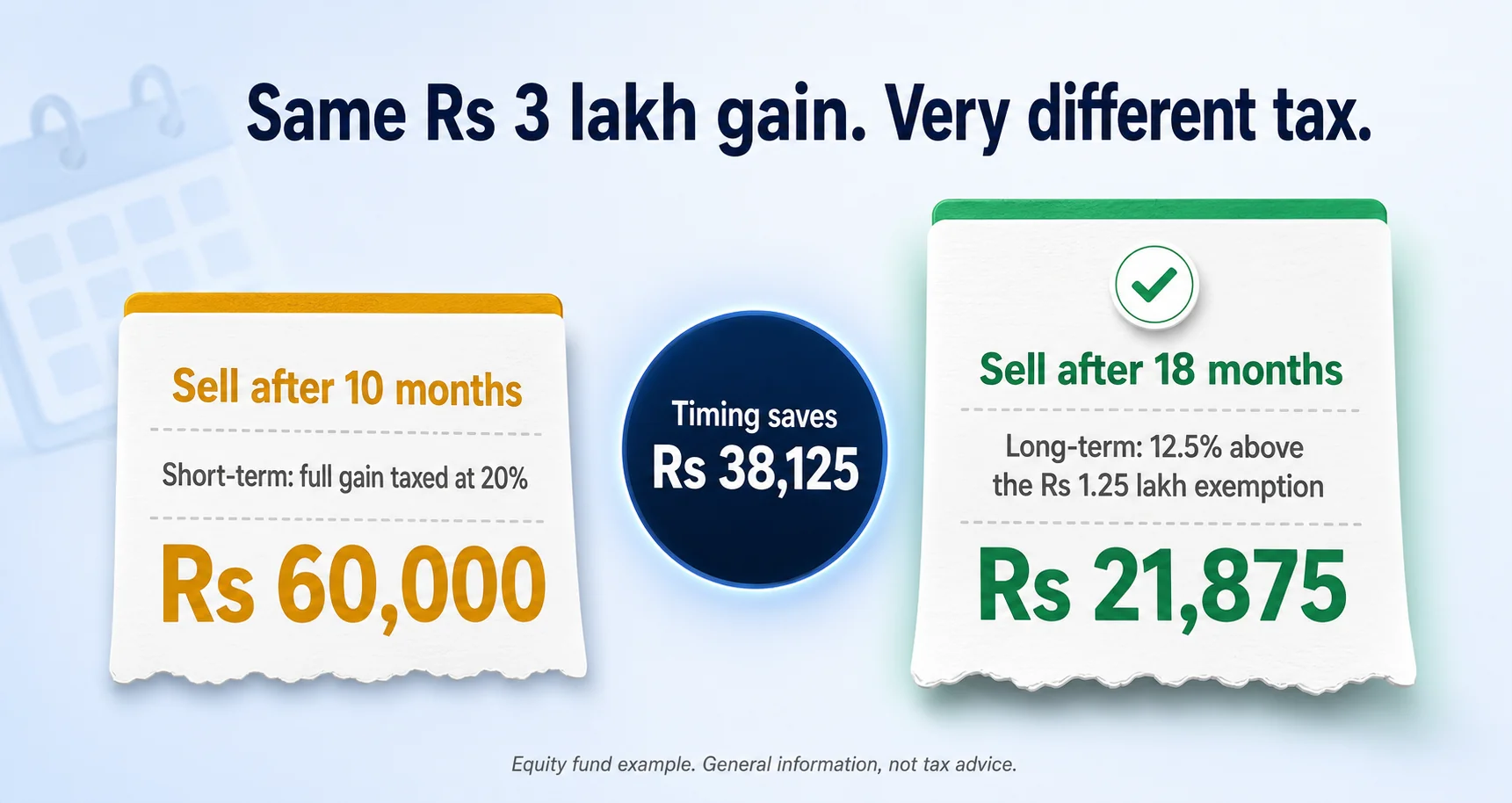
Say you invested Rs 5 lakh in an equity mutual fund and it is now worth Rs 8 lakh, a gain of Rs 3 lakh.
- If you sell after 10 months (short-term): the full Rs 3 lakh gain is taxed at 20%, which is Rs 60,000.
- If you sell after 18 months (long-term): the first Rs 1.25 lakh is exempt, and the remaining Rs 1.75 lakh is taxed at 12.5%, which is Rs 21,875.
Same gain, very different tax, purely because of timing. And in both cases you have permanently given up units that could have kept compounding.
ELSS: the one fund type with a tax break going in
ELSS (Equity-Linked Savings Scheme) is the only mutual fund category that gives you a tax break on the way in: your investment qualifies for a deduction of up to Rs 1.5 lakh under Section 80C, available if you are on the old tax regime. That benefit applies when you invest, not when you exit. ELSS units carry a mandatory three-year lock-in, and once it ends, any gains you book are taxed on the same equity rules as any other equity fund, LTCG at 12.5% on gains above Rs 1.25 lakh a year. So ELSS saves tax going in, but its redemption is taxed just like the rest of your equity portfolio.
Hybrid funds: taxed by their equity share
Hybrid funds are taxed by how much equity they actually hold, not by the label ‘hybrid’. If a fund keeps 65% or more in Indian equities, it is taxed as an equity fund, STCG at 20% under 12 months and LTCG at 12.5% above the Rs 1.25 lakh exemption after 12 months. If its equity share is lower, it is taxed on the debt rules that apply to it. Two funds both marketed as ‘balanced’ or ‘hybrid’ can therefore be taxed very differently, so it is worth checking the scheme's actual equity allocation before you invest or redeem.
How SIP investments are taxed when you redeem
If you invest through a SIP, each instalment counts as a separate purchase with its own date and holding period. When you redeem, units are sold on a first-in, first-out basis, so the earliest units go first. That means some units can qualify as long-term while your most recent instalments are still short-term.
For example, if you have run a SIP for 18 months and redeem part of it today, the oldest units may be taxed as LTCG while the units bought in the last 12 months are taxed as STCG. It is worth checking the holding period of the units being redeemed before you sell. If you are tempted to pause a SIP to raise cash, see why you should not break your SIP for cash.
Switching funds, dividends, and STT: what else gets taxed
Switching is taxable. Moving money from one scheme to another is treated as a redemption and a fresh purchase, so any gain on the units you switch out of can attract capital gains tax.
Dividends are taxed differently. Dividends (IDCW) are not capital gains. They are added to your income and taxed at your slab rate, and TDS may apply once your dividend income crosses the threshold in a financial year.
STT applies to equity funds. Securities Transaction Tax is charged when you redeem equity-oriented mutual fund units, though not on debt fund redemptions.
How to raise cash without selling or paying tax
Every rupee of the tax above is triggered by one action: selling. If you are selling your mutual funds only to raise cash for a short-term need, you are paying capital gains tax for money you intended to reinvest anyway.
There is another route. A loan against mutual funds lets you borrow against your units instead of selling them. Because you are not redeeming anything, there is no capital gains event and no tax on the amount you raise. Your units remain invested, continue to participate in market movements, and keep their original purchase date for tax purposes.
On Volt Money you can borrow from 9.99% p.a., pay interest only on what you draw, and access a credit line of up to 85% of your portfolio value. For a temporary cash need, that interest cost is often far lower than the capital gains tax plus lost compounding you would pay by selling.
Selling vs borrowing: a quick comparison
| Selling your mutual funds | Loan against mutual funds | |
|---|---|---|
| Capital gains tax | Yes, on the realised gain | None, nothing is sold |
| Units stay invested | No, they are redeemed | Yes, they remain invested |
| Cost to access cash | Tax plus lost future growth | Interest from 9.99% p.a. on the drawn amount |
| Reversible | No | Yes, repay and redraw within 6 years |
If you are actively weighing the two, our full breakdown of loan against mutual funds vs selling your investments runs the numbers side by side.
When selling still makes sense
Borrowing is not always the answer. If you no longer want to hold the fund, if you are rebalancing your portfolio, or if your gains fall within the Rs 1.25 lakh annual exemption anyway, selling can be the cleaner choice. The point is to make it a decision, not a reflex. Raising cash and exiting an investment are two different goals, and only one of them requires you to sell.
Need cash without a tax bill?
Check your credit limit on Volt Money. Free, takes 15 seconds. Check your credit limit
Ways to reduce capital gains tax on mutual funds
A few simple habits can keep your tax bill down when you do decide to sell:
- Use the Rs 1.25 lakh exemption. Time your equity redemptions so your long-term gains stay within the annual exemption where you can.
- Avoid unnecessary switching. Every switch is a taxable redemption, so switch only when there is a genuine reason to.
- Set off eligible losses. Capital losses can be set off against eligible capital gains under the rules, which lowers your net taxable gain.
- Borrow instead of selling. For a temporary cash need, a loan against your mutual funds raises money without redeeming units, so no capital gains tax is triggered at all.
This is general information, not tax advice. Tax rules change and your situation may differ. Confirm the current rates and your specific liability with a qualified tax advisor before you act.