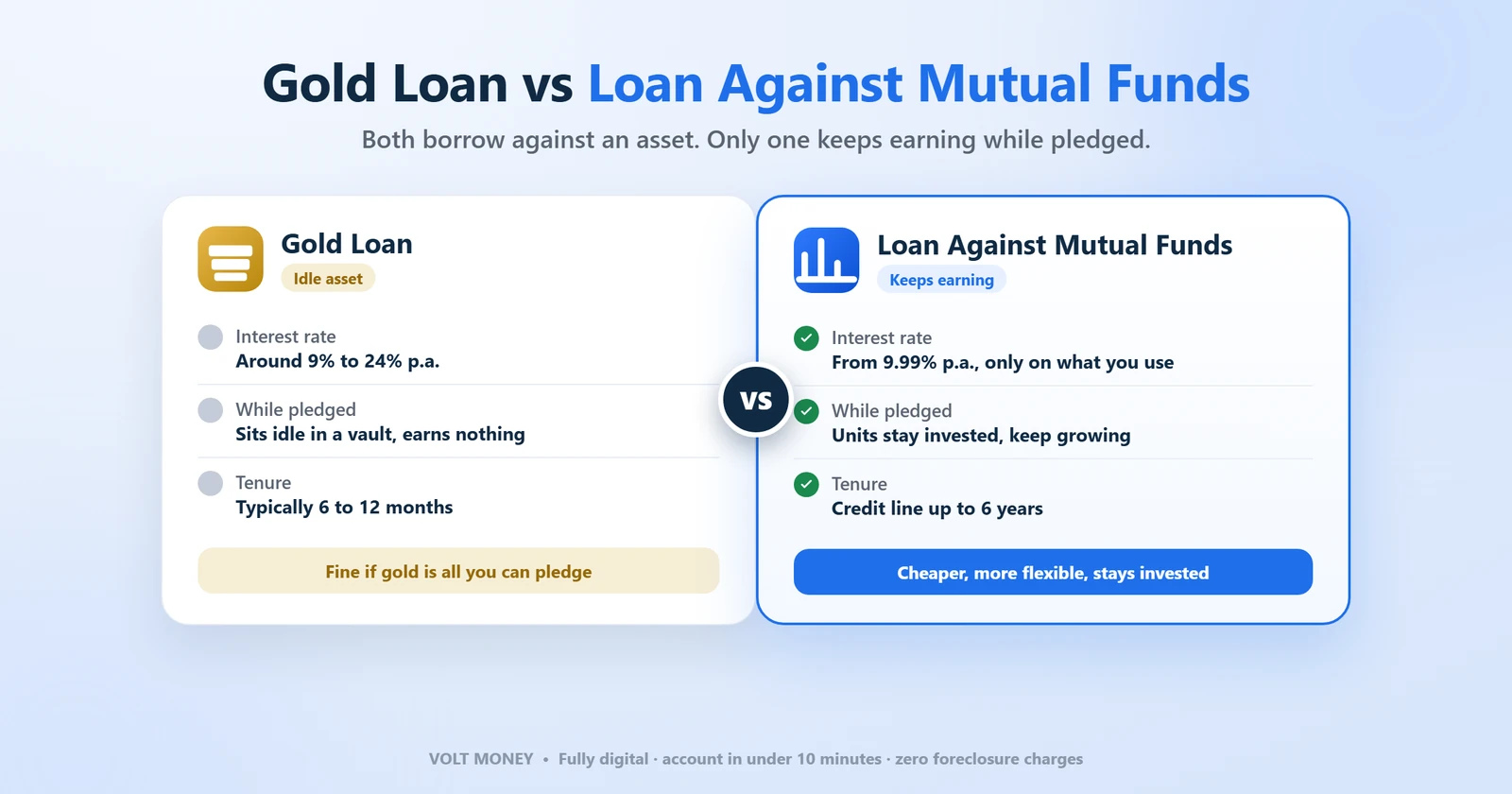
Both a gold loan and a loan against mutual funds let you borrow against an asset you already own instead of selling it. Both are secured, both can be quick, and neither leans on your credit score the way an unsecured personal loan does. But once you look at rate, flexibility, and what your asset is doing while it is pledged, they pull apart fast.
This guide compares the two point by point so you can see which fits your situation, especially if you happen to own both gold and mutual funds.
Quick comparison
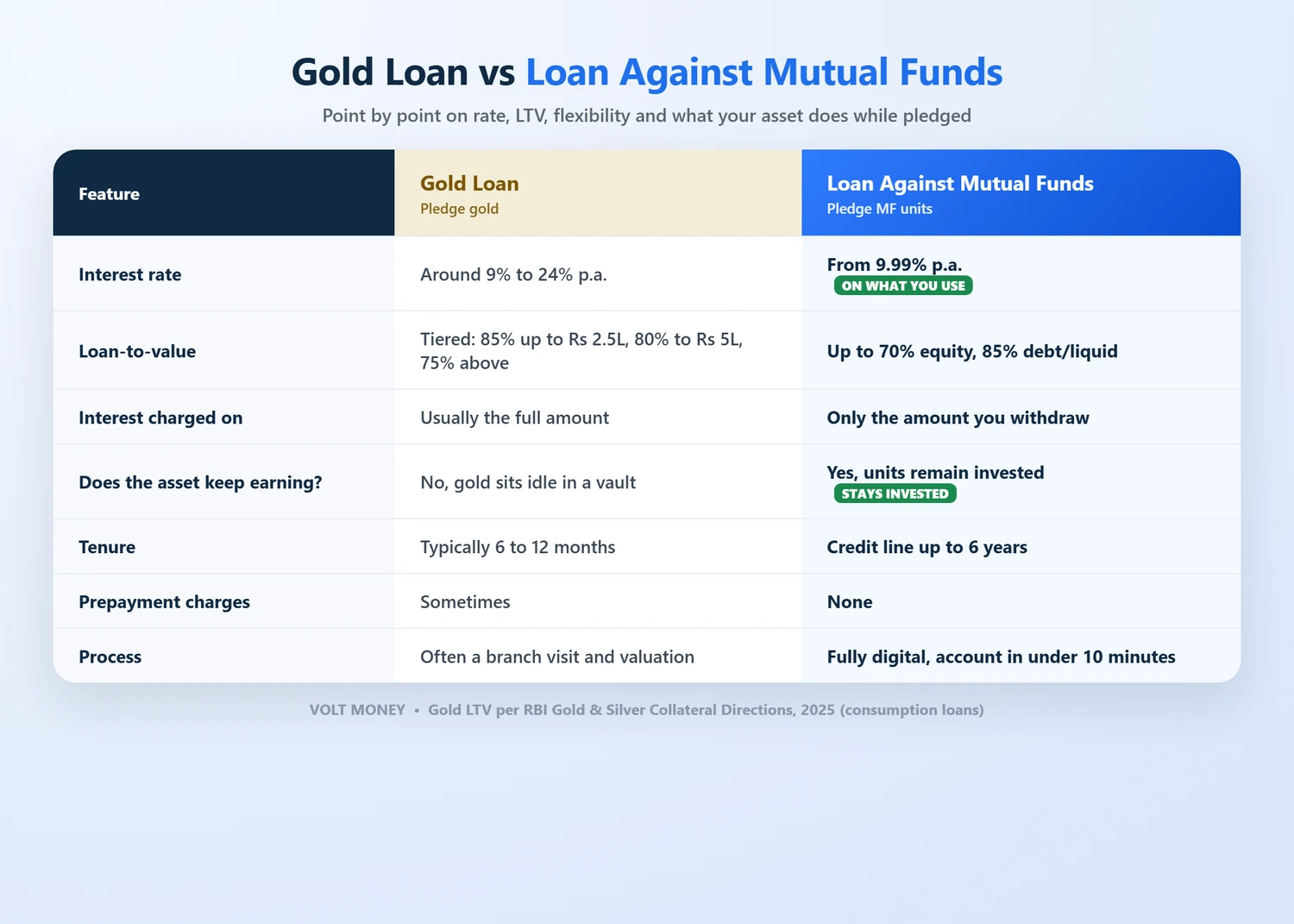
| Feature | Gold Loan | Loan Against Mutual Funds |
|---|---|---|
| What you pledge | Gold jewellery or coins | Your mutual fund units |
| Interest rate | Around 9% to 24% p.a. | From 9.99% p.a. |
| Loan-to-value (LTV) | Tiered under RBI 2025 rules for consumption loans: up to 85% (loans up to Rs 2.5 lakh), 80% (Rs 2.5 to 5 lakh), 75% (above Rs 5 lakh) | Up to 45% equity, up to 85% debt/liquid |
| Interest charged on | Usually the full amount | Only the amount you withdraw |
| Does the asset keep earning? | No, gold sits idle in a vault | Yes, units remain invested |
| Tenure | Typically 6 to 12 months | Credit line up to 6 years |
| Prepayment charges | Sometimes | None |
| Process | Often a branch visit and valuation | Fully digital, account in under 10 minutes |
| Credit score | Usually less important than for unsecured loans | Not required |
Interest rate: where they differ
Check your credit limit on Volt Money. Free, takes 15 seconds.
Check your limit →Gold loan rates vary widely, from around 9% at some banks to well over 20% at certain non-bank lenders, depending on tenure and how the loan is structured. A loan against mutual funds on Volt Money starts at 9.99% p.a., and crucially you pay interest only on the amount you actually withdraw, not on the full sanctioned limit. With many gold loans you pay interest on the entire amount from day one.
LTV: how much you can borrow
Gold loan LTV changed under RBI's 2025 rules, effective 1 April 2026. The RBI's revised gold loan rules replaced the old flat 75% cap with a tiered structure for consumption loans against eligible gold collateral: you can borrow up to 85% of the gold value on loans up to Rs 2.5 lakh, up to 80% on loans between Rs 2.5 lakh and Rs 5 lakh, and up to 75% on loans above Rs 5 lakh. A loan against mutual funds gives up to 45% on equity funds and up to 85% on debt and liquid funds, with an overall sanctioned limit up to 85% of your portfolio. Gold offers a higher headline LTV than equity funds and a similar one to debt and liquid funds. What really separates them is what your collateral does while it is pledged, which is covered next.
Source: RBI Gold and Silver Collateral Directions, 2025 (tiered LTV for consumption loans; loans above Rs 2.5 lakh also involve a credit and repayment assessment).
One practical point on gold: the loan amount depends on the purity and net weight of the gold you pledge. Stones, gems, design, and making charges are not counted, so the sanctioned amount can be lower than what the jewellery originally cost you. A loan against mutual funds is valued on the current market value of your units instead.
The real difference: what your asset does while pledged
This is the point that decides it for most investors. Pledged gold sits in a vault doing nothing. It does not earn, it does not compound, it just waits. Pledged mutual fund units stay invested the whole time. The lien only blocks redemption, so your money remains market-linked even while it is backing your loan.
In other words, a gold loan borrows against a dormant asset, while a loan against mutual funds borrows against a productive one. Your collateral remains invested instead of being redeemed.
Flexibility and tenure
Gold loans are usually short-tenure products, and bullet-repayment gold loans are capped at 12 months under RBI's 2025 directions, though other repayment structures vary by lender. A loan against mutual funds on Volt Money is a revolving credit line open for up to 6 years. You draw what you need, repay anytime with no foreclosure charges, and draw again from your available limit later. Withdrawals are instant and available 24/7 once your account is open.
A worked example: Rs 3 lakh for six months
Say you need Rs 3 lakh for six months and you own both gold and a Rs 10 lakh equity mutual fund portfolio.
Gold loan at, say, 16% p.a.: interest on Rs 3 lakh for six months is roughly Rs 24,000, often charged on the full amount, and your gold is locked away earning nothing.
Loan against mutual funds at 9.99% p.a.: interest on Rs 3 lakh for six months is roughly Rs 15,000, charged only on what you drew, while your Rs 10 lakh portfolio remains invested and continues to participate in market movements.
Lower rate, no idle asset, and more flexibility to repay. For anyone who holds mutual funds, that is a hard combination for a gold loan to beat.
Tax implications
Taking a gold loan or a loan against mutual funds does not usually trigger capital gains tax, because you are borrowing against the asset rather than selling it. Interest paid on either loan is generally not tax-deductible for personal use, though the treatment can differ if the loan funds a business purpose. When in doubt, check with a qualified tax advisor. If you are weighing borrowing against selling, see loan against mutual funds vs selling.
What happens if you default?
With a gold loan, the lender can auction the pledged gold after following the required notice and auction process. With a loan against mutual funds, the lender can redeem or liquidate the pledged units if you do not repay or fail to meet a margin call. In both cases your asset is genuinely at risk, so the safer approach is to borrow well within your limit and repay on time.
When a gold loan still makes sense
- You own gold but do not hold mutual funds or securities to pledge.
- You need a very small amount quickly and have a local lender you trust.
- You prefer pledging an asset you are comfortable locking away rather than one tied to the market.
Compare it against your own portfolio
Check your credit limit on Volt Money. Free, takes 15 seconds. Check your credit limit
The bottom line
A gold loan is a solid option if gold is the main asset you can pledge. But if you hold mutual funds, a loan against them is usually cheaper, more flexible, and smarter, because your collateral remains invested instead of sitting idle. You get a lower starting rate, interest only on what you use, up to 6 years to repay, and no branch visit.
Rates, limits, and charges are subject to change and are set out in your Key Facts Statement before you borrow.