You need money for a few months. Maybe it is a medical bill, a home renovation, a wedding, or a short business gap. You have built a healthy mutual fund portfolio, but selling those units feels wrong, and it can trigger capital gains and break a long-term plan. So the question becomes a choice between two kinds of borrowing: a loan against your mutual funds, or a personal loan.
Both put cash in your account without forcing you to sell your investments. But they work very differently on cost, speed, how much you can borrow, and how you repay. This guide compares them point by point so you can pick the one that actually fits your situation.
Quick comparison: loan against mutual funds vs personal loan
| Feature | Loan Against Mutual Funds | Personal Loan |
|---|---|---|
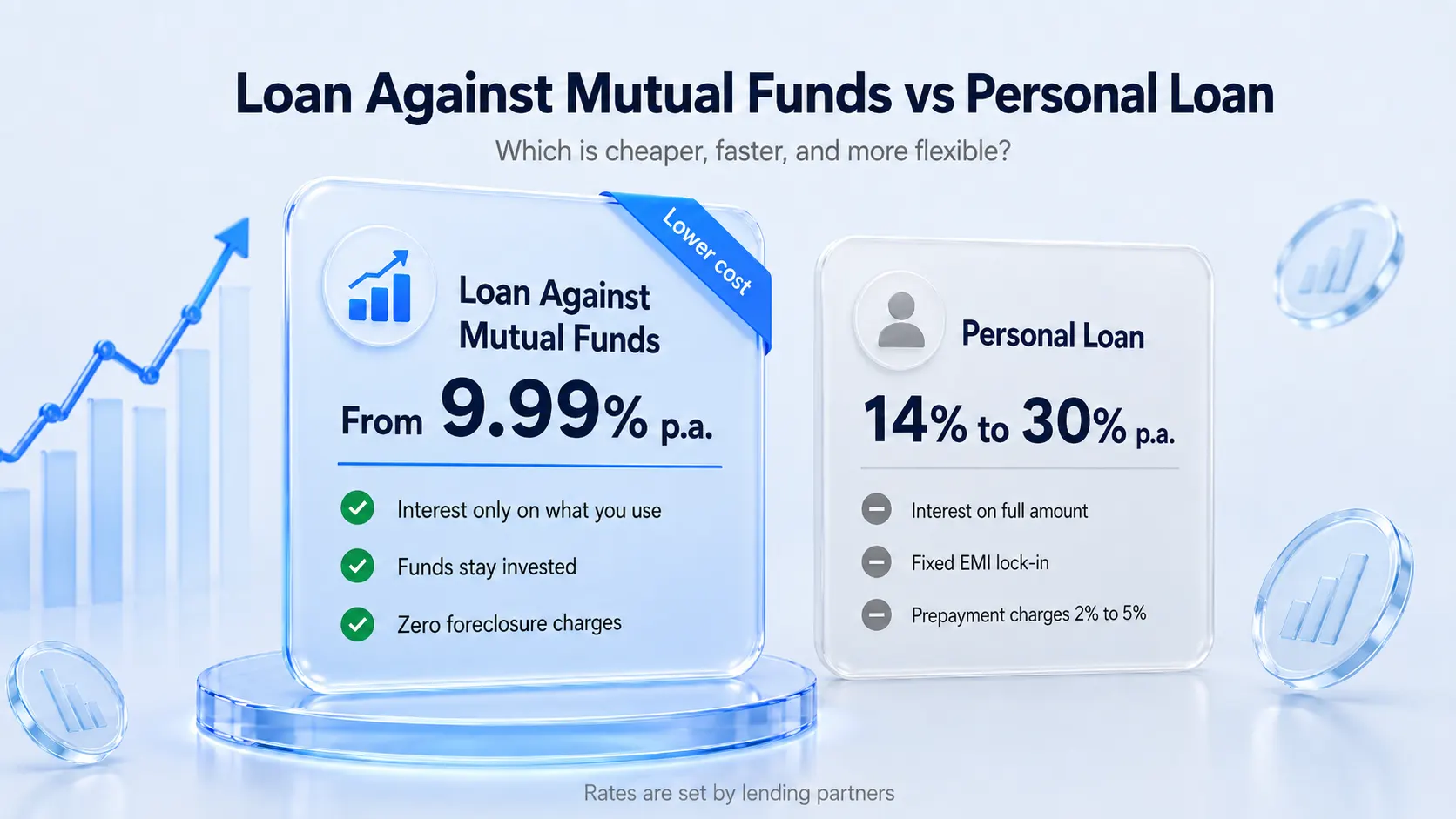
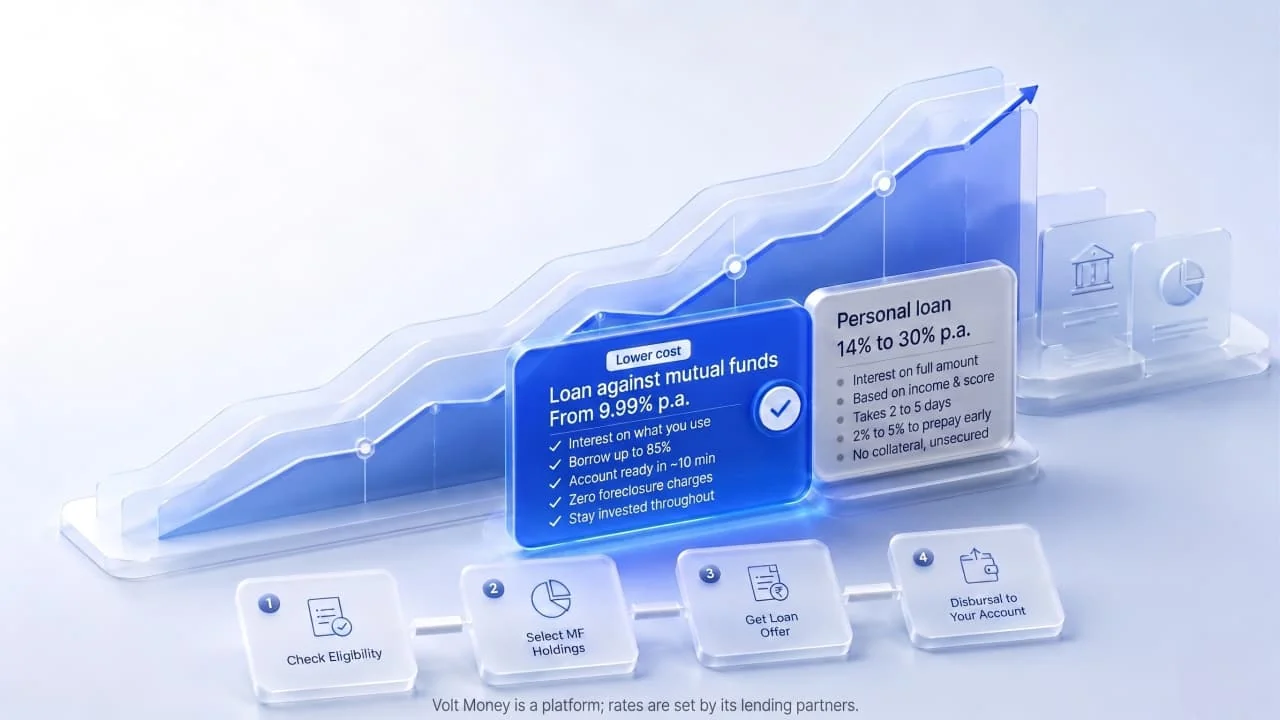
| Interest rate | From 9.99% p.a. | 14% to 30% p.a. |
| Interest charged on | Only the amount you withdraw | Full sanctioned amount from day one |
| Collateral | Your mutual fund units (stay invested) | None (unsecured) |
| How much you can borrow | Up to 85% of your portfolio value | Based on income and credit profile |
| How soon you get the money | Account ready in about 10 minutes, then withdraw instantly | Typically 2 to 5 business days |
| Tenure | Credit facility up to 6 years, repay anytime | Fixed EMI, usually 1 to 5 years |
| Prepayment charges | None (zero foreclosure charges) | Often 2% to 5% of the outstanding |
| Credit score | No minimum required (loan is secured) | Usually 700+ required |
| Checking eligibility | Quick check of available limit with your PAN | Hard enquiry can lower your score |
Volt Money is a platform; rates and final terms are set by the lending partners who work with the platform.
What is a loan against mutual funds?
Check your credit limit on Volt Money. Free, takes 15 seconds.
Check your limit →A loan against mutual funds (LAMF) is a secured credit facility. Your mutual fund units are pledged as collateral through a lien marked at the registrar (CAMS or KFintech), and a lender gives you a credit limit against them. You can read the full mechanics in our complete guide to loan against mutual funds.
The important part is that your units stay invested. The lien only stops you from redeeming them while the loan is open. It does not pull your money out of the market, so your portfolio keeps growing through the loan period. You also pay interest only on the amount you actually withdraw, not on your full limit.
What is a personal loan?
A personal loan is an unsecured term loan. The lender approves a fixed amount based on your income, employment, and credit score, transfers it to your account, and you repay it in equal monthly instalments (EMIs) over a fixed tenure. There is no collateral, which is why the interest rate is higher and your credit score matters a lot.
Because a personal loan is structured around a fixed tenure and fixed EMIs, it is built for planned, longer-term borrowing. Lenders rarely offer a personal loan for a short, few-month requirement, and even when they do, you usually pay interest on the entire amount for the full schedule.
Interest rates: where the real cost difference shows up
This is the biggest gap between the two. A loan against mutual funds starts at 9.99% p.a. on Volt Money, with the exact rate set by the lending partner who funds your loan. Personal loan rates typically run from 14% to 30% p.a. depending on the lender, your profile, and the amount.
There is a second, less obvious saving. With a personal loan you are charged interest on the full sanctioned amount from day one, even if you do not use all of it. With a loan against mutual funds you draw what you need from your limit and pay interest only on that drawn amount, calculated daily. If you have a Rs 7 lakh limit but only need Rs 2 lakh this month, you pay interest on Rs 2 lakh. And because interest is calculated daily, if you only need that Rs 2 lakh for, say, 10 days, you pay interest for just those 10 days.
How fast can you get the money?
A common myth is that borrowing against investments is slow. It is the opposite. On Volt Money you can open your loan account in about 10 minutes through a 100% digital flow: an eligibility check with just your PAN, OTP-based KYC, adding your bank account, pledging your units with a single OTP, and accepting the Key Facts Statement and loan agreement. Once the account is open you can withdraw whenever you need, with instant withdrawals available 24/7.
Selling mutual funds, by contrast, is what actually takes time. A redemption typically takes 2 to 5 business days to settle into your bank account, and you give up your units permanently. A personal loan also generally takes a few business days for approval and disbursal because of income verification and underwriting.
How much can you borrow?
With a loan against mutual funds, your limit is a percentage of your pledged portfolio value, known as the loan-to-value (LTV) ratio. RBI guidelines allow up to 50% on equity mutual funds and a higher limit on debt/liquid funds. Volt Money through its Lending Partner offers:
- Equity and hybrid funds: up to 45% of fund value
- Debt and liquid funds: up to 85% of fund value
Your overall sanctioned limit can go up to 85% of your mutual fund portfolio, depending on the mix. So a Rs 10 lakh equity portfolio can support a limit of up to Rs 4.5 lakh, and a debt or liquid portfolio of the same size can support up to Rs 8.5 lakh. Loan amounts on Volt Money range from Rs 10,000 up to Rs 5 crore, depending on your portfolio size.
A personal loan amount is not tied to any asset. It is set by your income, existing obligations, and credit score. You can estimate your interest either way using our loan against mutual funds interest calculator.
Repayment flexibility
A personal loan locks you into fixed EMIs for the full tenure. Paying it off early often costs a foreclosure or prepayment charge of 2% to 5% of the outstanding amount.
A loan against mutual funds on Volt Money is a credit facility that stays open for up to 6 years. You can repay the principal anytime within that period with zero foreclosure charges, and you can draw again from your available limit whenever you need. Repaying does not automatically release your units. The lien stays in place so your credit facility remains available, and you can unpledge your units instantly and free of charge from the Volt app or website whenever you want them freed.
Eligibility and credit score
A loan against mutual funds is secured by your units, so no minimum credit score is required. Even someone with no credit history can qualify, because the lender relies on the pledged collateral rather than a past borrowing record. You can check your eligible limit on the Volt Money app in a few seconds.
Costs and charges
Loan against mutual funds: interest from 9.99% p.a. (set by the lending partner) on the drawn amount, a one-time processing fee from Rs 999 (up to Rs 1,499), and zero foreclosure charges.
Personal loan: interest of 14% to 30% p.a. on the full amount, a processing fee of typically 1% to 3%, and prepayment or foreclosure charges if you close early.
When a loan against mutual funds makes more sense
- You already hold mutual funds and do not want to sell them or trigger capital gains.
- You want a flexible credit facility you can draw from whenever you need over the next 6 years, paying interest only on what you actually use.
- You want a low rate and the freedom to repay and redraw without penalties.
- Having little or no credit history shouldn't be a concern when applying for a loan against mutual funds with Volt Money, as your mutual fund portfolio is the collateral, not your credit score.
When a personal loan makes more sense
- You do not hold any mutual funds to pledge as collateral.
- You need an amount larger than your portfolio can support.
- You want a fixed, predictable EMI over a long tenure and prefer that structure for budgeting.
A worked example: Rs 3 lakh for 4 months
Say you need Rs 3 lakh to bridge a 4-month gap and you hold Rs 10 lakh in equity mutual funds.
Loan against mutual funds starting at 9.99% p.a. (rate set by the lending partner): interest on Rs 3 lakh for 4 months is roughly Rs 10,000, charged only on the drawn amount, with your units still invested and growing.
Personal loan at, say, 18% p.a.: interest on Rs 3 lakh for the same period is roughly Rs 18,000, plus a processing fee, and a personal loan is rarely offered for such a short duration in the first place.
For a short bridge against an existing portfolio, the loan against mutual funds is both cheaper and better suited to the need.
The bottom line
If you already own mutual funds and need flexible, low-cost credit, a loan against mutual funds is usually the stronger choice. It is cheaper, faster to access once your account is open, charges interest only on what you use, and keeps your investments working for you. A personal loan still has its place when you have nothing to pledge, need more than your portfolio can support, or specifically want a fixed long-term EMI.
For deeper reading, see Loan Against Mutual Funds: Complete Guide, How to Take a Loan Against Mutual Funds: Step-by-Step Guide, and Loan Against Securities Interest Rates in India 2026.