If you want to borrow without selling your investments, you will run into two closely related products: a loan against mutual funds and a loan against securities. They sound almost the same, and lenders often use the terms loosely. The difference matters, because it decides what you can pledge, how much you can borrow, and how much you pay.
This guide breaks down loan against mutual funds vs loan against securities in plain language, so you can pick the option that fits what you already own.
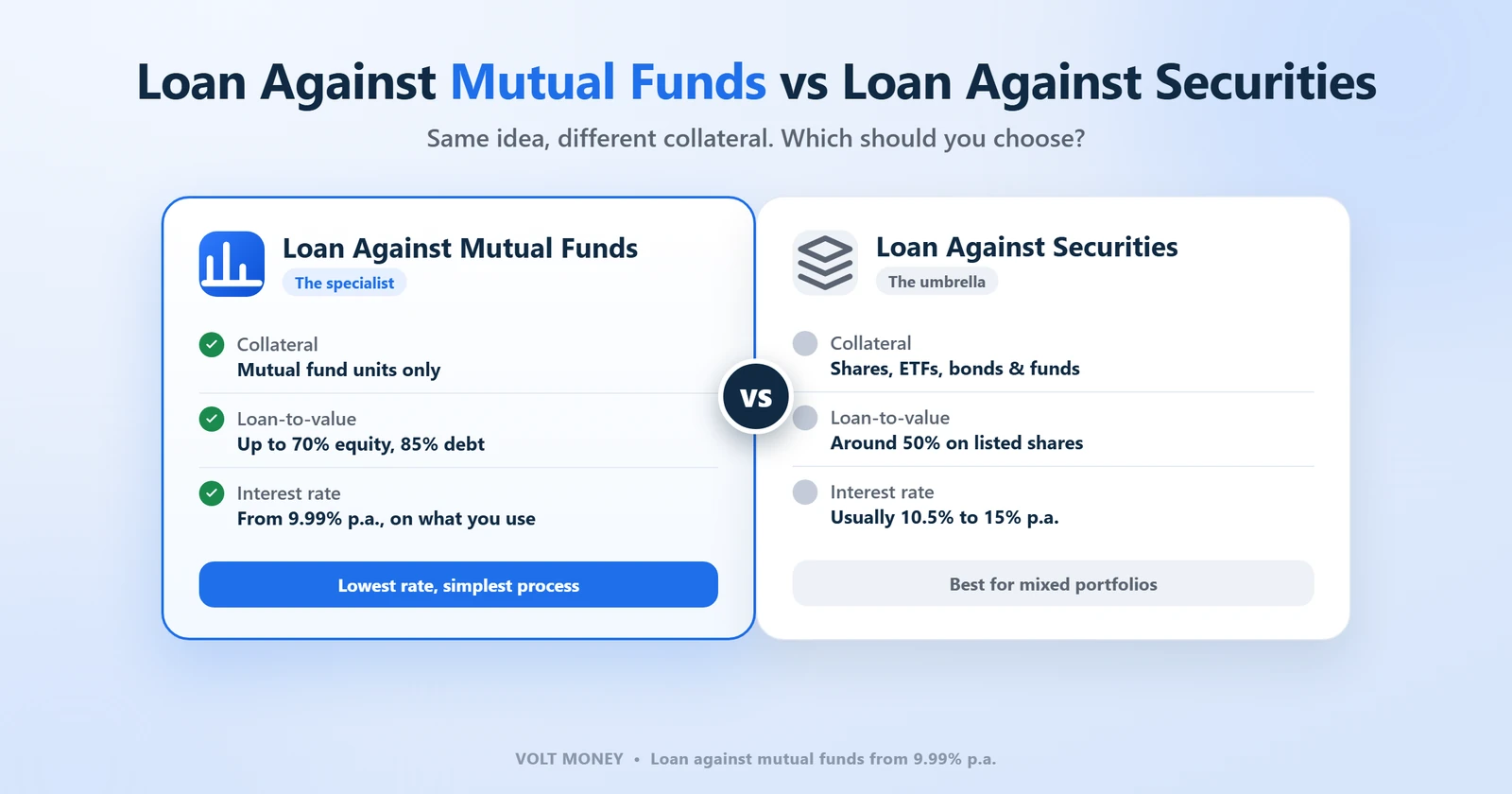
The quick distinction: LAS is the umbrella, LAMF is the specialist
Loan against securities (LAS) is the broad category. It covers borrowing against almost any market-linked asset held in your demat or folio: listed shares, exchange-traded funds (ETFs), bonds, and mutual fund units. A loan against shares is an even narrower version that accepts only listed equity shares.
A loan against mutual funds (LAMF) is the specialist product inside that umbrella. It accepts only mutual fund units, and because mutual funds are diversified and valued daily at NAV, lenders can offer higher loan-to-value ratios and lower rates than they do on single stocks. For the full picture of each product on its own, see our loan against mutual funds guide and our loan against securities guide.
What is a loan against mutual funds?
Check your credit limit on Volt Money. Free, takes 15 seconds.
Check your limit →A loan against mutual funds lets you pledge your mutual fund units as collateral and borrow against them without redeeming. The units are lien-marked with the registrar (CAMS, KFintech or MFCentral), which means they stay invested and keep growing, but you cannot redeem or switch them until the lien is lifted.
With Volt Money, a LAMF is a 6-year credit line, not a one-time loan. You get up to 45% LTV on equity funds and up to 85% on liquid and debt funds, across over 9,000 approved funds. Interest starts at 9.99% p.a. and is charged only on the amount you actually withdraw, calculated daily. There is no minimum credit score or CIBIL check because the loan is secured.
What is a loan against securities?
A loan against securities lets you pledge a mix of market assets: listed shares, ETFs, bonds, and often mutual funds too. Banks and NBFCs usually offer it as an overdraft against your demat holdings. Because single shares are more volatile than a diversified fund, lenders are more cautious: the loan-to-value on listed shares is typically around 50%, and prices are tracked closely so a sharp fall can trigger a margin call.
LAS suits someone who holds a spread of shares, bonds and ETFs and wants a single facility across all of them. The trade-off is, usually, a higher rate than a dedicated mutual fund loan.
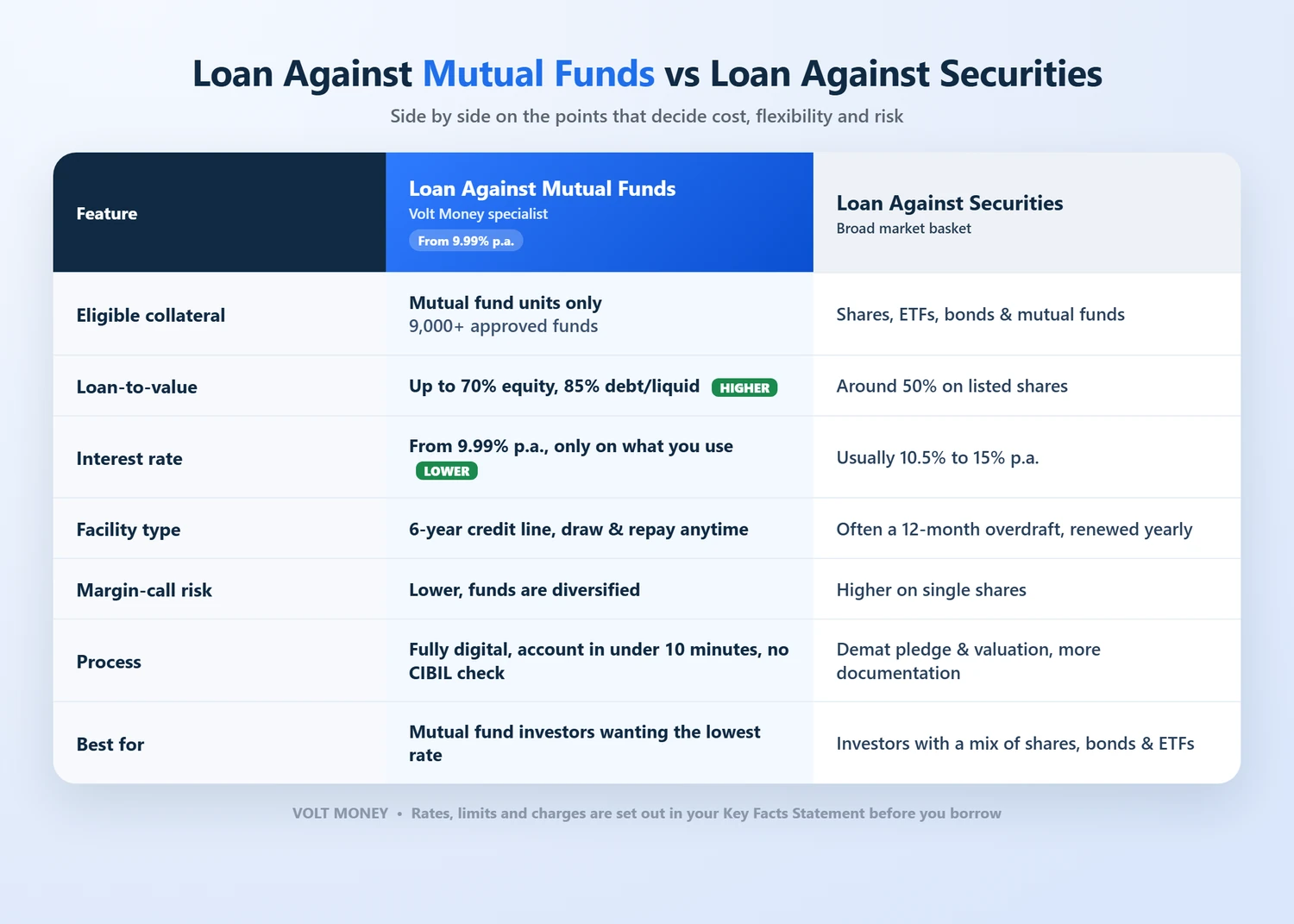
Loan against mutual funds vs loan against securities: side by side
| Feature | Loan Against Mutual Funds (Volt Money) | Loan Against Securities / Shares |
|---|---|---|
| Eligible collateral | Mutual fund units only (equity, hybrid, debt, liquid); over 9,000 approved funds | Broad basket: listed shares, ETFs, bonds and mutual funds ("loan against shares" covers only equity shares) |
| Loan-to-value (LTV) | Up to 45% on equity funds and up to 85% on liquid and debt funds | Typically around 50% on listed shares; higher on bonds and debt instruments |
| Interest rate | From 9.99% p.a., charged only on the amount used, calculated daily | Usually 10.5% to 15% p.a., varies by lender and collateral |
| Facility type | 6-year credit line; draw and repay any time within the tenure | Often a 12-month overdraft or term loan, renewed each year |
| Volatility and margin calls | Lower, especially for debt and hybrid funds | Higher for single shares; price swings can trigger margin calls |
| Process | Fully digital, NAV-based, loan account in under 10 minutes, no CIBIL check | Demat pledge and valuation; may need more documentation |
| Withdrawals and charges | Instant withdrawals 24/7, zero foreclosure charges, instant and free unpledging | Varies by lender; renewal and foreclosure charges may apply |
| Best for | Mutual fund investors who want the lowest rate and the simplest process | Investors holding a mix of shares, bonds and ETFs who want one facility across all |
LTV: how much you can actually borrow
Loan-to-value depends on what you pledge. Volt Money offers up to 45% of the value of equity funds and up to 85% on liquid and debt funds. A loan against listed shares is usually capped near 50%, because one company's price can move sharply in a day. On equity the two are close; on liquid and debt funds the mutual fund route frees up far more cash. You can see current rates in our loan against securities interest rates guide.
Risk: margin calls and volatility
Both products carry a few risks. If the value of your pledged holdings falls, the lender may ask you to add collateral or repay part of the loan, and if you do not, they can sell the pledged assets to recover their money. This margin-call risk is higher with a loan against shares, because a single stock can drop 10% or more in a session. A diversified mutual fund, especially a debt or hybrid fund, tends to move more gently, so the buffer between your loan and your collateral value is more stable.
Tax treatment
For both products, the loan itself is not income, so borrowing does not create a tax event. Interest on a loan taken for personal use is generally not deductible. Your pledged units or shares stay invested, so any growth continues to accrue to you, and tax applies only when you eventually redeem or sell. Because you have not sold, you also avoid triggering capital gains at the time you raise cash. Tax rules change, so confirm the current position with a tax advisor before you act.
A worked example
Suppose Rahul holds Rs 10 lakh in equity mutual funds and Rs 10 lakh in listed shares, and he needs Rs 3 lakh for two months to cover a short-term gap.
Against his equity mutual funds, a LAMF at 45% LTV gives him a limit of about Rs 4.5 lakh. Against his listed shares, a loan at roughly 50% LTV gives him about Rs 5 lakh. Either could fund the Rs 3 lakh he needs.
If he draws Rs 3 lakh on a Volt Money LAMF at 9.99% p.a. for two months, interest is only about Rs 4,900 (3,00,000 × 9.99% × 60 / 365), charged only on the amount used and only for the days he uses it. He repays the Rs 3 lakh when his money comes in, the interest stops, and his mutual fund units stay invested and keep growing the whole time.
Which one should you choose?
Choose a loan against mutual funds if most of your investments are in mutual funds and you want the lowest rate and the simplest, fully digital process. Choose a broader loan against securities if you mainly hold individual shares, bonds or ETFs and want a single facility that pools them together, and you are comfortable with closer margin monitoring on the equity portion.
For most mutual fund investors, a dedicated LAMF wins on cost and convenience. That is the product Volt Money is built around.
Where Volt Money fits
Volt Money is a specialist loan against mutual funds platform. You get a 6-year credit line of Rs 10,000 up to Rs 5 crore, up to 45% LTV on equity funds and 85% on debt and liquid funds, instant withdrawals 24/7, interest only on the amount you use, zero foreclosure charges, and instant, free unpledging when you are done. There is no CIBIL check, and the loan account opens in under 10 minutes. To understand how your units are pledged, read our guide to lien marking on mutual funds.
Deciding between LAMF and a loan against securities?
Check your credit limit on Volt Money. Free, takes 15 seconds. Check your credit limit