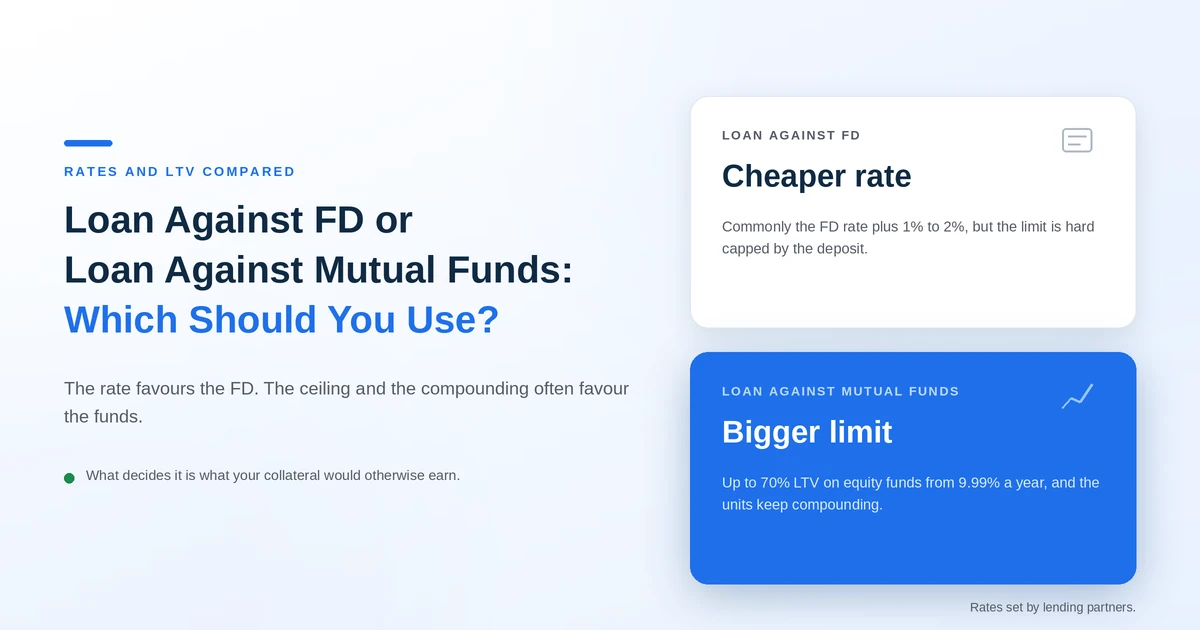
Fixed deposits are India's default collateral. Almost every bank offers a loan or overdraft against one, the rate is easy to understand, and the process is familiar. So when someone with both an FD and a mutual fund portfolio needs money, the FD is usually the first thing they think of.
It is often the wrong one, and the reason has nothing to do with the interest rate.
How each one works
- Loan against FD: your bank lends against the deposit, commonly up to 90% to 95% of it, at a rate set a percentage point or two above what the FD itself pays. The tenure is normally tied to the deposit's maturity.
- Loan against mutual funds: a lender records a lien on your units and gives you a 6-year credit line, up to 45% of equity funds and up to 85% of liquid and debt funds, from 9.99% a year on Volt Money, charged only on what you withdraw.
Volt Money is a platform, and the rates and limits shown are provided by its RBI-regulated lending partners.
Loan against FD vs loan against mutual funds, side by side
Check your credit limit on Volt Money. Free, takes 15 seconds.
Check your limit →| Feature | Loan against FD | Loan against mutual funds (Volt Money) |
|---|---|---|
| Typical LTV | Commonly 90% to 95% of the deposit | Up to 45% equity, up to 85% liquid and debt |
| Rate | Commonly the FD rate plus 1% to 2% | From 9.99% a year |
| Interest charged on | Varies; often the full sanctioned amount | Only the amount withdrawn, calculated daily |
| What the collateral earns meanwhile | The FD rate it was already earning | Whatever the market gives, which is the point |
| Tenure | Usually tied to the FD's maturity date | 6-year credit line, repay any time |
| Ceiling on the limit | Hard capped by the deposit value | Rs 10,000 to Rs 5 crore |
| Speed | Same day at most banks, often branch-dependent | Under 10 minutes, then instant 24/7 |
| Credit check | Usually none, it is secured | No minimum credit score or CIBIL check |
| Market risk on the collateral | None. An FD does not fall | Real. A market fall can trigger a margin call |
| Foreclosure charges | Varies by bank | Zero |
The comparison that actually matters
Look at the rate difference and the FD wins. Look at what the collateral is doing while it sits there and the picture changes.
Money in an FD is already earning the FD rate. Borrowing against it does not change that, so your real cost is the spread, typically one to two percentage points. That is genuinely cheap.
But the FD was only ever going to earn the FD rate. If your mutual funds are the part of your portfolio doing the long-term work, pledging those instead lets that work continue while you borrow. The question is not which loan has the lower number on it. It is which asset you would rather have working for you over the next few years.
There is also a ceiling problem. A loan against an FD cannot exceed the FD. If you hold Rs 2 lakh in deposits and need Rs 4 lakh, the FD route simply cannot get you there, regardless of rate.
Rs 4 lakh for eight months: FD or mutual funds
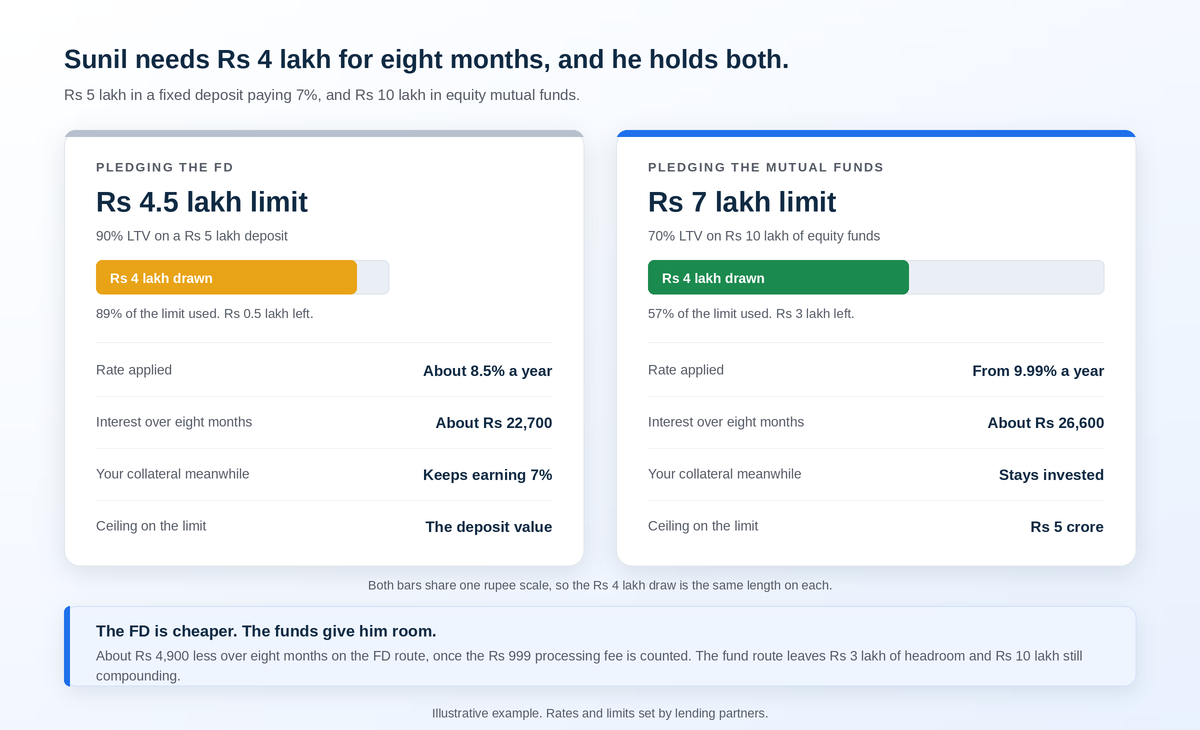
Sunil holds Rs 5 lakh in a fixed deposit paying 7%, and Rs 15 lakh in equity mutual funds. He needs Rs 4 lakh for eight months.
- Pledging the FD at 90% LTV gives him a Rs 4.5 lakh limit, just enough. At roughly 8.5%, eight months on Rs 4 lakh costs him about Rs 22,700 in interest. His Rs 5 lakh stays in the FD earning 7%.
- Pledging the mutual funds at 45% LTV gives him a Rs 6.75 lakh limit, comfortably more than he needs. At 9.99%, eight months on Rs 4 lakh costs about Rs 26,600, plus a one-time processing fee from Rs 999. His Rs 15 lakh stays invested in the market.
The FD route is about Rs 5,000 cheaper over eight months. Whether that is the better decision depends entirely on what his equity funds do in those eight months, and on the fact that the FD route leaves him drawn to 89% of his limit while the mutual fund route leaves him at 59%.
That second point is the one people skip. On the FD he has almost no headroom, but an FD cannot fall, so headroom does not matter. On the funds he has plenty of headroom, and he needs it, because they can. The two risks are not comparable, and neither is strictly better.
When the FD is the right answer
- The amount you need is comfortably inside the deposit, and you want zero market risk on the collateral.
- You want the simplest possible product and your bank already offers it against that deposit.
- You are borrowing for a short, defined period that fits inside the FD's remaining tenure.
- Breaking the FD early would cost you a penalty that borrowing against it avoids.
When the mutual funds are the right answer
- You need more than the deposit can support. This is the most common reason.
- You would rather keep long-term money compounding in the market than leave it earning a deposit rate.
- You want a facility rather than a loan: a 6-year line you draw from as needed, paying interest only on what you use and only for the days you use it.
- You want the option to raise the limit later, which instant additional pledging allows and a fixed deposit does not.
The honest summary is that if you hold a large FD and a small fund portfolio, use the FD. If you hold a large fund portfolio and a small FD, the FD cannot do the job. Most people asking this question are somewhere in between, and the deciding factor is usually the ceiling rather than the rate.
If you are weighing the alternative of just selling instead, borrowing against your funds compared with selling them covers the tax and timing side.
Not sure what your funds alone would support?
Check your credit limit on Volt Money. Free, takes 15 seconds. Check your credit limit