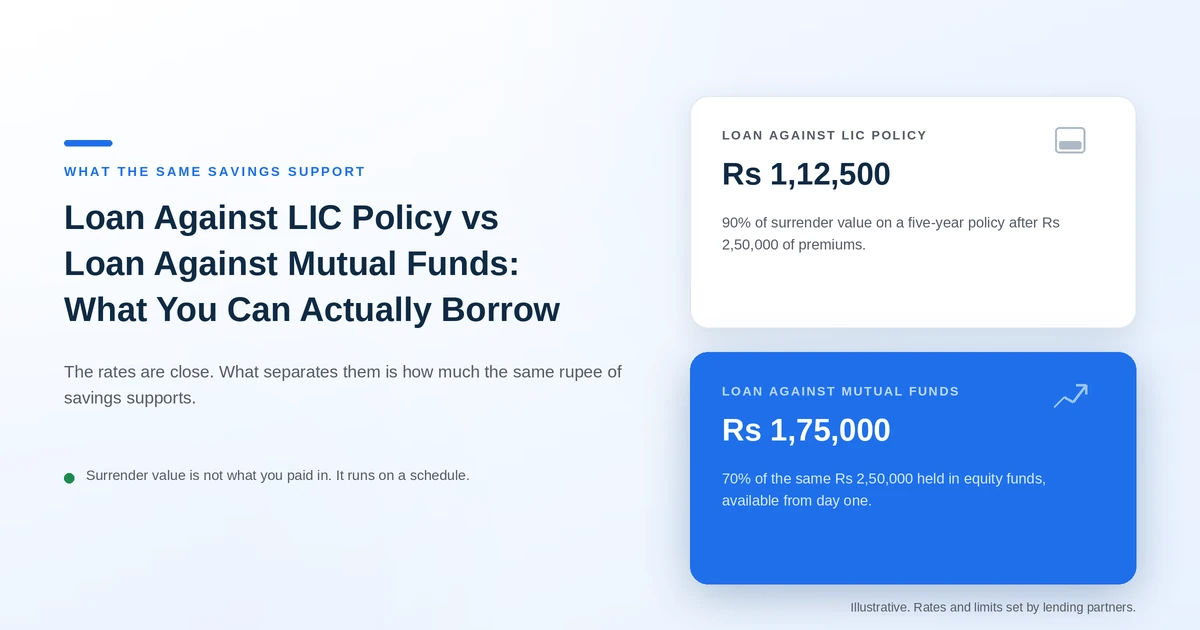
The catch is the base. LIC lends up to 90% of the surrender value, and surrender value runs on a schedule by policy year rather than tracking what you have paid in. Someone five years into a policy who has paid Rs 2,50,000 in premiums can borrow around Rs 1,12,500, roughly 45% of what has gone in.
A loan against mutual funds works off market value instead. The same Rs 2,50,000 in equity funds supports a Rs 1,12,500 limit at 45% loan to value, which matches the policy figure, but it is available from day one rather than from policy year two.
Surrender value is the number that decides this comparison, and it is not what most people assume. It is not what you have paid in, and it is not a flat percentage of that either. It runs on a schedule, and the schedule changed in 2019. Both parts matter, so the current one is set out in full below.
The rate is the part people compare, and on rate these two products are close enough that it barely matters. What separates them is how much you can borrow against the same rupee of savings, and that gap is large.
How a loan against an LIC policy works
You assign the policy to LIC as security and borrow against it. The policy stays in force as long as you keep paying premiums, and the cover continues. The loan plus accrued interest is recovered from the maturity or claim amount if it has not been repaid before then.
Three conditions have to hold before it is available at all.
- The policy must be a type that acquires a surrender value. Pure term plans never qualify. They pay out on death and build no cash value, so there is nothing to lend against. Loans are available on traditional savings plans such as endowment, money-back and whole-life policies. Check your own policy document, because the loan clause is plan-specific.
- It must have actually acquired that value. Under the current product regulations a regular-premium policy acquires a guaranteed surrender value once two consecutive years of premiums are paid, and the amount climbs sharply at policy year four.
- The premiums must be current. Lapsed and paid-up policies are treated differently. An in-force policy can borrow up to 90% of surrender value. A paid-up policy is generally limited to 85%.
The number that surprises people: surrender value is not premiums paid
Check your credit limit on Volt Money. Free, takes 15 seconds.
Check your limit →This is where the comparison is actually decided.
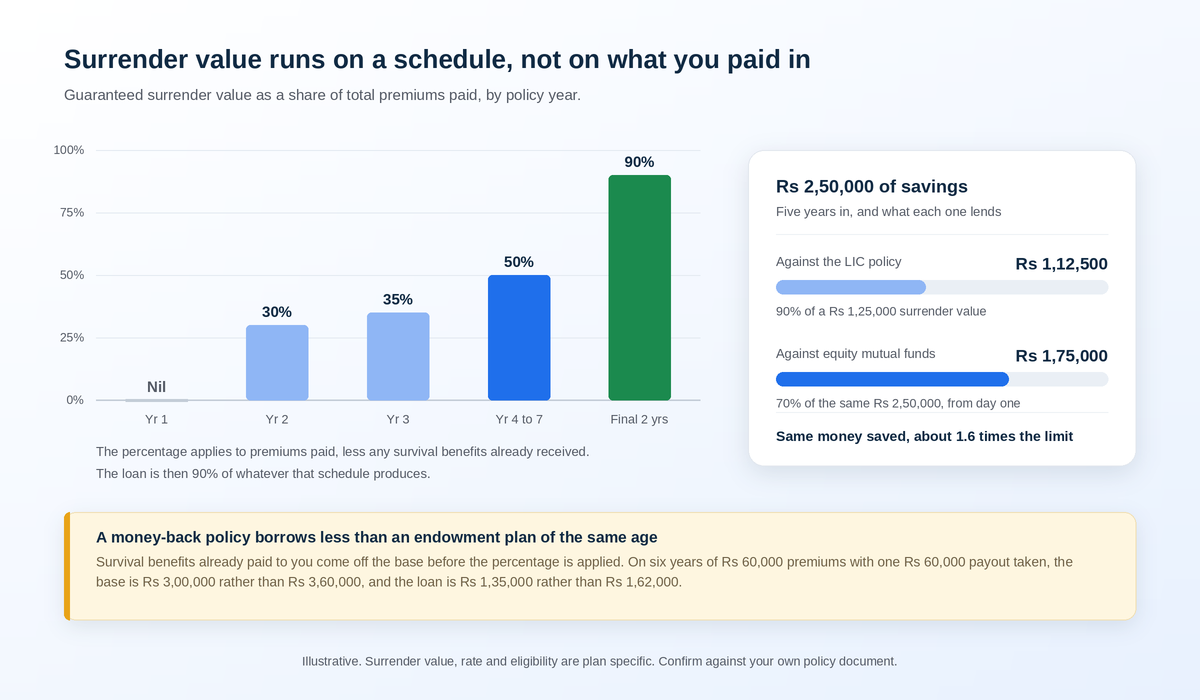
Guaranteed surrender value is not a flat percentage. It runs on a schedule set by policy year: nil in year one, 30% in year two, 35% in year three, 50% from year four to year seven, rising to 90% in the final two years. Beyond year seven it moves smoothly towards that 90%.
The percentage applies to total premiums paid, less any survival benefits already paid out to you. That second half matters on a money-back policy: every survival benefit you have already received comes off the base before the percentage is applied, so a money-back plan several payouts in supports a smaller loan than an endowment plan of the same premium and age.
An older rule, 30% of premiums paid excluding the first year's premium, applied before 2019 and has since been superseded. It produces a much lower figure on a mid-tenure policy, so if a number you have been given sits well below the schedule above, a difference in basis is usually why. It is worth asking which one was used.
The loan is then 90% of whatever that schedule produces. LIC pays the higher of the guaranteed and the special surrender value, so a participating policy with accrued bonus can be worth more again. What does not change is the shape: the number is a fraction of what you have put in, and the fraction depends on how long you have held the policy.
Work it through on a policy with a Rs 50,000 annual premium after five years of payments.
- Total premiums paid: Rs 2,50,000.
- Policy year five sits in the four-to-seven band, so the guaranteed surrender value factor is 50%. This is an endowment plan with no survival benefits paid out, so the base is the full Rs 2,50,000: 50% of that is Rs 1,25,000.
- Loan at 90% of that: Rs 1,12,500.
Rs 2,50,000 paid in, and about Rs 1,12,500 available to borrow. That is roughly 45% of the money you have handed over. It is not a flaw in the product, it is what a savings-linked insurance policy is: most of your early premium buys cover and pays costs rather than building cash value.
Two things the quoted rate does not tell you
LIC states that the rate of interest on a policy loan is declared by the Corporation every year and is plan-specific. So the 9% to 10.5% band, which this article quotes too, is a market range rather than your rate. The only number that governs your policy is the one on your policy schedule or in the customer portal. Check it before you plan around it.
The second is easier to miss and harder to work around: the minimum loan period is six months. If you need money for eight weeks, you are still paying six months of interest. A credit line charges you for the days you actually hold the money, which is the whole difference on a short requirement.
The interest is charged half-yearly, and that matters
LIC charges policy loan interest half-yearly, and if you do not pay it, it is added to the outstanding and starts earning interest itself. This is the failure mode with policy loans. A borrower treats it as money taken out of their own policy, stops thinking about it, and the balance grows quietly for years.
If the loan plus accumulated interest ever approaches the surrender value, LIC can foreclose the policy. You lose the cover you were paying for, on top of the money. It is a slow risk rather than a sharp one, which is exactly why it gets missed.
How to apply for a loan on your LIC policy
LIC runs the loan as a service request rather than as a fresh application, which is why it is faster than most people expect once the policy qualifies.
- Register on the LIC customer portal. You need your policy number, date of birth and the registered mobile number. Enrolling the policy under the portal's premier services is what unlocks the loan module.
- Check whether the policy shows as loan-eligible. The portal will show the available loan amount against the policy. If the module does not appear, the policy either has not acquired surrender value yet or is of a type that does not offer loans.
- Raise the online loan service request, then complete the requirement the portal sets out. Older policies and higher amounts can still require the physical policy document and a signed form at the servicing branch, because the policy is assigned to LIC as security.
- Money is credited to the bank account registered under NEFT mandate. If your NEFT details are not registered, that is the step that will hold everything up, so check it before you start.
Repayment is equally flexible: you can pay the half-yearly interest and settle the principal whenever you choose, or let the loan and interest be recovered from the maturity or claim amount. Interest and loan repayment can be paid online through net banking, debit card or UPI.
A loan against mutual funds: market value, not surrender value
The collateral is the market value of your units, not a formula value. Your units are pledged, a lien is recorded, and a credit line is opened against them. Nothing is redeemed, so the money stays invested and keeps compounding through the loan.
Volt Money lends against over 9,000 approved mutual funds, from Rs 10,000 to Rs 5 crore.
- Loan to value is 45% on equity funds and 85% on liquid and debt funds, with a sanctioned limit up to 85% of the portfolio. The interest rate is broadly in line with the market.
- Cost. Interest starts at 9.99% p.a.*, calculated daily and charged only on what you have drawn, only for the days you have held it.
- Structure. A 6-year credit line. Draw, repay, redraw. Repayment does not automatically release your units, because the line stays open for the rest of the term.
- Speed. Instant eligibility check and pledging, account opened in under 10 minutes, and withdrawals 24/7. Unpledging is instant and free when you want the units released.
- Eligibility. No minimum credit score and no income proof. The eligibility check is a soft bureau check and leaves no mark on your score.
Starting rate. Your rate depends on your portfolio and profile.
LIC policy loan vs loan against mutual funds
| Feature | Loan against LIC policy | Loan against mutual funds (Volt Money) |
|---|---|---|
| Interest rate | Around 9% to 10.5% p.a., commonly 9.5% compounded half-yearly | Starts at 9.99% p.a.*, simple interest calculated daily |
| What you borrow against | Surrender value, a formula figure well below premiums paid | Current market value of your units |
| Borrowing limit | 90% of surrender value, 85% if the policy is paid up | 45% of equity funds, 85% of liquid and debt funds |
| Rs 2,50,000 of savings buys you | Roughly Rs 1,12,500 on a five-year endowment policy | Rs 1,12,500 on equity funds at 45% |
| Waiting period | Two years of premiums before any value builds | None |
| Minimum loan period | Six months, so a short need still costs six months of interest | None. Interest runs for the days you hold the money |
| Which assets qualify | Traditional savings plans only. Term plans never qualify | Over 9,000 approved funds. ELSS is blocked only during its 3-year lock-in |
| Interest handling | Half-yearly. Unpaid interest compounds into the balance | Charged on the drawn amount only, for the days used |
| Repayment | Flexible, often settled from maturity or claim proceeds | Any time within the 6-year term. Zero foreclosure charges |
| Worst case | Policy can be foreclosed if loan plus interest nears surrender value | Pledged units can be sold if a fall breaches the limit and you do not restore it |
| Setup | Online through the LIC portal for eligible policies, otherwise a branch visit | Digital. PAN, an Aadhaar-linked mobile and bank details. No documents to upload |
When the LIC loan is the better option
- You hold an old, high-value endowment or money-back policy with a substantial surrender value, and the amount you need is comfortably inside 90% of it.
- You do not hold mutual funds, or the funds you hold are ELSS units still inside their three-year lock-in, which cannot be pledged.
- You want a long, undated borrowing you may settle out of the maturity proceeds, and you are disciplined about paying the half-yearly interest so it does not compound.
When your policy is not the right place to borrow from
- Your policy is young. Nothing is available in year one, and the year-two and year-three factors of 30% and 35% make for a small number. The step up to 50% only comes at year four.
- You hold term insurance, which is the right product to hold and the wrong one to borrow against.
- You need more than the policy supports. This is the common case, and the numbers above show why.
- You need the money today rather than after a service request cycle.
- You want to keep the insurance clean. A policy loan sits against your cover. A pledge on mutual fund units does not touch it.
If you are weighing this against an unsecured loan instead, the comparison with a personal loan covers it. Personal loans run roughly 10% to 24% a year, with most borrowers landing between 12% and 18%, and lenders rarely write them for terms under 12 months, so a short requirement gets expensive fast.
What a money-back policy six years in actually supports
Anand needs Rs 1,20,000 for his sister's wedding and expects to clear it in about four months. He holds a money-back policy on which he has paid Rs 60,000 a year for six years, and Rs 5,00,000 in equity mutual funds. His policy is worth walking through slowly, because money-back plans behave differently here from endowment plans.
LIC policy. Premiums paid come to Rs 3,60,000. He has already received one survival benefit of Rs 60,000, and that comes off the base, so the base is Rs 3,00,000, not Rs 3,60,000. Policy year six sits in the 50% band, giving a guaranteed surrender value of Rs 1,50,000, and the loan is 90% of that: Rs 1,35,000.
Why it is not Rs 1,62,000. Had the same Rs 3,60,000 gone into an endowment plan with no payouts along the way, the base would have been the full Rs 3,60,000 and the loan Rs 1,62,000. The survival benefit he has already enjoyed costs him Rs 27,000 of borrowing capacity. This is the step that is easiest to miss, and it is why a money-back policy borrows less than an endowment plan of the same age and premium.
Mutual funds. Rs 5,00,000 at 45% gives a sanctioned limit of Rs 2,25,000, so the Rs 1,20,000 is well inside it. At 9.99%* for 120 days the interest is about Rs 3,941. Opening the line also carries a one-time setup fee, from Rs 999, charged once rather than on each drawdown, so it does not recur if he borrows again inside the six years. He repays in full with no foreclosure charge, and his units stayed invested throughout.
Which one wins. Both routes cover Rs 1,20,000, so this is a genuine choice rather than a shortfall, and the headline rates say the policy should win: 9.5% against 9.99%. It does not. The policy loan carries a six-month minimum period, so a four-month need still pays six months of interest, which is about Rs 5,700. The credit line charges for 120 days and stops on the day he repays, so about Rs 3,941 in interest against Rs 5,700. The cheaper headline rate is the more expensive loan.
Starting rate. Your rate depends on your portfolio and profile.
If markets fall while your units are pledged
Unit values move, and your borrowing limit moves with them. If a fall takes the amount you have drawn above that limit, the lender asks you to restore it, either by pledging more units or by paying back part of what you have drawn. Neither carries a charge. Ignore the request and the lender can sell enough of the pledged units to close the gap. Set against a policy loan this is a faster-moving risk, but it is also one you can see coming and settle in a day, rather than one that builds quietly over years while you are not looking. How a loan against mutual funds works covers the pledge, the limit and the mechanics in full.
Important notes
- This article is for educational purposes only and is not financial advice.
- LIC loan eligibility, surrender value, the interest rate and foreclosure terms are plan-specific. Confirm them against your own policy document and the LIC customer portal.
- Mutual fund investments are subject to market risk. The value of pledged units can rise and fall, and a fall can mean you are asked to add units or repay part of the balance, as described above.
- Interest rates, loan to value limits, fees and eligibility depend on your portfolio and profile. Your final terms are set out in the Key Facts Statement and the loan agreement you accept before drawdown, which also name the lending partner.
See what your mutual funds can support
Check your credit limit on Volt Money. Free, takes 15 seconds. Check your credit limit
Your loan is made by an RBI-regulated lending partner, a bank or NBFC, named in the Key Facts Statement and the loan agreement you accept before drawdown.