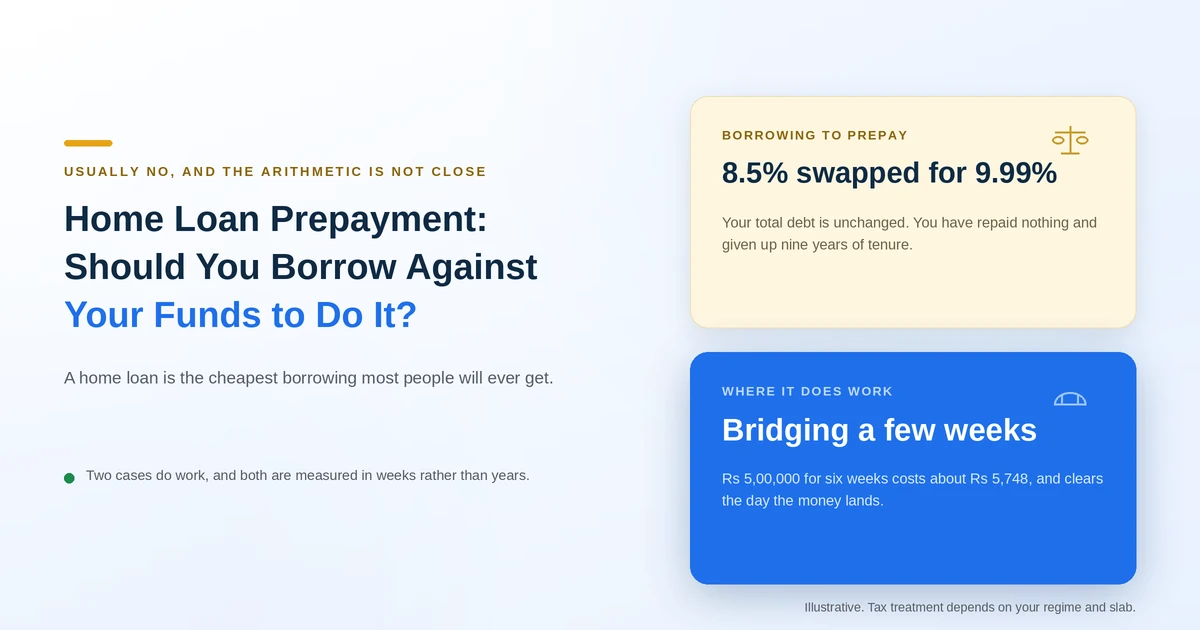
The saving people quote from prepaying belongs to the money, not to the prepayment. Borrow the money instead and you have repaid nothing: you have swapped 8.5% debt for 9.99% debt and given up nine years of tenure.
Two situations do justify it: bridging a short gap before money you already know is coming, and avoiding a forced sale of your investments. Both are about timing, and both are measured in weeks, not years.
One thing has changed. From 1 January 2026, RBI directions bar pre-payment charges on floating rate loans to individuals for non-business purposes, so the old reason to hesitate is gone.
Two questions that get mixed up
Two different questions get mixed together whenever home loan prepayment comes up, and they have different answers.
- Should I prepay my home loan with spare money? A real question with a real answer, and the answer depends on your alternative return, your tax regime and how much you value being debt free.
- Should I borrow money in order to prepay my home loan? Almost always no, and the arithmetic is not close.
This article is about the second one. If you are on the first, the short version is at the bottom.
The arithmetic of prepaying with borrowed money
Check your credit limit on Volt Money. Free, takes 15 seconds.
Check your limit →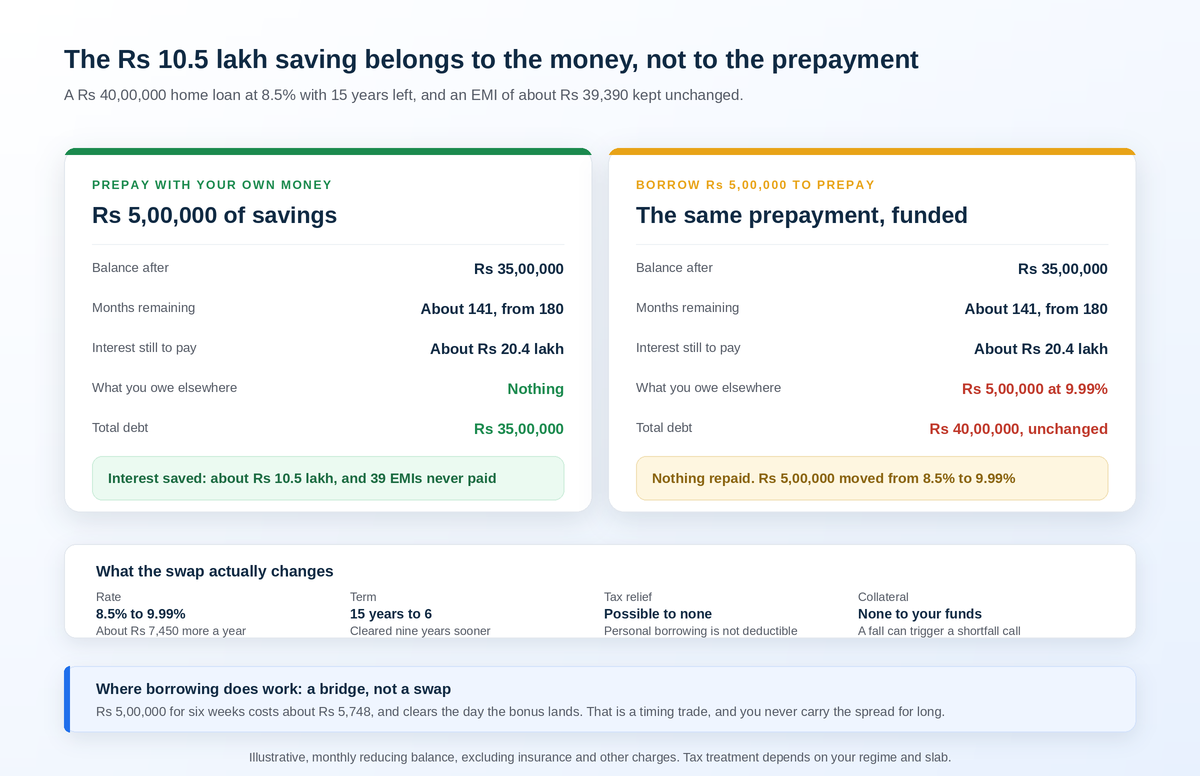
Take a home loan of Rs 40,00,000 outstanding at 8.5% p.a. with 15 years left to run. The EMI is about Rs 39,390 and the interest still to be paid across those 15 years is about Rs 30.9 lakh.
Now prepay Rs 5,00,000 and keep the EMI the same, so the tenure shortens instead:
| Feature | No prepayment | Rs 5,00,000 prepaid from savings |
|---|---|---|
| Outstanding today | Rs 40,00,000 | Rs 35,00,000 |
| EMI | Rs 39,390 | Rs 39,390, unchanged |
| Months remaining | 180 | About 141 |
| Interest still to pay | About Rs 30.9 lakh | About Rs 20.4 lakh |
| Interest saved | About Rs 10.5 lakh, and 39 EMIs never paid |
That Rs 10.5 lakh is the number every prepayment calculator shows you, and it is real. It is also entirely a product of the Rs 5,00,000 being your money. Nothing about the mechanics of prepaying created it.
Now borrow Rs 5,00,000 instead.
Your home loan balance falls to Rs 35,00,000, exactly as above. But you now owe Rs 5,00,000 on a credit line at 9.99%. Your total debt is unchanged at Rs 40,00,000. What has changed is the price and the term of Rs 5,00,000 of it.
| What you did | Effect |
|---|---|
| Moved Rs 5,00,000 of debt from 8.5% to 9.99% | Costs about Rs 7,450 more a year, every year you carry it |
| Moved it from a 15-year term to a 6-year credit line | The same principal now has to be cleared nine years sooner |
| Moved it from a loan with possible tax relief to one with none | Interest on borrowing for personal use is not deductible. Home loan interest may be, depending on your regime |
| Moved it from unsecured-by-your-portfolio to secured against your funds | A market fall can now trigger a shortfall call on a debt you took to reduce another debt |
Four moves, all in the wrong direction, to achieve a rearrangement that repaid nothing.
How the new tax regime changes the maths
You will find bank blogs computing the effective cost of a home loan by taking the interest rate, subtracting relief at your slab under section 24(b), and arriving at something like 6.3% against a 9% rate. That arithmetic assumes you are on the old tax regime. Most people are not, because the new regime is the default.
| Feature | Old regime | New regime (default) |
|---|---|---|
| Interest on a self-occupied property, section 24(b) | Deductible up to Rs 2,00,000 a year | Not available |
| Principal repaid, section 80C | Part of the Rs 1,50,000 limit | Not available |
| Interest on a let-out property | Deductible in full against rental income | Deductible in full against rental income |
| Loss from house property set off against salary or other income | Capped at Rs 2,00,000 a year | Not permitted |
What that does to the number, on the same Rs 40,00,000 loan at 8.5% with about Rs 3,34,707 of interest in the year:
| Your position | Relief | Effective cost of the home loan |
|---|---|---|
| Old regime, 30% slab, self-occupied | Rs 2,00,000 deductible at 31.2% with cess, worth Rs 62,400 | About 6.8% |
| New regime, self-occupied | None | 8.5% |
| Let-out property, either regime | Full interest set against rent, subject to the set-off rules above | Depends on your rental income |
Read that table in the direction that matters here. If you are on the old regime, your home loan effectively costs under 7% and borrowing at 9.99% to reduce it is worse than it first looked. If you are in the new regime, your home loan costs the full 8.5% and the case for prepaying it with your own money gets stronger, while the case for borrowing to do it does not.
There is no version of the table where borrowing at a higher rate to repay a cheaper one comes out ahead.
Prepayment charges: what changed on 1 January 2026
The old argument against prepaying was the foreclosure penalty. For most borrowers it no longer exists.
Floating rate home loans taken by individuals have been free of foreclosure charges since the RBI's June 2012 circular. The RBI (Pre-payment Charges on Loans) Directions, 2025, issued on 2 July 2025, now put a uniform regime across all commercial banks other than payments banks, co-operative banks, NBFCs including housing finance companies, and all India financial institutions, for every term and demand loan sanctioned or renewed on or after 1 January 2026:
- No pre-payment charges on floating rate loans to individuals for non-business purposes.
- It makes no difference whether there are co-borrowers, or where the money came from.
- There is no lock-in period to serve first.
- On dual or hybrid rate loans, what counts is whether the loan is in its floating phase when you prepay.
- Any charge not disclosed in the sanction letter, loan agreement or Key Facts Statement cannot be levied without your explicit consent, and a charge once waived cannot be reinstated.
Fixed rate loans are the exception. A lender may still levy a charge there if the terms allow, commonly around 2%. Check which one you actually have before assuming.
The two cases where borrowing to prepay does make sense
Bridging money you already know is coming.
Your annual bonus lands in six weeks. Your lender's part-prepayment window is now, or a rate reset is due, or you simply want the tenure cut before the next reset. Borrowing Rs 5,00,000 for six weeks at 9.99% costs about Rs 5,748. If prepaying six weeks earlier is worth more than that to you, do it and clear the line when the bonus arrives.
This works because it is a timing trade, not a debt swap. The line is repaid almost immediately, so you never carry the 1.49 point spread for long. On a Volt Money line you can repay the moment the money lands, with zero foreclosure charges, and you pay interest only for the days the money is out.
Avoiding a forced sale of your investments.
The alternative that actually costs most people money is not borrowing. It is redeeming, and the gap between borrowing against your units and selling them is wider than it looks.
Sell equity units to fund a prepayment and you crystallise long term capital gains, taxed at 12.5% above the Rs 1,25,000 annual exemption, you take the units permanently out of the market, and the money takes two to five business days to reach your bank. If your reason for prepaying was to reduce a cost, paying tax and giving up compounding to do it deserves a hard look.
Which debts a credit line at 9.99% does replace
Nothing above says borrowing against your funds is a bad idea. It says borrowing at 9.99% to replace debt at 8.5% is a bad idea. Flip the rates and the whole argument flips with it, most sharply on a credit card revolving balance.
| Debt you are carrying | Typical rate | Does replacing it with a line at 9.99% help? |
|---|---|---|
| Home loan, floating | About 8% to 9% | No. You would be paying more |
| Car loan | About 9% to 12% | Marginal. Check your actual rate and remaining term |
| Personal loan | Roughly 10% to 24%, most borrowers 12% to 18% | Usually yes, and often by a wide margin |
| Credit card revolving balance | Typically 36% to 45% annualised | Yes, and this is the clearest case of all |
If you are prepaying with your own money, two decisions are left
Reduce the tenure, not the EMI. Keeping the EMI and shortening the term is what produced the Rs 10.5 lakh saving above. Reducing the EMI and keeping the term saves a fraction of it. Most lenders default to the option you did not want, so ask explicitly.
Prepay early in the loan, not late. In the early years almost all of your EMI is interest, so every rupee of principal you remove cancels the most future interest. In the last few years the same prepayment barely moves the number, and at that point you are giving up liquidity for very little.
Bridging a gap, not swapping a loan? See your limit first
Check your credit limit on Volt Money. Free, takes 15 seconds. Check your credit limit
Important notes
- This article is for educational purposes only and is not financial advice.
- Tax treatment depends on your regime, your slab and whether the property is self-occupied or let out. The rules cited are those in force for assessment year 2026-27. Confirm your own position with a qualified tax adviser before acting.
- EMI, interest and saving figures are illustrative, computed on a monthly reducing balance at the rates stated, and exclude insurance and other charges your lender may levy.
- Mutual fund investments are subject to market risk. The value of pledged units can rise and fall, and a fall can mean you are asked to add units or repay part of the balance.
- Interest rates, loan to value limits, fees and eligibility depend on your portfolio and profile. Your final terms are set out in the Key Facts Statement and the loan agreement you accept before drawdown, which also name the lending partner.
Your loan is made by an RBI-regulated lending partner, a bank or NBFC, named in the Key Facts Statement and the loan agreement you accept before drawdown.