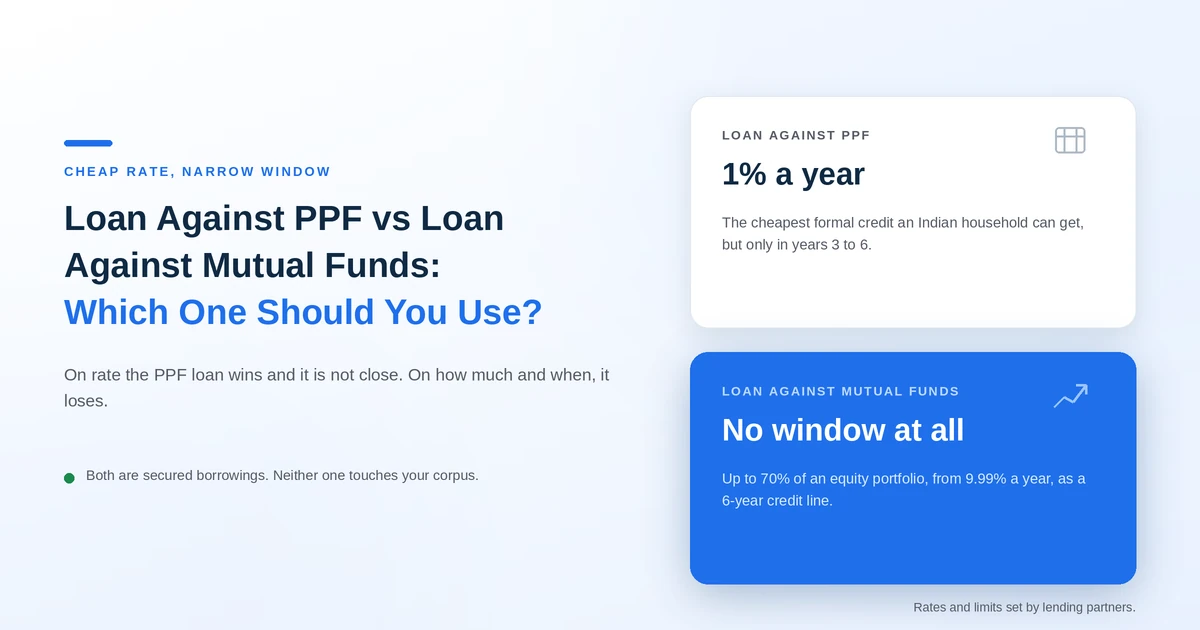
On availability it loses badly. You can only borrow between the third and sixth financial year of the account, only up to 25% of a balance that is two years old, only one loan at a time, and the whole facility disappears from year seven. A loan against mutual funds has no window, lends up to 45% of an equity portfolio and runs as a 6-year credit line.
So the honest answer is: if you are inside the PPF window and 25% of that old balance covers what you need, take the PPF loan. If you are outside it, or the number is too small, borrow against your mutual funds.
A PPF account is one of the few places a household can borrow from at a genuinely low rate, and most people do not realise the facility exists. It also comes with conditions that decide whether it is of any use to you: a window that opens and closes, a limit set by an old balance, and a fixed repayment term. This is what it costs, what you can get, and when borrowing against mutual funds is the better answer.
What a loan against PPF is
Your Public Provident Fund account is locked for 15 years. The scheme softens that in two ways: a loan in the early years, and partial withdrawals later on. They are different facilities with different rules, and people mix them up constantly.
The loan is available from the third financial year to the end of the sixth financial year from the year the account was opened. You borrow, you repay, the corpus is untouched at the end of it.
Partial withdrawal becomes available from the seventh financial year. That is money out, permanently, and it does not come back.
This article is about the first one. If you are past year six, the loan option no longer exists for you and the comparison below is really between a partial withdrawal and borrowing elsewhere.
What a PPF loan costs
Check your credit limit on Volt Money. Free, takes 15 seconds.
Check your limit →The Public Provident Fund Scheme, 2019 charges interest on a PPF loan at one per cent per annum, flat. Not 1% above the PPF rate, and not linked to it at all. On a Rs 1,50,000 loan held for a year, that is Rs 1,500.
There is no processing fee and no charge for prepaying. The only other rate in the scheme is a penalty: if the loan is not fully repaid within 36 months, interest on whatever is still outstanding is charged at 6% per annum instead of 1%.
You may come across a figure of 8.1% instead. That comes from reading the 1% as a margin over the PPF rate: 7.1% plus 1% gives 8.1%. It is not a margin. The scheme sets the loan rate at a flat 1%, and it does not move when the PPF rate moves.
Does your PPF balance stop earning interest during the loan?
A fair question at this point is whether the borrowed amount stops earning PPF interest while the loan is outstanding. If it did, the real cost of the loan would be far higher than 1%, so it is worth being precise about what the scheme actually says.
Paragraph 7 of the Public Provident Fund Scheme, 2019 credits interest on the lowest balance in the account between the close of the fifth day and the end of each month. A loan under paragraph 8 of the same scheme does not debit the account. It is a separate advance against the balance, which is why paragraph 9 sets a repayment schedule for it rather than a restoration of the corpus. Nothing in the scheme withholds interest on the balance while a loan is running.
So on the text, your PPF corpus continues to earn while you are borrowing against it, and the 1% is the real cost rather than a headline over a hidden one. This is the reading of the scheme rather than a line the scheme spells out, so if you are borrowing a large sum, ask your bank or post office to confirm how they will treat the interest credit before you draw.
A PPF loan is therefore genuinely cheap credit. At 1% a year, nothing in the retail market competes with it. A loan against mutual funds is not cheaper on rate and this article will not pretend otherwise. The case for borrowing elsewhere is about how much you can get and when, not about the rate.
The four rules that decide whether a PPF loan is any use to you
- The window. Applications are accepted from the third financial year after the account was opened, and the facility closes at the end of the sixth. An account opened in FY 2021-22 can borrow from FY 2023-24 through FY 2026-27, and never again.
- The amount. You can borrow up to 25% of the balance at the close of the second financial year immediately preceding the year you apply. Apply in FY 2026-27 and the number is fixed by your balance on 31 March 2025. Two years of contributions and two years of compounding count for nothing.
- One at a time. A second loan is not permitted while the first is still outstanding, and you get one loan per financial year.
- Thirty-six months, firm. The principal must be repaid within 36 months of the month following drawdown. Once the principal is cleared, the 1% interest is payable in up to two monthly installments. Miss the 36-month deadline and the rate on what is outstanding jumps to 6%.
Rule 2 is the one that catches people. The limit is not a quarter of your PPF balance. It is a quarter of what your balance was two years ago, which on a young account is a much smaller number than the one you see in your passbook.
How to apply for a PPF loan, and which form to use
You apply at the bank branch or post office holding the account, or through netbanking where your bank offers it. The application is Form 2 under the Public Provident Fund Scheme, 2019.
You may still see the form referred to as Form D. That was the loan application under the PPF Scheme, 1968. The 2019 scheme renumbered the forms, and Form 2 now covers both the loan and the partial withdrawal application. If a bank hands you something labelled Form D it will function the same way, but the current scheme calls it Form 2.
There is no shopping around to do here, and that is the useful thing to know. The terms come from the scheme rather than from the institution, so the 1% rate, the 25% limit, the year three to year six window and the 36-month term are identical wherever your account sits. Comparing lenders, which is the right instinct for almost every other loan, is wasted effort on this one.
The facility is available at any office authorised to hold a PPF account:
- India Post, at any post office offering the scheme.
- State Bank of India and its branches.
- The other public sector banks that hold PPF accounts, including Punjab National Bank, Bank of Baroda, Canara Bank, Union Bank of India, Bank of India, Indian Bank, Central Bank of India and UCO Bank.
- The authorised private banks, principally HDFC Bank, ICICI Bank, Axis Bank, Kotak Mahindra Bank and IDBI Bank.
What does differ is the plumbing rather than the terms. Some banks accept the loan request through netbanking and some still want the form at the branch, and turnaround varies. Ask your own branch which applies before you assume you can do it from your phone.
PPF partial withdrawal: what you can take out from year seven
From the seventh financial year the loan facility ends and a different one opens. Under paragraph 10 of the scheme you may withdraw once in a financial year, up to 50% of the balance at the end of the fourth year preceding the withdrawal or at the end of the preceding year, whichever of the two is lower.
Two things follow from that wording. The lower-of-two test means a recent run of contributions does not lift the ceiling much, and the four-year lookback keeps the figure well behind your passbook. More importantly, this is a withdrawal and not a loan. The money leaves a tax-free account earning 7.1% and there is no mechanism to put it back, so the cost is the compounding you give up for the remaining life of the account rather than any interest you pay.
That is the trade worth weighing against borrowing. A withdrawal is free and permanent; a loan against another asset costs interest and leaves the corpus intact.
A loan against mutual funds: no window, and a bigger limit
A loan against mutual funds works on the opposite principle. Nothing is withdrawn and nothing is sold. Your units are pledged, a lien is recorded against them, and a credit line is opened against that collateral. The units stay invested and keep earning through the whole loan. The lien blocks redemption and switching, and nothing else.
Volt Money lends against over 9,000 approved mutual funds, with a limit of Rs 10,000 to Rs 5 crore.
- 45% loan to value on equity funds, 85% on liquid and debt funds, and a sanctioned limit up to 85% of the portfolio.
- A 6-year credit line. Draw what you need, when you need it, and pay interest only on the amount you have actually used, calculated daily.
- Fully digital. The eligibility check is instant and the account opens in under 10 minutes, with withdrawals landing 24/7.
- Secured, so the bar is your portfolio. No minimum credit score and no income proof are required, because the loan is secured. The eligibility check is a soft bureau check, so it leaves no mark on your score.
- Costs. Interest starts at 9.99% p.a.*, the processing fee starts at Rs 999, and there are zero foreclosure charges.
Starting rate. Your rate depends on your portfolio and profile.
Loan against PPF vs loan against mutual funds
| Feature | Loan against PPF | Loan against mutual funds (Volt Money) |
|---|---|---|
| Interest rate | 1% p.a. flat, rising to 6% p.a. if unpaid past 36 months | Starts at 9.99% p.a.*, charged daily on the drawn amount only |
| When you can borrow | Only FY3 to FY6 of the account. Closed from FY7 | Any time you hold eligible units |
| How much | 25% of the balance two financial years ago | 45% of equity fund value, 85% of liquid and debt |
| Upper limit | Whatever the 25% rule allows. No separate ceiling | Rs 10,000 to Rs 5 crore |
| Tenure | 36 months, hard deadline | 6-year credit line, repay any time inside it |
| Repeat borrowing | One loan per year, none while one is outstanding | Draw, repay and redraw inside the 6 years |
| Does the asset keep working | Corpus stays in the account | Units stay invested and keep growing |
| Credit score | Not assessed | No minimum score. Soft check only, no mark on your score |
| Setup | Form at your bank or post office branch, or netbanking where offered | Digital. Account opened in under 10 minutes |
| Fees | None | From Rs 999 one time. Zero foreclosure charges |
A Rs 4,00,000 need, three months to repay
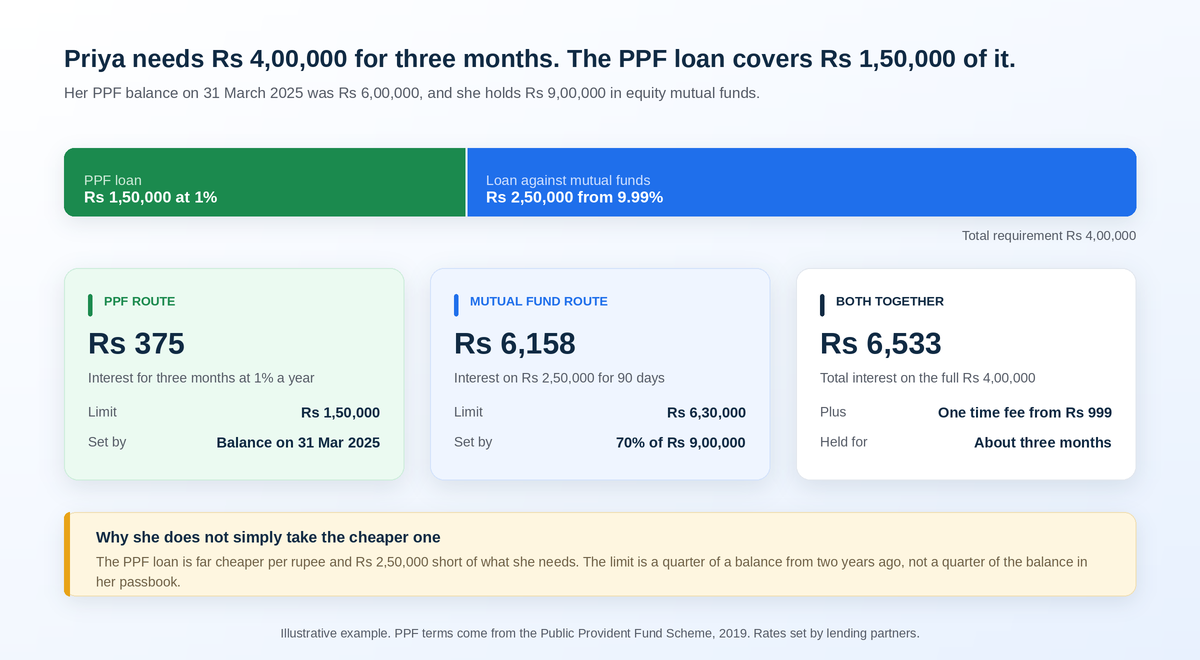
Priya opened her PPF account in FY 2021-22, and her balance as on 31 March 2025 was Rs 6,00,000. She needs Rs 4,00,000 in September 2026 to finish a home renovation she has already committed to, and expects to clear it in about three months when a fixed deposit matures.
PPF route. She is in FY 2026-27, the sixth financial year, so she is still inside the window. The limit is set by that 31 March 2025 balance, so it is 25% of Rs 6,00,000, or Rs 1,50,000. Interest runs at 1% from the first day of the month after she draws it to the last day of the month she clears it, so three months costs about Rs 375. Had she taken the full 36 months, it would have been about Rs 4,500, and even that is remarkably cheap money.
Mutual fund route. She also holds Rs 9,00,000 in equity mutual funds. At 45% loan to value that is a sanctioned limit of Rs 4,05,000. She draws Rs 4,00,000. At 9.99%* for 90 days the interest is about Rs 9,853, plus the one-time setup fee, which starts at Rs 999.
The PPF loan is far cheaper per rupee. It is also Rs 2,50,000 short of what she needs. The sensible answer is not one or the other: she takes the Rs 1,50,000 PPF loan at 1%, and draws the remaining Rs 2,50,000 against her mutual funds, which costs about Rs 6,158 for the 90 days. Total interest across both, about Rs 6,533 on a Rs 4,00,000 requirement held for three months.
Starting rate. Your rate depends on your portfolio and profile.
When the PPF loan is the right call
- You are in the third to sixth financial year of the account.
- 25% of that older balance covers the full amount you need.
- You are confident about clearing it within 36 months. The jump to 6% applies to the outstanding amount, so a near miss is not catastrophic, but it removes the entire reason you chose this route.
- You do not have a second loan running on the same account.
When the mutual fund route is the better call
- Your PPF account is in year seven or later. The loan facility is gone and the only PPF option left is a partial withdrawal, which permanently removes money from a tax-free compounding account.
- Your PPF account is in year one or two. Nothing is available yet.
- The 25% limit does not cover the requirement.
- You need the money today. A PPF loan goes through a branch or netbanking request and a processing cycle.
- You want to repay and redraw. PPF gives you one loan at a time. A credit line does not work that way.
Selling the mutual funds instead is the option worth ruling out first. Redemption proceeds take 2 to 5 business days to reach your bank, you trigger capital gains tax, and you are out of the market on the day you sell.
Can you use both?
Yes, and the example above is exactly why you would. They are unrelated facilities with unrelated collateral. A PPF loan is not reported as a borrowing against your mutual funds and a lien on your units has nothing to do with your PPF account. Take the cheap money first, up to its ceiling, and cover the gap with the flexible line.
What happens if your portfolio value falls
This is the risk that belongs to borrowing against a market-linked asset, and it has no equivalent on the PPF side, so it is worth stating rather than burying.
Your limit is a percentage of what the pledged units are worth. If markets fall far enough that the amount you have drawn breaches that percentage, the lender raises a shortfall call. You then have two ways to clear it, and they are both ordinary housekeeping rather than an emergency:
- Pledge more units. Additional pledging is instant, so bringing more units under the lien restores the ratio without any money changing hands.
- Repay part of what you have drawn. Bringing the drawn balance back under the limit works just as well, and there are no foreclosure charges for doing it.
If a shortfall call is left unaddressed, the lender can invoke the lien and redeem enough of the pledged units to cover it. That is the genuine downside, and it is why drawing your full sanctioned limit and leaving no headroom is a bad idea. Borrowing well inside the limit is what keeps a market fall from turning into a call at all.
Two things that do not happen. Interest is charged on what you have drawn and does not roll up into the balance, so nothing compounds against you while you are not looking. And a fall in value touches only the units you have pledged, not the rest of your holdings.
Important notes
- This article is for educational purposes only and is not financial advice.
- PPF loan terms come from the Public Provident Fund Scheme, 2019. Confirm the current position, and how your interest credit is treated during a loan, with the bank or post office holding your account.
- Mutual fund investments are subject to market risk. The value of pledged units can rise and fall, and a fall can mean you are asked to add units or repay part of the balance, as described above.
- Interest rates, loan to value limits, fees and eligibility depend on your portfolio and profile. Your final terms are set out in the Key Facts Statement and the loan agreement you accept before drawdown, which also name the lending partner.
Not sure what your portfolio can support?
Check your credit limit on Volt Money. Free, takes 15 seconds. Check your credit limit
Your loan is made by an RBI-regulated lending partner, a bank or NBFC, named in the Key Facts Statement and the loan agreement you accept before drawdown.