Search for how to pledge your mutual funds and you will get two sets of answers that look similar and are not. One is about trading. The other is about borrowing. People end up in the wrong process regularly, so it is worth ten minutes to separate them.
What margin pledge is
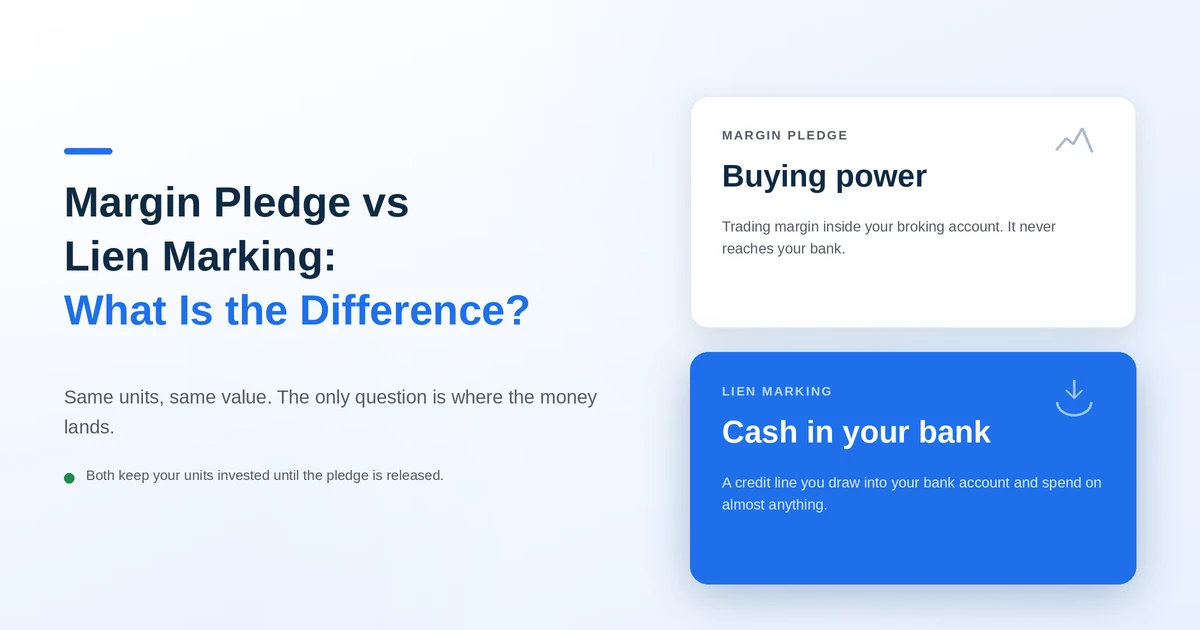
Margin pledge is a broking arrangement. You pledge holdings in your demat account to your broker, and in return you get trading margin, which is buying power inside that account.
- What you get: trading margin, credited against your collateral after a haircut
- What you cannot do: nothing lands in your bank account. The value stays inside the broking system as limit
- Who records it: the depository, on instruction from your broker, with an OTP confirmation
- Who it is for: traders funding positions, and anyone using a margin trading facility
What lien marking is
Check your credit limit on Volt Money. Free, takes 15 seconds.
Check your limit →Lien marking is a lending arrangement. A lender records a lien on your units and gives you a credit line against them. You draw from it into your bank account and spend it on whatever you like, within the rules.
- What you get: a sanctioned credit limit you can withdraw as cash, up to 45% of equity funds and up to 85% of liquid and debt funds
- Where it lands: money in your bank account, instantly and 24/7 once the pledge is recorded
- Who records it: the depository for demat units, or the registrar, CAMS or KFintech, for SOA units
- Who it is for: anyone who needs liquidity without selling their investments
Volt Money is a platform, and the rates and limits shown are provided by its RBI-regulated lending partners.
Margin pledge vs lien marking, side by side
| Feature | Margin pledge | Lien marking for a loan (Volt Money) |
|---|---|---|
| What it is for | Trading collateral | Borrowing cash |
| Who holds the claim | Your broker | An RBI-regulated lender |
| What you receive | Margin inside the broking account | A credit line you draw into your bank |
| Can you spend it outside the market | No | Yes, on almost anything |
| Units accepted | Usually demat holdings only | Demat or SOA, both accepted |
| What it costs | Interest on margin funding, plus pledge charges per security at many brokers | From 9.99% a year, only on what you withdraw, calculated daily |
| Release | Unpledge through the broker | Instant and free, on request |
| Credit check | Not typically a lending decision | No minimum credit score or CIBIL check |
| Can you buy shares with it | That is its purpose | No. RBI bars loan-against-securities money from capital market use |
The point most people miss
A margin pledge and a lien for a loan are not interchangeable, and one specific difference catches people out: RBI rules bar money borrowed against securities from being used for capital market investment. You cannot draw on a loan against mutual funds to buy shares, subscribe to an IPO, or fund margin trading.
So if your goal is to trade with more capital, a loan against mutual funds is the wrong instrument and using it that way would breach the agreement you accept. If your goal is a medical bill, working capital, a wedding or clearing an expensive card balance, it is exactly the right one, and margin pledge cannot help you at all because that money never leaves the broking account.
What both have in common
- You keep owning the units. Neither is a sale.
- Your units stay invested and keep moving with the market, up and down.
- Both block redemption of the pledged holdings until released.
- Both can be unwound. Under a lien on Volt Money, unpledging is instant and free.
- Both carry the same underlying risk: if the collateral falls far enough while you are drawn down, you will be asked to restore the cushion, and the holder of the claim can sell your units if you do not.
Rs 10 lakh pledged: trading margin or cash in the bank
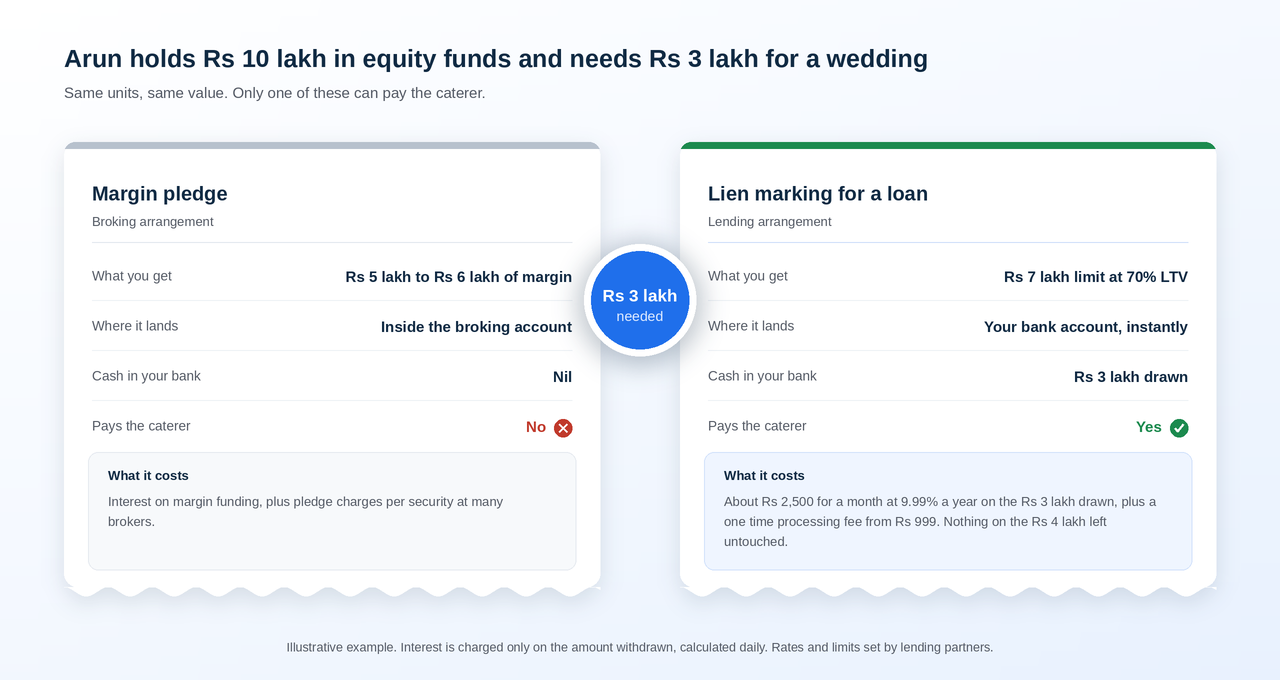
Arun holds Rs 10 lakh in equity mutual funds and wants Rs 3 lakh for his sister's wedding.
- Margin pledge would give him roughly Rs 5 lakh to Rs 6 lakh of trading margin after a haircut, usable only to take positions. He cannot pay a caterer with it.
- Lien marking at 45% LTV gives him a Rs 4.5 lakh limit. He draws Rs 3 lakh into his bank account. At 9.99% a year that is about Rs 2,500 for a full month, plus a one-time processing fee from Rs 999, and nothing on the Rs 1.5 lakh he left untouched.
Same units, same value, completely different outcome. The only question that matters is whether you need buying power or money.
If it is money, how to pledge mutual funds for a loan walks through the process end to end.
Need cash rather than trading margin?
Check your credit limit on Volt Money. Free, takes 15 seconds. Check your credit limit