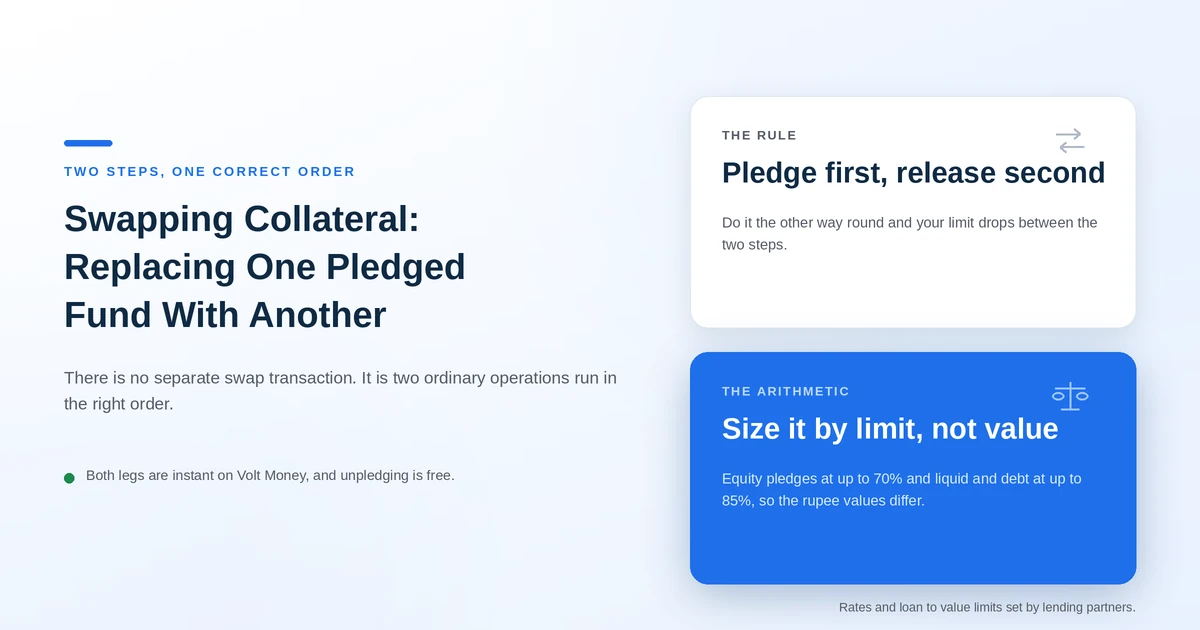
In that order your limit never dips, because both funds are briefly under lien at once. The other way round it drops between the two steps, which is what people are afraid of and why they don't try.
Size the replacement by what it contributes to your limit, not by its rupee value. Equity is pledged at up to 45% and liquid and debt at up to 85%, so Rs 10,00,000 of one is not worth Rs 10,00,000 of the other.
Why you might want to change your collateral
Pledging is not meant to freeze your portfolio in the shape it happened to be in on the day you borrowed. Reasons people want to change the collateral:
- You want to sell the pledged fund. A lien blocks redemption, so the units have to come out from under it first, and something has to take their place if you still owe money.
- Your allocation has drifted and the rebalance you want to make involves a fund that is pledged.
- The fund has been underperforming, or is being merged, or you have simply changed your mind about it.
- You pledged an equity fund and would rather pledge a debt fund, because it supports a bigger limit for the same money.
- You pledged a dozen small holdings and want to consolidate into two or three larger ones, which is worth doing if your units are in demat and each security carries its own pledge charges.
None of that requires closing the loan, repaying what you have drawn, or reapplying.
The question that stops people: does the limit drop in between?
Check your credit limit on Volt Money. Free, takes 15 seconds.
Check your limit →It can. Whether it does is decided entirely by the order you do the two steps in, and this is the part the rest of the internet leaves out.
| Order | What happens to your limit | Risk |
|---|---|---|
| Release the old fund first, then pledge the new one | Falls the moment the old units are released, and stays down until the new pledge is registered | If your drawn balance is close to the limit, you are in shortfall for that window and the lender can raise a call |
| Pledge the new fund first, then release the old one | Rises briefly while both funds are under lien, then returns to where it was | None. You are over-collateralised for a few minutes, which is never a problem |
So the rule is one line long. Pledge first, release second. Always.
How much of the new fund to pledge
The second thing that goes wrong is swapping like for like on rupee value. Your limit is not a share of what you pledged. It is a share of what you pledged after the loan to value percentage for that type of fund.
| Fund type | Loan to value | Limit contribution of Rs 10,00,000 pledged |
|---|---|---|
| Equity funds | Up to 45% | Rs 4,50,000 |
| Liquid and debt funds | Up to 85% | Rs 8,50,000 |
Which gives you a formula worth keeping. To leave your limit exactly where it is:
Value of the new units = value of the old units × old LTV ÷ new LTV
Swapping Rs 10,00,000 of an equity fund for a debt fund: 10,00,000 × 0.45 ÷ 0.85 = Rs 5,29,412. You need less of the debt fund, not the same amount.
Swapping Rs 10,00,000 of a debt fund for an equity fund: 10,00,000 × 0.85 ÷ 0.45 = Rs 18,88,889. You need noticeably more of the equity fund.
Swapping equity for equity, or debt for debt, the formula collapses to matching the rupee value, which is what most people assume applies in every case.
The swap that looks safe and is not
The dangerous swap is the one that looks safest: replacing a debt fund with an equity fund of the same value.
Priya has Rs 10,00,000 of a liquid fund pledged. At 85% her limit is Rs 8,50,000 and she has drawn Rs 8,00,000. She decides to swap the liquid fund for Rs 10,00,000 of an equity fund. Same money, so she assumes nothing changes.
| Feature | Before | After the swap |
|---|---|---|
| Pledged | Rs 10,00,000 liquid fund | Rs 10,00,000 equity fund |
| Loan to value | 85% | 45% |
| Sanctioned limit | Rs 8,50,000 | Rs 4,50,000 |
| Drawn | Rs 8,00,000 | Rs 8,00,000 |
| Headroom | Rs 50,000 | Rs 3,50,000 over the limit |
Nothing about her portfolio got smaller. She still holds Rs 10,00,000 of funds and still owes Rs 8,00,000. But the collateral now supports a smaller limit than she has drawn, and the lender raises a shortfall call. She had to pledge about Rs 18,88,889 of the equity fund, not Rs 10,00,000, or repay the difference first.
This is the only genuine risk in the whole exercise, and it is fully avoidable by doing the arithmetic before the first instruction rather than after the second.
How to do it, step by step
- Work out what you have drawn, not what you have been sanctioned. The drawn balance is what the collateral has to cover. Sanctioned headroom you are not using gives you room to be imprecise.
- Size the new pledge using the formula above. Match limit contribution, not rupee value, and if the two funds are of different types round up rather than down.
- Pledge the new units first. Additional pledging is instant. Approve the lien with the OTP sent to your registered mobile and email. Your limit goes up.
- Confirm the new limit has moved before you touch anything else. One glance at the app. This is the checkpoint that makes the wrong order impossible.
- Release the old units. Unpledging is instant and free. Your limit comes back down to roughly where it started, and the released units are yours to sell, switch or hold.
- Check the drawn balance still sits comfortably inside the limit. If it does not, you released too much or pledged too little. Pledge more units, which is instant, rather than scrambling to repay.
Nothing in that sequence touches your loan. The account number, the interest rate, the six-year term and the drawn balance are all unaffected. You have changed what is standing behind the line, not the line.
What a swap costs
On Volt Money, nothing. Additional pledging is instant and unpledging is instant and free, so both legs of a swap are free. Interest carries on being charged only on what you have drawn, at the same rate, unchanged by any of this.
It is worth knowing that this is not the market norm. Several lenders in this space charge around Rs 500 plus tax for a security withdrawal and around Rs 500 plus tax for a top-up pledge, which makes a single swap roughly a Rs 1,000 decision, and makes routine rebalancing something you think twice about. Where units are held in demat, the depositories also levy small per-security charges on each pledge and release, on top of the other charges on a loan against mutual funds.
ELSS lock-ins and exit loads to check first
- ELSS. ELSS units cannot be pledged during their three-year statutory lock-in. That is enforced at the registrar, not by the lender, so an ELSS fund cannot be the replacement until the lock-in on those units has run.
- Exit loads and holding periods. Releasing units so you can sell them does not remove an exit load, and it does not change the holding period that decides your capital gains treatment. Check both before you decide the swap is the cheap part of the plan.
When you should not swap at all
If your reason for swapping is that you want a bigger limit, do not swap. Just pledge more. Additional pledging is instant, there is nothing to release, and there is no arithmetic to get wrong.
If your reason is that you want to sell a pledged fund and you have drawn nothing, you do not need a replacement either. Release the units and leave the line open with whatever else is pledged, or with nothing pledged at all. An untouched line costs nothing to keep.
Swapping is for one situation only: you have money drawn, and you want to change what is standing behind it.
A complete swap, with numbers
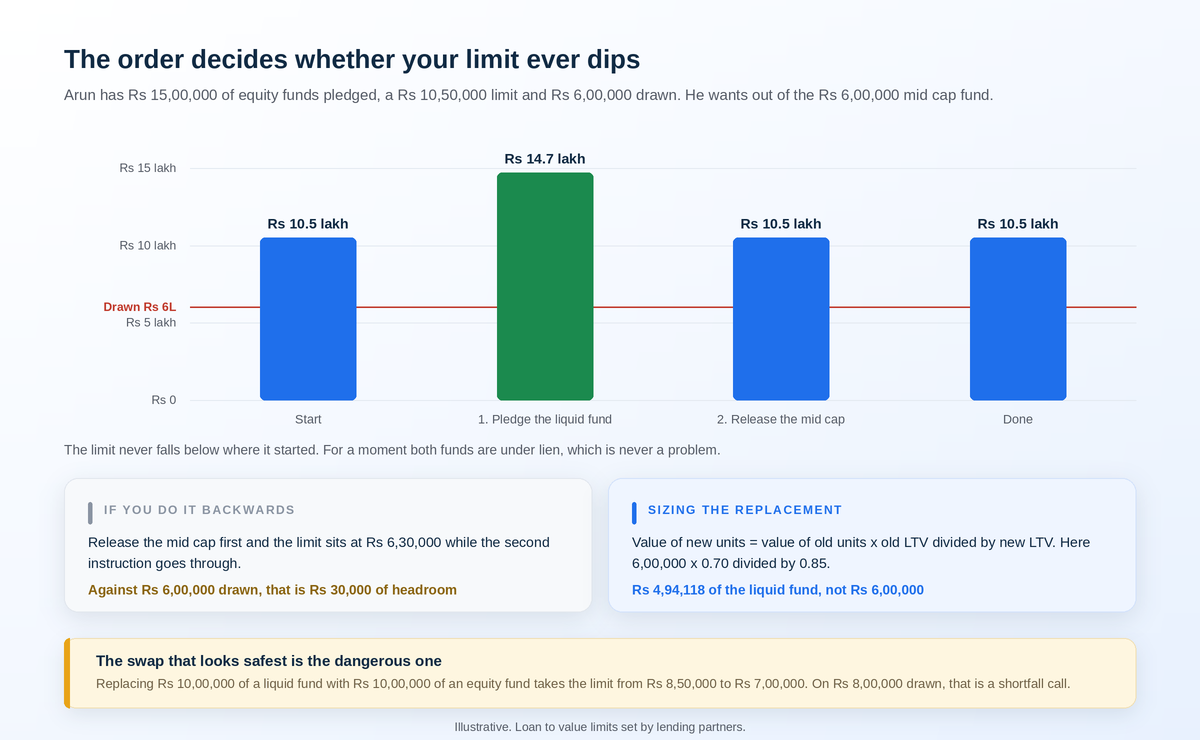
Arun has Rs 15,00,000 in equity funds pledged, split across a large cap fund at Rs 9,00,000 and a mid cap fund at Rs 6,00,000. At 45% his limit is Rs 6,75,000 and he has drawn Rs 6,00,000. He wants to exit the mid cap fund entirely and replace it with a liquid fund he already holds outside the pledge.
| Step | Action | Pledged after | Limit after | Drawn | Headroom |
|---|---|---|---|---|---|
| Start | Rs 9L large cap + Rs 6L mid cap | Rs 15,00,000 | Rs 6,75,000 | Rs 6,00,000 | Rs 75,000 |
| 1 | Pledge Rs 3,17,647 of the liquid fund (6,00,000 × 0.45 ÷ 0.85) | Rs 18,17,647 | Rs 9,45,000 | Rs 6,00,000 | Rs 3,45,000 |
| 2 | Release the Rs 6,00,000 mid cap fund | Rs 12,17,647 | Rs 6,75,000 | Rs 6,00,000 | Rs 75,000 |
| Done | Sell the mid cap units | Rs 12,17,647 | Rs 6,75,000 | Rs 6,00,000 | Rs 75,000 |
The limit ends exactly where it started. It never fell below it at any point. The loan was never touched, no fee was paid, and Arun needed less of the liquid fund than the equity fund it replaced because liquid funds are pledged at a higher percentage.
Had he done it in the other order, his limit would have dropped to Rs 4,05,000 against a drawn balance of Rs 6,00,000 while the second instruction went through, leaving him Rs 1,95,000 over the limit. That is exactly the shortfall the pledge-first order avoids.
Pledge more, release the rest, both instant and free
Check your credit limit on Volt Money. Free, takes 15 seconds. Check your credit limit
Important notes
- This article is for educational purposes only and is not financial advice.
- Loan to value percentages of up to 45% for equity funds and up to 85% for liquid and debt funds are maximums. The percentage applied to a specific scheme depends on the lender's approved fund list, and your sanctioned limit follows from that.
- Charges attributed to other lenders are market observations from published schedules of charges in September 2026, not any particular lender's current pricing.
- Mutual fund investments are subject to market risk. The value of pledged units can rise and fall, and a fall can mean you are asked to add units or repay part of the balance.
- Interest rates, loan to value limits, fees and eligibility depend on your portfolio and profile. Your final terms are set out in the Key Facts Statement and the loan agreement you accept before drawdown, which also name the lending partner.
Your loan is made by an RBI-regulated lending partner, a bank or NBFC, named in the Key Facts Statement and the loan agreement you accept before drawdown.