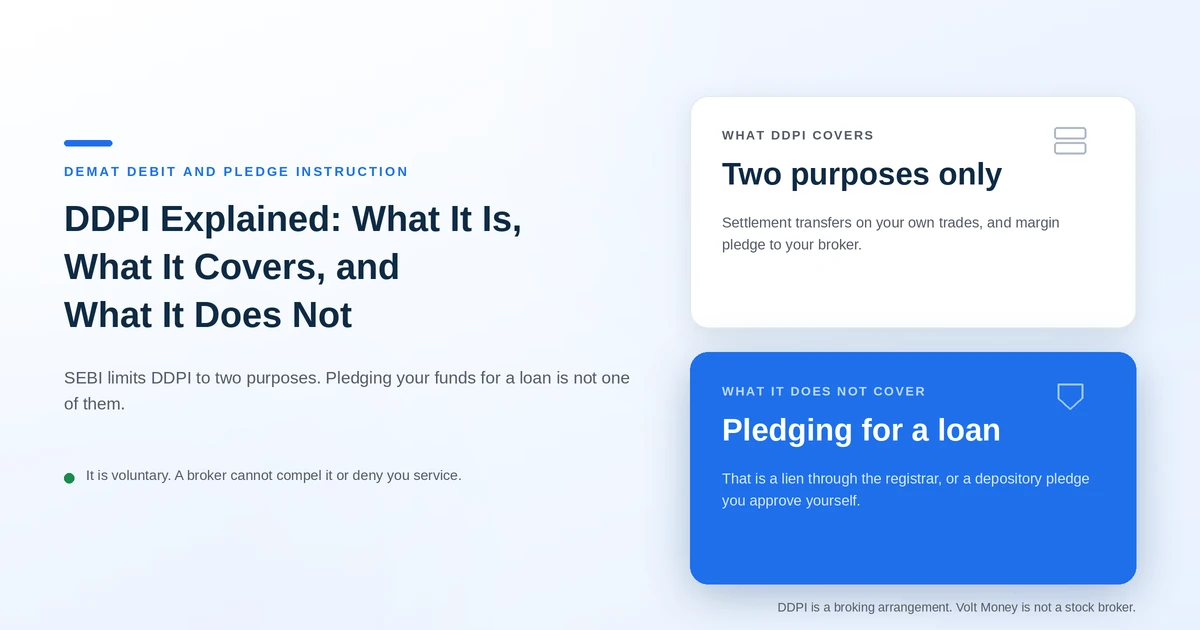
SEBI limits it to two purposes: settling trades you have executed, and margin pledging to your broker. It is voluntary, your broker cannot compel it, and it costs about Rs 100 plus GST.
The word pledge here means margin pledge to your broker. It does not cover pledging your holdings to a bank or NBFC for a loan, which is a different instruction on a different system.
What DDPI stands for, and what it replaced
DDPI is short for Demat Debit and Pledge Instruction. Before it existed, brokers took a Power of Attorney from clients to do the same job. A PoA is a broad legal instrument, and SEBI's concern was that its breadth was being misused. So in April 2022 the regulator carved the two things a broker genuinely needs out of the PoA and put them in a purpose-built document.
The circular that did this is SEBI/HO/MIRSD/DoP/P/CIR/2022/44, dated 4 April 2022, applicable from 1 September 2022 after SEBI extended the original 1 July deadline. A clarification followed on 6 October 2022, and brokers were required to be compliant on or before 20 January 2023.
The practical effect is what most people notice: with DDPI active you sell a share and it goes. Without it, every sale needs a TPIN and OTP from the depository, or an electronic delivery instruction slip.
The two purposes SEBI allows
Check your credit limit on Volt Money. Free, takes 15 seconds.
Check your limit →This is the part worth being precise about, because it decides what DDPI can and cannot be used for. The circular says in terms that the use of DDPI shall be limited only to two purposes:
| # | Purpose, as written in the circular | What it means in practice |
|---|---|---|
| 1 | Transfer of securities held in the beneficial owner account of the client towards stock exchange related deliveries or settlement obligations arising out of trades executed by that client on the stock exchange through the same stock broker | When you sell, your broker can move the shares out to settle the trade without asking you for a TPIN each time |
| 2 | Pledging or re-pledging of securities in favour of the trading member or clearing member for the purpose of meeting margin requirements of the client in connection with the trades executed by that client on the stock exchange | Your broker can margin pledge your holdings so you get collateral margin for trading |
SEBI later widened the scope in the October 2022 clarification, with effect from 18 November 2022: mutual fund transactions executed on stock exchange order entry platforms, and tendering shares in open offers through stock exchange platforms. Both are still exchange-routed transactions. The shape of the permission did not change.
What that list does not include
- Withdrawing money from your trading account.
- Buying or selling on your behalf without your instruction.
- Moving securities anywhere other than to settle your own trades. Under the circular, securities transferred using DDPI can be credited only to the client's trading member pool account.
- Pledging your holdings to a bank or an NBFC as security for a loan.
Is DDPI compulsory?
No, and the circular is unusually blunt about it. DDPI is a voluntary document, it is executed only if the client gives explicit consent, and SEBI required brokers to add a clause to the rights and obligations document reading that the stock broker shall not directly or indirectly compel clients to execute a PoA or a DDPI, or deny services to a client who refuses.
Two follow-ons from that:
- Existing PoAs still work. If you signed a Power of Attorney before DDPI existed, it stays valid until you revoke it. You are not required to switch.
- You can cancel a DDPI. SEBI required brokers to enable clients to revoke or cancel a DDPI they have given.
DDPI compared with the alternatives
| Feature | Power of Attorney | DDPI | No authorisation (eDIS) |
|---|---|---|---|
| What it covers | Broad. Historically used for far more than settlement | Two purposes only, both exchange-related | Nothing standing. You authorise each transfer |
| How you approve a sale | Broker acts under the PoA | Broker acts under the DDPI | You enter a CDSL TPIN and OTP, or submit a DIS, for every sale |
| Can you revoke it | Yes | Yes, brokers must enable this | Nothing to revoke |
| Is it required | No, and never was | No. The broker cannot compel it or deny you service | This is the default if you sign neither |
| Typical cost | Stamp paper and notarisation, historically | About Rs 100 plus 18% GST at most brokers | Free, but slower every single time |
What it costs and how long it takes
Charges are set by the broker, not by SEBI. A representative example: Zerodha charges Rs 100 plus 18% GST and activates DDPI within about 24 working hours when it is done online with Aadhaar e-sign. Offline activation, which is required for NRI accounts using custodial services, joint accounts and non-individual accounts, takes around 72 working hours from receipt of the signed form.
Two details the circular sets that brokers do not always explain. The DDPI must be adequately stamped, which is why an e-stamp step appears in the online flow. And it may be signed digitally, which is why the Aadhaar OTP route exists at all.
The pledge in DDPI is not the pledge in a loan
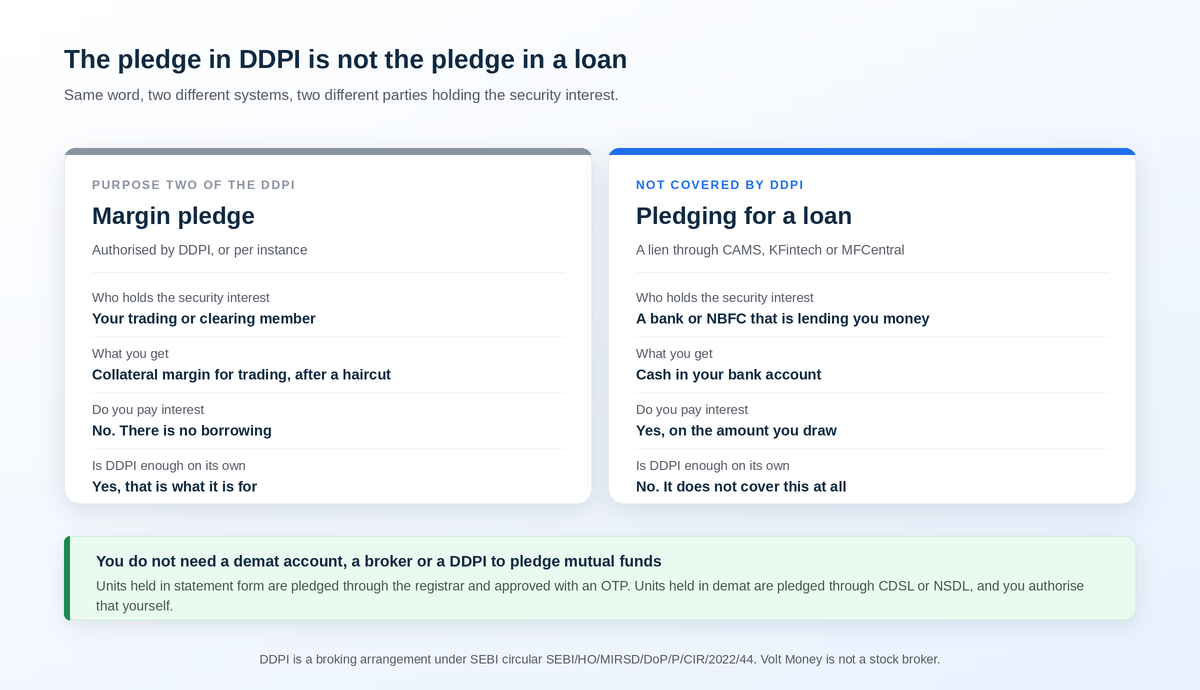
This is the single most common misreading of the acronym, and it matters if you are looking at borrowing against your investments.
The word pledge appears in DDPI because of purpose two: margin pledge in favour of your trading or clearing member. That is a pledge to your broker, so that the value of your holdings can count as collateral margin for your own trading. It is not a loan. Nobody sends you money. Your broker is not lending against the shares, the exchange is accepting them as margin cover.
Borrowing against your investments is a different transaction on a different rail:
| Feature | Margin pledge (the DDPI kind) | Pledging for a loan |
|---|---|---|
| Who holds the security interest | Your trading or clearing member | A bank or NBFC that is lending you money |
| What you get | Collateral margin for trading, after a haircut | Cash in your bank account |
| Which authorisation is used | DDPI, or a per-instance approval | A lien marked through the mutual fund registrar, or a depository pledge you approve yourself with an OTP |
| Is DDPI enough on its own | Yes, that is what purpose two is for | No. DDPI does not cover it |
| Do you pay interest | No. There is no borrowing | Yes, on the amount you draw |
So how does pledging for a loan against mutual funds work?
It depends on how you hold the units, and neither route uses DDPI.
- Units held in statement form (SOA). Lien marking on mutual funds runs through the registrar and transfer agent, CAMS, KFintech or MFCentral. You approve it with an OTP sent to your registered mobile and email. No demat account is involved at any point.
- Units held in demat. A pledge is created in favour of the lender through CDSL or NSDL, and you authorise it yourself. It is not something your broker does under a DDPI.
Either way the units stay in your name and stay invested. The lien blocks redemption and switching. It does not touch returns, and it does not move your money.
What this means if you want to borrow against your funds
If you have been trading, you have probably already met the pledge idea in its margin form and concluded that borrowing against holdings is complicated. It isn't, and the confusion is largely linguistic. On a Volt Money credit line the pledge takes minutes, runs on an OTP, and does not require a demat account, a DDPI, a broker or a TPIN.
What the pledge gets you is a sanctioned limit of up to 45% of the value of your equity funds and 85% for liquid and debt funds, from Rs 10,000 up to Rs 5 crore, as a six-year credit line with interest from 9.99% p.a.* charged only on what you actually withdraw. Over 9,000 approved funds are eligible.
Starting rate. Your rate depends on your portfolio and profile.
See what your funds can borrow against, without a demat account
Check your credit limit on Volt Money. Free, takes 15 seconds. Check your credit limit
Important notes
- This article is for educational purposes only and is not financial advice.
- DDPI is a stock broking arrangement between you and your broker. Volt Money is not a stock broker and does not issue or process DDPI. Charges and timelines quoted are one broker's published figures as at September 2026 and vary between brokers.
- ELSS units cannot be pledged during their three-year statutory lock-in.
- Mutual fund investments are subject to market risk. The value of pledged units can rise and fall, and a fall can mean you are asked to add units or repay part of the balance.
- Interest rates, loan to value limits, fees and eligibility depend on your portfolio and profile. Your final terms are set out in the Key Facts Statement and the loan agreement you accept before drawdown, which also name the lending partner.
Your loan is made by an RBI-regulated lending partner, a bank or NBFC, named in the Key Facts Statement and the loan agreement you accept before drawdown.