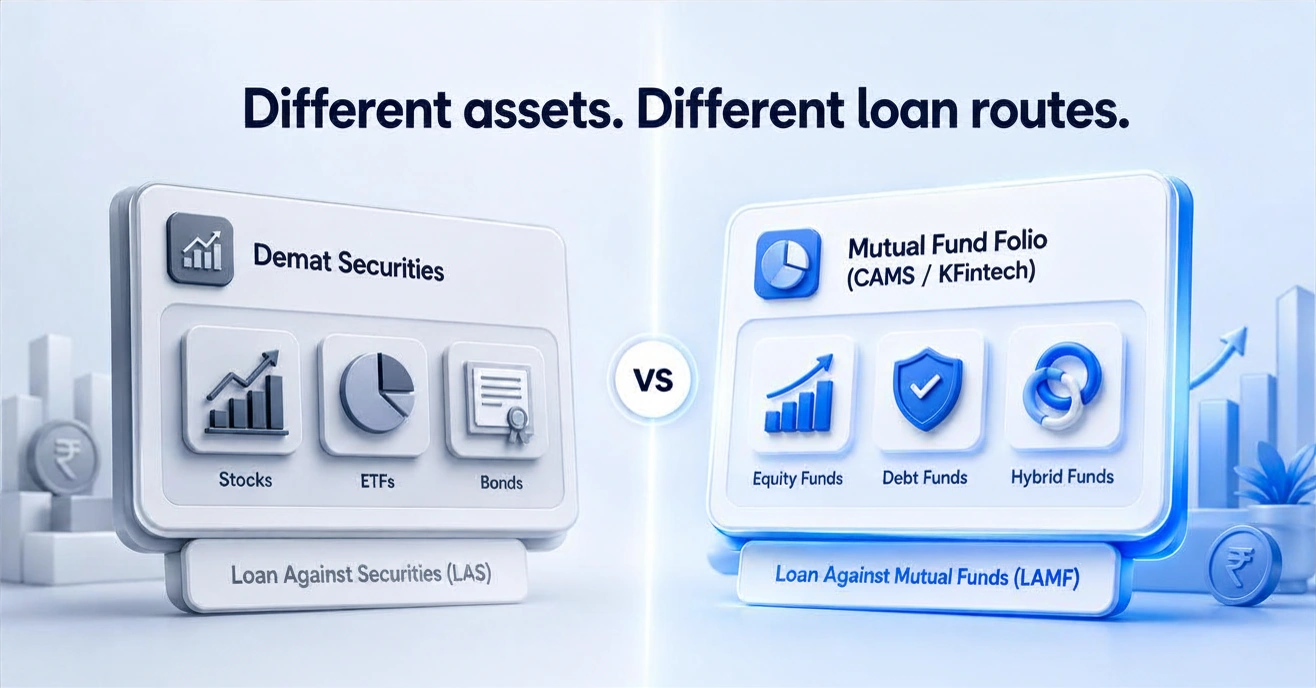
If you are a Zerodha user with a portfolio of stocks, ETFs, or bonds, you may have come across the option to take a loan against those holdings. Zerodha's loan against securities facility lets you pledge your demat holdings for a credit facility without selling them. But the product has limits worth knowing before you apply, especially if part of your wealth is held in mutual funds outside a demat account.
How Zerodha Loan Against Securities Works
Zerodha offers LAS through Zerodha Capital, its NBFC subsidiary. Clients with a Zerodha demat account can pledge eligible listed shares, ETFs, and bonds as collateral for a credit facility. The pledge is created through CDSL or NSDL, India's two demat depositories, via OTP-based authorisation.
Once the pledge is confirmed, a credit facility is released. You can draw from it for any purpose — paying a tax bill, covering a business expense, or managing a short-term cash flow gap. Interest accrues only on the amount you draw, not the total credit limit.
One important limit: Zerodha does not offer a mutual fund-specific pledge facility for folios held outside a demat account. If your mutual funds are in a regular RTA folio (CAMS or KFintech), Volt Money is the better route as it handles lien marking directly, covering over 8,000 schemes, with disbursal typically in under 10 minutes.
LAMF Alternatives for Mutual Fund Investors
Check your credit limit on Volt Money. Free, takes 15 seconds.
Check your limit →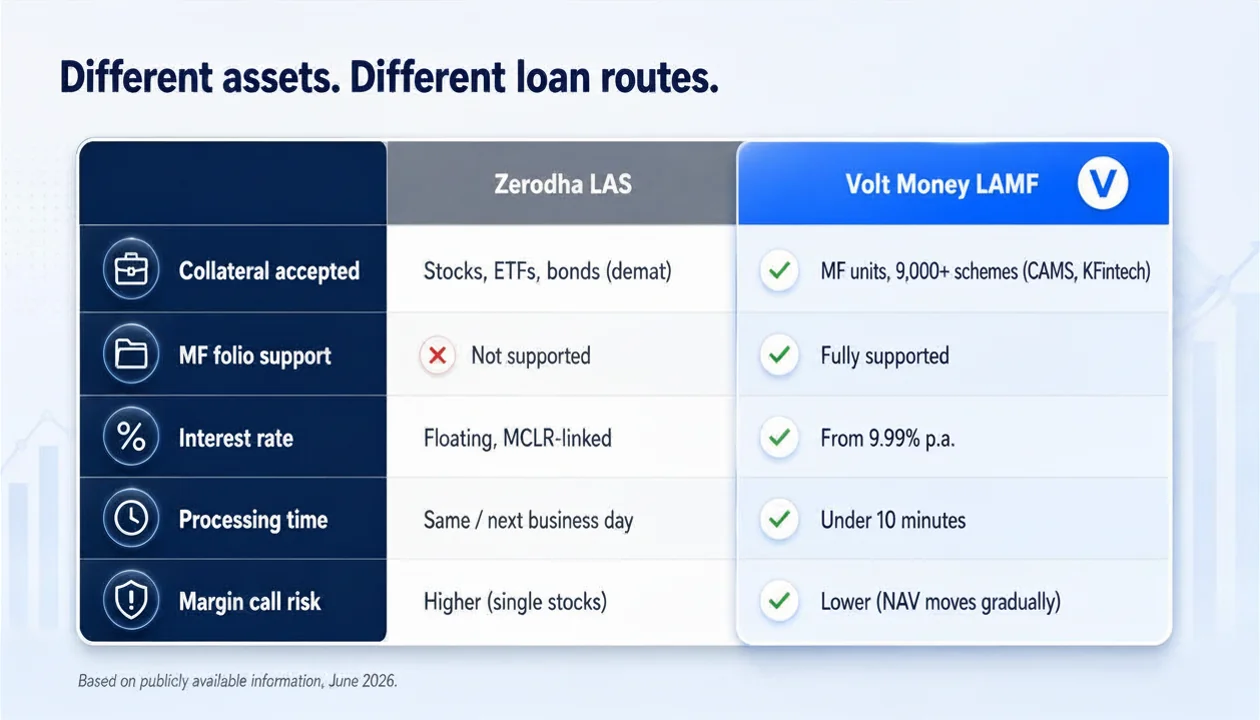
Zerodha LAS and dedicated LAMF platforms like Volt Money are designed for different investor profiles.
Zerodha LAS works well for investors whose wealth is concentrated in listed equities and who already use Zerodha for trading. The integration with the existing demat account makes pledging stocks simple and familiar. But the product does not extend to mutual fund folios held in RTA format outside demat.
Dedicated LAMF platforms are built for investors whose primary wealth vehicle is mutual funds, which describes the majority of retail investors in India. Volt Money processes mutual fund pledges through CAMS, KFintech, and MFCentral, covering a wide range of schemes. Rates on LAMF start at just 9.99% p.a., which is lower because mutual funds carry less price volatility than individual stocks.
If your portfolio is a mix of stocks and mutual funds, you no longer need two separate facilities. Volt Money now offers loans against shares alongside its mutual fund pledging, with loans against demat mutual funds coming soon, so you can cover both from a single platform.
| Zerodha Capital LAS | Volt Money LAMF | |
|---|---|---|
| Lender | Zerodha Capital, an RBI-registered NBFC | NBFC lending partners, via the Volt Money platform |
| Collateral accepted | Shares, ETFs and mutual funds held in demat | Mutual fund units in statement or demat mode, over 9,000 approved schemes |
| Account required | A Zerodha demat account | None |
| Loan range | Rs 25,000 to Rs 10 crore | Rs 10,000 to Rs 5 crore |
| Interest rate | Slab-based: 11.00% from Rs 25,000 to Rs 50 lakh, 10.75% to Rs 1 crore, 10.50% to Rs 5 crore, 10.00% from Rs 5 crore to Rs 10 crore | From 10.49% p.a. |
| Disbursal | Credited within one working day | Instant, 24/7 |
| Tenure | 3 years, interest-only monthly | 6-year credit line |
| Processing fee | 0.25% of the loan amount or Rs 25,000, whichever is lower, plus 18% GST and stamp duty | From Rs 999, one time |
| Pledge and unpledge fees | Rs 32 per security to pledge, Rs 32 to unpledge | Instant and free |
| Prepayment | Principal repayable any time without penalty | Zero foreclosure charges |
Interest Rates on Zerodha LAS
Zerodha LAS rates are typically floating, linked to MCLR or an internal base rate set by Zerodha Capital. Rates vary depending on the collateral type and the size of the credit facility. Equity-backed LAS generally carries a higher rate than mutual fund-backed LAMF, because individual stocks are more volatile collateral.
For context, Volt Money's LAMF product, backed by mutual fund units, starts at 9.99% p.a. Volt Money is a platform and these rates are provided by the lenders who have tied up with it. If your holdings are primarily mutual funds rather than stocks, a dedicated LAMF platform typically offers a lower rate. For a full rate comparison, see Loan Against Securities Interest Rates in India 2026.
Which Securities Are Eligible for Zerodha LAS?
Zerodha LAS accepts collateral from the Zerodha Capital approved list of securities, which generally includes:
- NSE and BSE listed equity shares from a defined approved list
- Exchange-traded funds (ETFs) including gold ETFs and index ETFs
- Bonds and NCDs listed on exchanges
- Sovereign gold bonds
Unlisted shares, international fund-of-funds, and mutual fund units held in RTA folios in non-demat form are not accepted. The approved list changes periodically, and some stocks may carry a lower LTV or not be eligible due to liquidity concerns. Always check the current approved list before planning to use specific holdings as collateral.
How to Apply for LAS Through Zerodha
To apply for Zerodha LAS, you need an active Zerodha trading and demat account. Log in to Kite, go to the loan section or visit Zerodha Capital's application page, select the shares or securities to pledge, and submit the pledge request, confirmed via CDSL OTP. Processing time varies. For approved securities, most investors complete the process within the same or next business day.
Risks of Zerodha LAS
- Approved list changes: Zerodha Capital periodically updates its approved securities list. A stock eligible today may be removed tomorrow, which can suddenly reduce your credit limit. Review the list before relying on specific holdings as primary collateral.
- Stock volatility creates margin call risk: Individual stocks are far more volatile than mutual funds. A single stock dropping 15% on earnings can breach your LTV threshold within a single trading session. Zerodha will issue a margin shortfall notice and require action within a short window.
- Forced square-off: If you cannot meet a margin shortfall in the specified time, Zerodha Capital will liquidate pledged securities to recover the outstanding amount. This is automatic and market-price dependent — you may sell at an unfavourable price.
To understand how mutual fund pledging differs, see What Is Lien Marking on Mutual Funds and Loan Against Securities: Complete Guide.