Indian investors tend to think of loans in one of two ways: personal loans or home loans. But if you hold stocks, bonds, or mutual funds, there is a third option that most people overlook. A loan against securities (LAS) lets you pledge financial assets to unlock a credit limit without selling them. Your investments keep compounding. You pay interest only on what you actually use.
What Is a Loan Against Securities (LAS)?
A loan against securities is a credit facility where you pledge eligible financial assets — such as stocks, mutual funds, government bonds, or ETFs — with a lender. The lender creates a lien on those assets and releases a credit facility, usually 40% to 90% of the current market value depending on the asset type. Debt mutual funds attract up to 85% to 90% LTV, while equity-backed products typically range from 45% to 50%.
You do not sell your investments. They remain in your portfolio and continue to generate returns. If you hold equity funds that appreciate while your loan is running, you benefit from both the capital growth and the liquidity from the credit facility simultaneously.
LAS is sometimes called loan against shares when the collateral is primarily listed equities, or loan against mutual funds (LAMF) when the collateral is mutual fund units specifically. The underlying mechanics are similar — pledge your assets, create a lien, draw funds as needed, repay at your pace. The flexi structure means that as you repay, the credit refills and you can draw again.
Types of Securities You Can Pledge for LAS
Check your credit limit on Volt Money. Free, takes 15 seconds.
Check your limit →The range of eligible securities is wider than most investors expect. Accepted collateral types typically include:
- Listed equity shares (NSE/BSE listed, subject to the lender's approved list)
- Equity and debt mutual funds (regular and direct plans, subject to scheme eligibility)
- Government securities and RBI bonds
- Exchange-traded funds (ETFs) including gold ETFs and index ETFs
- Non-convertible debentures (NCDs) and sovereign gold bonds with select lenders
Loan Against Equity Shares
Lenders typically advance 50% to 60% of market value, within an RBI ceiling of 60% for banks.
Loan Against ETFs
Lenders typically advance 50% to 60% of market value. The RBI ceiling for banks is 75%, so the gap is lenders being cautious rather than the rules.
Loan Against Bonds and NCDs
From 1 July 2026 banks can lend 85% against AAA-rated listed debt and 75% against AA to BBB. NCDs with an original maturity of a year or less cannot be pledged at all.
The exact list varies by lender. Dedicated LAMF platforms like Volt Money work with lenders whose approved securities lists cover over 9,000 mutual fund schemes — one of the broader eligible lists available for MF-backed lending in India.
How LAS Works: Pledge and Lien Marking
LAS has two stages: pledge creation and fund drawdown.
For mutual funds, pledge creation happens through your registrar and transfer agent (RTA). The lender sends a request to mark a lien on specified units. The RTA marks the lien, and those units cannot be redeemed, switched, or transferred until the lien is released. No ownership transfer occurs. The units remain in your folio, in your name, earning returns.
For listed shares, the pledge creation involves your demat account. Your demat holdings are pledged through CDSL or NSDL via your broker, which requires signing physical or broker-assisted documentation.
Once the pledge is confirmed, the lender creates a credit limit. You draw as needed and pay interest only on what you have withdrawn. The full mechanics of the mutual fund pledge process — how lien marking works across MFCentral, CAMS, and KFintech — are covered in detail in What Is Lien Marking on Mutual Funds.
Loan-to-Value (LTV) Ratios by Asset Class
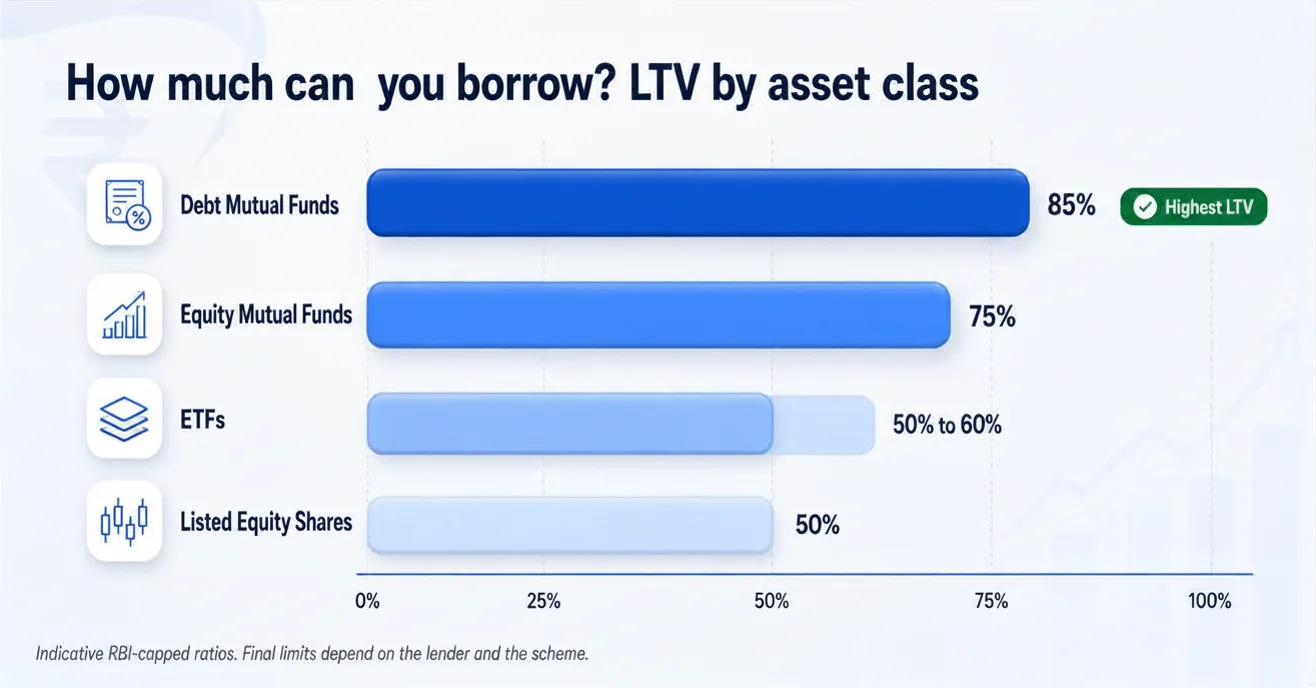
LTV is the percentage of your asset's market value you can borrow. The RBI caps how much banks may lend against each asset class, and lenders set their own limits within those caps:
| Asset pledged | RBI ceiling (banks, from 1 Jul 2026) | Typically offered | On a Rs 10 lakh holding |
|---|---|---|---|
| Equity mutual funds | 75% | 45% to 50%; 45% at Volt Money | Rs 4.5 lakh to Rs 5 lakh |
| Liquid and debt mutual funds | 85% | 80% to 85% | Rs 8 lakh to Rs 8.5 lakh |
| Listed equity shares | 60% | 50% to 60%, lender dependent | Rs 5 lakh to Rs 6 lakh |
| ETFs and index funds | 75% | 50% to 60%, lender dependent | Rs 5 lakh to Rs 6 lakh |
| Listed debt securities | 85% AAA, 75% AA to BBB | Lender and rating dependent | Rs 7.5 lakh to Rs 8.5 lakh |
| Government securities | Per bank policy | Lender dependent | Lender dependent |
The RBI column applies to banks and small finance banks. NBFCs set their own LTV on mutual fund collateral, which is why NBFC-funded platforms can exceed bank ceilings on some assets and sit below them on others.
One limit applies to banks and not to everyone. From 1 July 2026 a bank may lend an individual no more than Rs 1 crore against eligible securities, aggregated across the entire banking system. The cap excludes government securities, listed debt securities and debt mutual fund units, which each bank limits under its own policy. It sits in the RBI directions for commercial banks and small finance banks and does not bind NBFCs, which is why an NBFC-funded platform can sanction a limit above Rs 1 crore where a bank cannot. Volt Money’s own regulatory standing is covered separately in Is Volt Money Safe?.
LAS vs Loan Against Mutual Funds: Key Differences
| Feature | LAS on demat holdings | LAMF at Volt Money |
|---|---|---|
| Collateral | Listed shares, ETFs, bonds | Mutual fund units, over 9,000 approved schemes |
| LTV | Around 50% to 60% on equity shares | 45% on equity funds, 85% on liquid and debt |
| Loan size | Varies by lender | Rs 10,000 to Rs 5 crore |
| Account opening | Often partial paperwork; usually needs a demat or bank relationship | Fully digital, under 10 minutes, no existing relationship needed |
| Credit check | Credit assessment applies | No minimum credit score or income proof; the eligibility check is a soft bureau check |
| Withdrawals | Business hours | Instant, 24/7 |
| Tenure | Typically 12 months renewable, up to 3 years at some NBFCs | 6-year credit line |
| Additional pledging | Fresh request each time | Instant |
| Unpledging | Lender timelines, may carry a per-security fee | Instant and free |
| Foreclosure | Charges common at some NBFCs | Zero foreclosure charges |
LAS Interest Rates in India (2026)
LAS rates vary by lender type and collateral. As a working benchmark for 2026: dedicated LAMF platforms start at 9.99% p.a. for mutual fund collateral; NBFCs typically charge 10.5% to 16% for stock-backed LAS; banks offer repo-linked or MCLR-linked rates, generally 10.5% to 14% for equity-backed LAS.
For a detailed rate comparison across specific banks, NBFCs, and platforms, and to see how rates are determined, see Loan Against Securities Interest Rates in India 2026.
Banks and NBFCs Offering Loan Against Securities
| Lender | Examples | Rate Range | Collateral |
|---|---|---|---|
| LAMF platforms | Volt Money (in partnership with its Lenders) | From 9.99% p.a. | Mutual fund units |
| Banks | HDFC, ICICI, Kotak, SBI | ~10.5% to 14% p.a. | Equity (MCLR/repo-linked) |
| NBFCs | Bajaj Finserv, Tata Capital, Zerodha Capital | ~11% to 16% p.a. | Stocks, bonds, MF units |
Eligibility and Documents Required
Eligibility for LAS is generally clear: Indian resident above 18 years, a qualifying financial portfolio meeting the minimum value threshold, and KYC compliance with a valid PAN and Aadhaar/other OVD. No minimum credit score is required for most MF-backed loans.
For most modern platforms, the entire process is digital with just OTP verification — no physical documents or branch visits required.
Risks: Margin Call, NAV Drop, Forced Liquidation
Margin call is the main risk to manage. If the value of your pledged securities falls below the LTV threshold, the lender issues a margin call: pledge more securities, make a partial repayment, or face liquidation. For stock-backed LAS, this risk is acute — a 20% fall in a pledged stock can breach the LTV within a single trading session. Mutual fund-backed LAMF carries lower margin call risk because NAVs move more gradually.
Forced liquidation: if you cannot meet a margin call in the specified window (typically within 7 working days), the lender will sell pledged securities to restore the required LTV. This may lock in losses at the worst possible time.
LAS does not make sense when your pledged securities are highly volatile, or when you are borrowing close to the maximum LTV. For investors whose wealth is primarily in mutual funds, see What Is a Loan Against Mutual Funds.