
Both options let you borrow against something you already have: equity in your home, or a portfolio of funds. They are built for different jobs. Picking the wrong one costs either interest or time.
What a home loan top up is
A top up loan is extra borrowing from your home loan lender, secured by the same property. You do not mortgage anything new. The lender increases its exposure against a house it already holds.
Typical conditions:
- A repayment track record. Lenders want a period of on-time EMIs first. HDFC Bank, for example, offers a top up 12 months after final disbursement of the home loan, once the property is complete or in your possession.
- Room in the property's value. Your outstanding home loan plus the top up must stay within the lender's loan to value limit, which at HDFC Bank is 75% to 80% depending on the size of the total loan.
- Income to service both EMIs. The lender reassesses your income.
- Tenure. Up to 15 years at HDFC Bank and up to 30 years at SBI, subject to the borrower's age.
You can use the money for almost any purpose other than speculation. In August 2024, RBI flagged that certain lenders were not strictly following loan to value, risk weight and end-use monitoring norms on top up loans.
Home loan top up interest rate and charges
Check your credit limit on Volt Money. Free, takes 15 seconds.
Check your limit →What three large lenders publish on their own sites, as of October 2026:
| Lender | Published terms | Notes |
|---|---|---|
| SBI top up loan | Tenure up to 30 years, borrower up to age 70. Insta Top Up fee is a flat Rs 3,000 plus tax | Rate is on SBI's current rate card |
| HDFC top up loan | 8.00% to 13.70% p.a. Tenure up to 15 years | Eligible 12 months after final disbursement |
| Axis Bank top up | Up to Rs 50 lakh | Rate is on Axis Bank's current rate card |
RBI raised the repo rate by 0.25 percentage points to 5.50% on 7 October 2026. Top up loans are floating-rate, so these figures are likely to move up. Check the lender's current rate card.
Other costs:
- Processing fee. Varies by lender, from a flat fee such as SBI's Rs 3,000 to a percentage of the amount, plus GST.
- Legal and valuation. Some lenders revalue the property.
- Prepayment. No charge on floating-rate loans to individuals.
A home loan top up calculator on your lender's site will show the EMI. What it will not show is the fee and the wait.
What a loan against mutual funds is
A loan against mutual funds is a credit line secured by fund units you own. A lien is marked on the units. They are not sold. They stay invested and keep growing while pledged.
With Volt Money:
- Amount. Rs 10,000 up to Rs 5 crore, against over 9,000 approved funds.
- Limit. 70% loan to value on equity funds, an industry first and the industry's highest, and 85% on liquid and debt funds.
- Structure. A 6-year credit line. Interest only on the utilized amount, only for the duration used, calculated daily. Repay the withdrawn amount any time within 6 years.
- Speed. Instant eligibility check and pledging, loan account opened in under 10 minutes, and instant withdrawals, 24/7.
- Eligibility. No minimum credit score and no income proof are required. The eligibility check is a soft bureau check, so it leaves no mark on your score.
- Cost. Interest starts at 9.99% p.a.*, the processing fee starts from Rs 999, and there are zero foreclosure charges.
Starting rate. Your rate depends on your portfolio and profile.
New to it? See what is a loan against mutual funds.
Home loan top up vs loan against mutual funds
| Home loan top up | Loan against mutual funds (Volt Money) | |
|---|---|---|
| Security | Your home, already mortgaged | Mutual fund units, pledged not sold |
| Who can get it | Existing home loan borrowers with a clean record | Anyone holding eligible funds |
| Interest rate | 8.00% to 13.70% p.a. at HDFC Bank, floating | Starts at 9.99% p.a.* |
| Interest charged on | Full amount from disbursal | Only the amount drawn, calculated daily |
| Amount | Limited by property value and income | 70% of equity fund value, 85% of liquid and debt |
| Tenure | Up to 15 to 30 years, by EMI | 6-year credit line; repay any time within it |
| Processing fee | A flat fee or a percentage, by lender, plus GST | From Rs 999 |
| Time to money | Depends on the lender's income and property checks | Account opened in under 10 minutes; instant withdrawals |
| Income and credit check | Yes, both | No minimum credit score, no income proof |
| Closing early | No charge on floating rate | Zero foreclosure charges |
| Borrow again | Fresh application | Draw, repay and redraw within 6 years |
| Main risk | Your home secures a larger debt | Shortfall call if markets fall |
Rs 8,00,000 for six months: the lower rate loses
Sanjay needs Rs 8,00,000 to replace the roof and waterproof his house before the monsoon. A property sale in his family will pay him enough to clear it in six months. He has a home loan with a good record, and Rs 15,00,000 in equity funds.
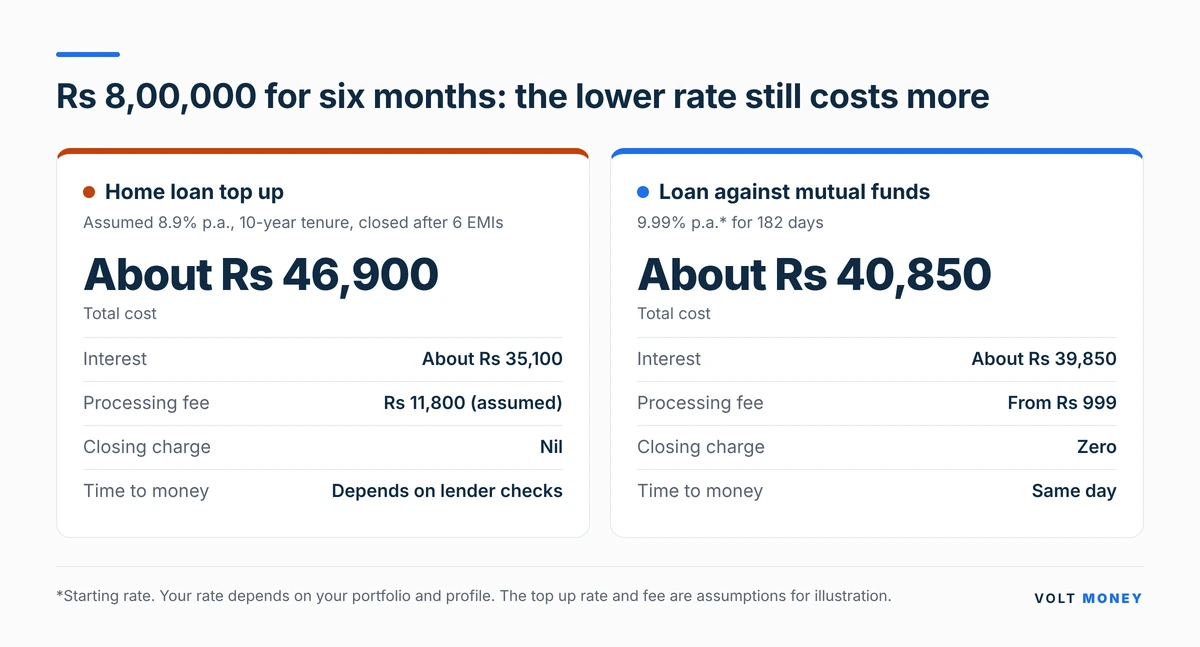
| Cost | Top up at an assumed 8.9% p.a., 10-year tenure, closed after 6 EMIs | Loan against mutual funds at 9.99%* for 182 days |
|---|---|---|
| Interest | About Rs 35,100 | About Rs 39,850 |
| Processing fee | Assumed at Rs 10,000 plus GST: Rs 11,800 | From Rs 999 |
| Closing charge | Nil | Nil |
| Total | About Rs 46,900 | About Rs 40,850 |
| Time to money | Depends on the lender's checks | Same day |
The top up is more than a percentage point cheaper on rate and still costs about Rs 6,000 more, because the fee is spread over only six months. Sanjay also avoids a fresh income assessment and a possible property revaluation.
If he needs the money for only three months, the gap widens: interest on the credit line falls to about Rs 19,900, while the top up fee stays at Rs 11,800.
Rs 8,00,000 for ten years: the top up wins
Now suppose Sanjay has no windfall coming and wants to repay from salary over ten years.
Top up. EMI of about Rs 10,090 a month at 8.9%. Total interest about Rs 4,10,900. The Rs 11,800 fee is small against that.
Loan against mutual funds. The credit line runs for 6 years, so the withdrawn amount must be repaid within that. At a rate about one point higher, he would also pay more interest for every year the balance stays.
For long, steady repayment, the top up is the right tool. The break-even in this example sits at roughly a year: under that, the mutual fund route is cheaper; well beyond it, the top up is.
Tax: what a top up does and does not give you
Interest on a top up loan is deductible only when the money is used to buy, build, repair or renovate a house, and only under the old tax regime. For a self-occupied house the total interest deduction is capped at Rs 2 lakh a year, and within that, repairs and renovation are capped at Rs 30,000.
Use the top up for a wedding, a car or a holiday and there is no deduction. Keep bills for the work if you plan to claim.
Interest on a loan against mutual funds used for personal purposes is not deductible either. Its tax advantage is different: pledging is not a sale, so it triggers no capital gains tax.
When the top up is the better choice
- You need the money for five years or more.
- The amount is large relative to your mutual fund portfolio.
- You are renovating and can use the interest deduction under the old regime.
- Your lender offers a top up close to your home loan rate with a low fee.
- You would rather not have borrowing linked to market values.
When the mutual fund route is the better choice
- You will repay within a year or two.
- You need the money this week, not next month.
- You have no home loan, or it is less than a year old.
- Your home loan lender's top up would breach its loan to value limit.
- Your income is irregular or hard to document.
- You are unsure of the final amount and want to draw in stages.
Some borrowers use both: a top up for the planned, long-term part of a renovation, and a credit line for the overruns that every renovation produces.
What happens if your portfolio value falls
A top up is secured by a house, whose value does not move day to day. A loan against mutual funds is secured by units whose value does. That carries a few risks.
Your limit is a percentage of the current value of the pledged units. If markets fall far enough that the amount drawn crosses that percentage, the lender raises a shortfall, often called a margin call. You clear it by pledging more units, which is instant, or by repaying part of the balance, which carries no charge. If it is left unaddressed, the lender can redeem pledged units to cover it.
Sanjay drew Rs 8,00,000 against a limit of Rs 10,50,000. His funds would have to fall about 24% before a shortfall arises. Pledging a larger part of his portfolio, or borrowing a little less, would widen that margin.
There is no fixed EMI on the principal, so he should fix his own repayment date. And repaying does not release his units by itself. The lien stays so the credit line remains open for the 6 years; unpledging on request is instant and free of charge.
Important notes
- This article is for educational purposes only and is not financial or tax advice.
- Top up terms are taken from the lenders' own websites in October 2026 and vary by loan size and profile. The rate and fee in the worked example are assumptions. Confirm current terms with your lender.
- Tax treatment depends on end use and regime. Consult a chartered accountant.
- Mutual fund investments are subject to market risk. The value of pledged units can rise and fall.
- Interest rates, loan to value limits, fees and eligibility depend on your portfolio and profile. Your final terms are set out in the Key Facts Statement and the loan agreement you accept before drawdown.
Compare before you apply for a top up.
Check your credit limit on Volt Money. Free, takes 15 seconds.
Your loan is made by an RBI-regulated lending partner, a bank or NBFC, named in the Key Facts Statement and the loan agreement you accept before drawdown.


