
Both are secured loans, so both cost less than unsecured credit. The difference is what you pledge, how long approval takes, and how much stands between you and the money. This guide covers rates, eligibility, credit score, income proof, tax and the position for senior citizens.
What a loan against property is
A loan against property, often shortened to LAP, is a mortgage loan. You pledge a house, flat, shop or office you already own, and a bank or housing finance company lends you a share of its market value, usually 60% to 65% at large banks. You keep living in or using the property and repay through monthly EMIs, typically over 10 to 20 years.
Because the collateral is physical, the lender has to verify it. That means a title search by a lawyer, a site valuation, a check of approved plans and tax receipts, and registration of the mortgage with stamp duty. The fastest lenders promise disbursal within 72 hours of approval. Others quote 7 to 15 days from application to disbursal.
What a loan against mutual funds is
Check your credit limit on Volt Money. Free, takes 15 seconds.
Check your limit →A loan against mutual funds is a credit line secured by your fund units. A lien is marked on the units with the registrar. You do not sell anything. The units stay invested and keep growing while pledged; the lien only blocks redemption and switching.
Volt Money lends against over 9,000 approved funds, from Rs 10,000 up to Rs 5 crore:
- 70% loan to value on equity funds, an industry first and the industry's highest, and 85% on liquid and debt funds.
- A 6-year credit line. Interest only on the utilized amount, only for the duration used, calculated daily. Repay the withdrawn amount any time within 6 years.
- Fully digital. Instant eligibility check and pledging, loan account opened in under 10 minutes, and instant withdrawals, 24/7.
- What you need. Your PAN number, an Aadhaar-linked mobile number and bank account details. No documents to upload and no branch visit.
- No minimum credit score and no income proof are required. The eligibility check is a soft bureau check, so it leaves no mark on your score.
- Costs. Interest starts at 9.99% p.a.*, the processing fee starts from Rs 999, and there are zero foreclosure charges.
Starting rate. Your rate depends on your portfolio and profile.
New to the product? Read what is a loan against mutual funds.
Loan against property vs loan against mutual funds
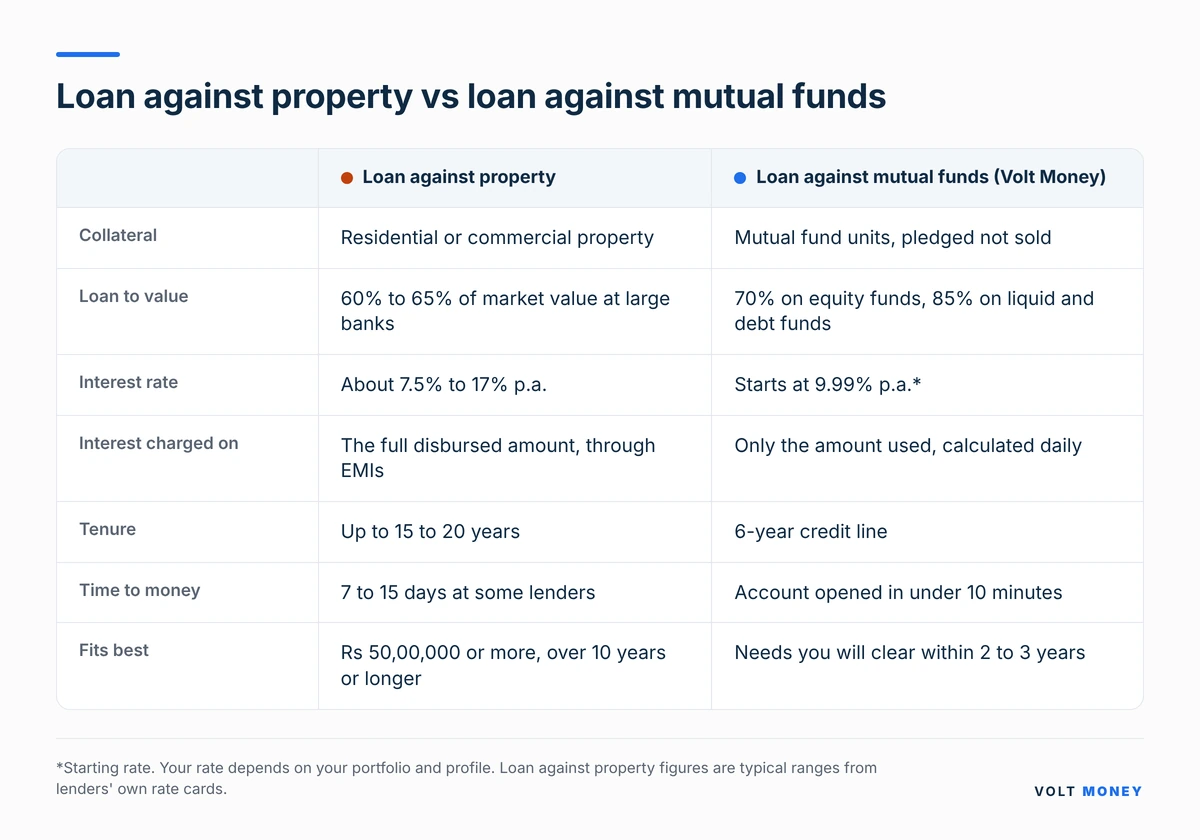
| Loan against property | Loan against mutual funds (Volt Money) | |
|---|---|---|
| Collateral | Residential or commercial property | Mutual fund units, over 9,000 approved funds |
| Loan amount | From Rs 10,00,000 at SBI, up to several crore | Rs 10,000 up to Rs 5 crore |
| Loan to value | Usually 60% to 65% of market value at large banks | 70% on equity funds, 85% on liquid and debt funds |
| Interest rate | About 7.5% to 17% p.a., by lender and profile | Starts at 9.99% p.a.* |
| Interest charged on | The full disbursed amount, through EMIs | Only the amount used, calculated daily |
| Tenure | Up to 15 to 20 years | 6-year credit line; repay any time within it |
| Time to money | 7 to 15 days at some lenders | Account opened in under 10 minutes; instant withdrawals, 24/7 |
| Process | Title search, valuation, mortgage registration | 100% digital: instant eligibility check and pledging |
| Credit score | 700 at some lenders; 650 considered at others | No minimum credit score |
| Income proof | Salary slips, ITRs, bank statements | Not required |
| Upfront cost | Processing fee, legal and valuation charges, stamp duty | Processing fee from Rs 999 |
| Closing early | Nil on floating-rate loans to individuals for non-business use; other loans can carry a charge | Zero foreclosure charges |
| Borrowing more later | Top-up loan with fresh assessment | Instant additional pledging |
| Releasing collateral | Lender returns title documents after closure | Instant unpledging, free of charge |
Loan against property figures are typical market ranges and vary by lender.
Loan against property interest rate
The loan against property interest rate at large lenders runs from about 7.5% to 17% p.a. on their published rate cards. Borrowers with a strong profile and a clean residential property sit at the lower end. Self-employed borrowers, commercial property and weaker credit scores push the rate up.
Four things decide where you land:
- Credit score. A score of 750 or more gets the advertised starting rate. Below 700, expect a premium.
- Income profile. Salaried borrowers with a known employer usually get better rates than self-employed applicants.
- Property. Self-occupied residential property in a good location is priced best. Commercial and older properties cost more.
- Rate type. Most loans are floating and move with the repo rate, which RBI raised to 5.50% on 7 October 2026. Fixed-rate options cost more and can carry prepayment charges.
The rate is only half the cost. A loan against property is disbursed in full on day one, and interest runs on the whole amount. On top of the rate you pay a processing fee, which ranges from about 1% of the loan at SBI and Tata Capital to about 3.5% at Bajaj Finance, plus legal and valuation charges and stamp duty on the mortgage as per your state.
A loan against mutual funds is a credit line. If your limit is Rs 14,00,000 and you use Rs 4,00,000 for 45 days, you pay interest on Rs 4,00,000 for 45 days. At 9.99%* that is about Rs 4,927. The unused Rs 10,00,000 costs nothing.
Loan against property eligibility
Loan against property eligibility rests on three checks: you, your income and your property.
- Age. Lenders cap your age at loan maturity, commonly at 65 to 70.
- Income. Salaried applicants give salary slips and Form 16 or ITRs. Self-employed applicants give ITRs, financial statements and business proof.
- Credit score. Tata Capital asks for a minimum of 700. Bajaj Finance describes 650 or higher as ideal.
- Existing EMIs. Lenders cap total EMIs at a share of your income, so current loans reduce what you can borrow.
- Property. Clear title in your name, approved building plan, occupancy certificate, tax receipts and no dispute. Co-owners must join as co-applicants.
The amount is the lower of two numbers: 60% to 65% of the property's value, and what your income can service as EMI. A Rs 1 crore flat does not guarantee a Rs 65,00,000 loan if your income supports an EMI on only Rs 40,00,000.
For a loan against mutual funds the check is the portfolio. Meera holds Rs 12,00,000 in equity funds and Rs 4,00,000 in a liquid fund. Her limit is 70% of Rs 12,00,000, which is Rs 8,40,000, plus 85% of Rs 4,00,000, which is Rs 3,40,000. That comes to Rs 11,80,000. Her salary, employer and credit score do not change the number. ELSS units cannot be pledged during their 3-year lock-in.
Loan against property with bad CIBIL
A loan against property with bad CIBIL is possible, but it costs more and takes longer. The property reduces the lender's risk. It does not remove the credit check.
Lenders publish different floors. Tata Capital asks for a minimum score of 700, and Bajaj Finance describes 650 or higher as ideal. Below those levels, expect fewer willing lenders, a higher rate, a lower loan to value and, often, a request for a co-applicant.
Three things improve the odds: asking for a smaller share of the property's value, adding a co-applicant with a clean record, and applying to NBFCs before banks. Avoid applying to many lenders at once. Each formal application is a hard enquiry and pulls the score down further.
A loan against mutual funds works differently. Because it is fully secured by liquid collateral, no minimum credit score is required, and someone with no credit history can still qualify. The loan does appear in your credit report, so paying interest on time matters. See loan against mutual funds with a low CIBIL score.
Loan against property without income proof
A loan against property without income proof exists in name, but not in the sense most borrowers hope. Lenders still assess repayment ability. They use substitutes for salary slips and ITRs:
- 6 to 12 months of bank statements showing steady credits
- GST returns or business turnover records
- Rental income from the property or other assets
- A co-applicant with documented income
Expect a higher interest rate, a lower loan to value and more questions than a fully documented application gets.
With a loan against mutual funds, income proof is not part of the process. The limit is set by portfolio value, so freelancers, new business owners, homemakers and retirees with investments qualify on the same terms as salaried borrowers.
Loan against property tax benefits
Loan against property tax benefits depend on how you use the money, not on the loan. There is no automatic deduction for taking one.
| How the money is used | Tax treatment of interest |
|---|---|
| Business or professional expenses | Interest and loan charges are deductible as business expenses |
| Buying or building a house you live in | Interest deductible up to Rs 2,00,000 a year, old tax regime only |
| Repairing or renovating a house you live in | Interest deductible up to Rs 30,000 a year, within the Rs 2,00,000 cap, old tax regime only |
| Wedding, travel, medical bills, other personal use | No deduction |
| Principal repayment, any use | No deduction |
Keep proof of how the funds were used. Without a clear trail from the loan to the expense, the deduction can be disallowed.
Interest on a loan against mutual funds follows the same end-use rule. Its real tax advantage is what you avoid. Pledging is not a sale, so it creates no capital gains tax. Selling the same units would.
Arjun bought equity fund units for Rs 6,00,000. They are now worth Rs 12,00,000 and he has held them for over a year. If he sells, his long-term gain is Rs 6,00,000. After the Rs 1,25,000 annual exemption, Rs 4,75,000 is taxed at 12.5%, which is Rs 59,375 before cess. If he pledges the units instead, there is no tax event and all Rs 12,00,000 stays invested. Selling is also slower than it looks: redemption money takes 2 to 5 business days to reach your bank. See capital gains tax on mutual funds.
Loan against property for senior citizens in India
A loan against property for senior citizens in India is available, but age shortens the tenure and pension income limits the amount.
Lenders commonly cap the borrower's age at loan maturity at 65 to 70. A 65-year-old applying to a lender with a cap of 70 gets a tenure of 5 years, not 15. Short tenure means a high EMI. On Rs 20,00,000 at 10% p.a., the EMI is about Rs 21,500 over 15 years and about Rs 42,500 over 5 years. A pension rarely supports the second number, so the sanctioned amount shrinks.
Reverse mortgage is the senior-specific alternative. It is for homeowners aged 60 and above. The lender pays you, monthly or as a lump sum, against your self-occupied home, and you make no repayments in your lifetime. The loan is settled when the house is sold, or your heirs repay it and keep the house. The trade-offs are tenures of 10 to 20 years, caps on the payout, slow processing and less equity left for your heirs.
Many retirees hold mutual funds alongside property. For a short-term need, a loan against those funds avoids the hurdles above: no income proof, no fixed EMI on the principal, and zero foreclosure charges.
Mr Rao, 68, needs Rs 3,00,000 for a knee surgery and expects a fixed deposit to mature in 4 months. He holds Rs 10,00,000 in debt funds, which gives him a limit of Rs 8,50,000 at 85%. He draws Rs 3,00,000 and repays it after 120 days. His interest at 9.99%* is about Rs 9,850. His home is untouched and his funds stay invested.
Rs 10,00,000 for eight months: the lower rate loses
Priya owns a flat worth Rs 1 crore and equity mutual funds worth Rs 20,00,000. She needs Rs 10,00,000 to cover a business gap until a client payment arrives in 8 months.
| Cost | Loan against property at 9.5% p.a., 10-year tenure, closed after 8 EMIs | Loan against mutual funds at 9.99%* for 8 months |
|---|---|---|
| Limit available | Up to about Rs 60,00,000 to Rs 65,00,000, subject to income | Rs 14,00,000 at 70% |
| Interest | About Rs 62,200 | About Rs 66,500 |
| Processing fee | 1% plus GST: Rs 11,800 | From Rs 999 |
| Legal, valuation, mortgage registration | About Rs 10,000, assumed; varies by state and lender | None |
| Foreclosure charge | Nil on a floating-rate loan | Zero |
| Total cost | About Rs 84,000 | About Rs 67,500 |
| Time to money | A week or two | Same day |
The loan against property has the lower rate and still costs about Rs 16,500 more, because its fixed costs are spread over only 8 months. Priya would also be mortgaging a Rs 1 crore home to borrow Rs 10,00,000. A personal loan would not have solved this either, since personal loans are rarely offered for under 12 months.
Rs 50,00,000 for ten years: the property loan wins
Now suppose Priya wants Rs 50,00,000 to buy office space and plans to repay over 10 years.
Loan against property. An EMI of about Rs 64,700 at 9.5%. The upfront costs are small against a loan of this size and tenure.
Loan against mutual funds. She would need about Rs 71,50,000 in equity funds to get a Rs 50,00,000 limit, and the withdrawn amount must be repaid within 6 years.
If she already has a home loan on the flat, a top up is a third option. See home loan top up vs loan against mutual funds.
Which one to choose
| Your situation | Better fit |
|---|---|
| Need under Rs 25,00,000, for under 3 years | Loan against mutual funds |
| Need money within days | Loan against mutual funds |
| Low credit score, no income proof, or retired | Loan against mutual funds |
| Unsure how much you will need | Loan against mutual funds; you pay only for what you draw |
| Need Rs 50,00,000 or more for 10 years or longer | Loan against property |
| Own property but few or no mutual funds | Loan against property |
| Funding a business where interest is a deductible expense | Either; compare total cost |
What happens if your portfolio value falls
A loan against property is secured by a house, whose value does not move day to day. Its risk is different: your home or office is the collateral, and sustained default lets the lender take possession and sell it.
A loan against mutual funds carries a few risks of its own. Your limit is a percentage of the value of the pledged units. If markets fall far enough that the amount drawn crosses that percentage, the lender raises a shortfall, often called a margin call. You clear it by pledging more units, which is instant, or by repaying part of the balance, which carries no charge. If it is left unaddressed, the lender can redeem pledged units to cover it.
Priya drew Rs 10,00,000 against a Rs 14,00,000 limit. Her funds would have to fall about 29% before a shortfall arises. Borrowing closer to half the limit gives more room.
There is no fixed EMI on the principal, so set your own repayment date. And repaying does not release your units by itself. The lien stays so the credit line remains open for the 6 years; unpledging on request is instant and free of charge.
Important notes
- This article is for educational purposes only and is not financial or tax advice.
- Loan against property rates, fees, loan to value and age limits are typical market ranges and vary by lender and profile. Confirm current terms with the lender.
- Tax treatment depends on end use and regime. Consult a chartered accountant.
- Mutual fund investments are subject to market risk. The value of pledged units can rise and fall.
- Interest rates, loan to value limits, fees and eligibility depend on your portfolio and profile. Your final terms are set out in the Key Facts Statement and the loan agreement you accept before drawdown.
Before you mortgage your home for a short-term need.
Check your credit limit on Volt Money. Free, takes 15 seconds.
Your loan is made by an RBI-regulated lending partner, a bank or NBFC, named in the Key Facts Statement and the loan agreement you accept before drawdown.