This article is written by a lender's platform, so read it with that in mind. It is also in our interest that borrowers use the product well. The rules below are the ones we would give a friend.
What a debt trap is
A debt trap is a situation where you borrow to service earlier borrowing. Interest on one loan is paid by drawing on another, the total owed rises each month, and income no longer covers the cost.
It rarely starts with one bad decision. It starts with a manageable balance that is never repaid, a second one added on top, and a shock, such as a job loss or a market fall, that arrives while both are open.
A credit line is more exposed to this than an EMI loan for one reason. An EMI forces repayment. A credit line leaves it to you.
What is a credit line, and why it behaves differently
Check your credit limit on Volt Money. Free, takes 15 seconds.
Check your limit →A credit line is a sanctioned limit you can draw from, repay and draw from again. An overdraft works the same way. You pay interest only on what you have drawn, for the days it is outstanding.
A Volt Money loan against mutual funds is a 6-year credit line secured by your fund units, from Rs 10,000 up to Rs 5 crore. Interest starts at 9.99% p.a.* and is calculated daily on the utilized amount. You can repay the withdrawn amount any time within 6 years, with zero foreclosure charges.
Starting rate. Your rate depends on your portfolio and profile.
Rule 1: borrow for a gap, not for a lifestyle
The right use is a timing gap. Money is coming, from a bonus, an insurance reimbursement, a maturing deposit or a client payment, and you need it sooner.
Before you draw, write down two things: where the repayment will come from, and the date. If you cannot name both, you are not bridging a gap. You are funding spending your income does not support, and borrowing only postpones that problem.
| Good uses | Poor uses |
|---|---|
| Hospital bill until insurance reimburses | Monthly household expenses, repeatedly |
| Fees or a deposit due before a bonus | A holiday you could not repay within a year |
| Short business cash-flow gap | Paying EMIs on other loans |
| Avoiding a redemption that would trigger tax or an exit load | Trading or buying more of the same funds |
Rule 2: use about half your limit
Your limit is a percentage of your portfolio's current value. When the market falls, the limit falls with it. If your drawn amount ends up above the new limit, the lender raises a shortfall, commonly called a margin call.
How close you sit to the limit decides how much of a fall you can absorb. Take equity funds worth Rs 10,00,000 at 70% loan to value, a limit of Rs 7,00,000:
| Amount drawn | Share of limit used | Fall in portfolio before a shortfall |
|---|---|---|
| Rs 7,00,000 | 100% | Any fall at all |
| Rs 5,25,000 | 75% | 25% |
| Rs 3,50,000 | 50% | 50% |
| Rs 2,10,000 | 30% | 70% |
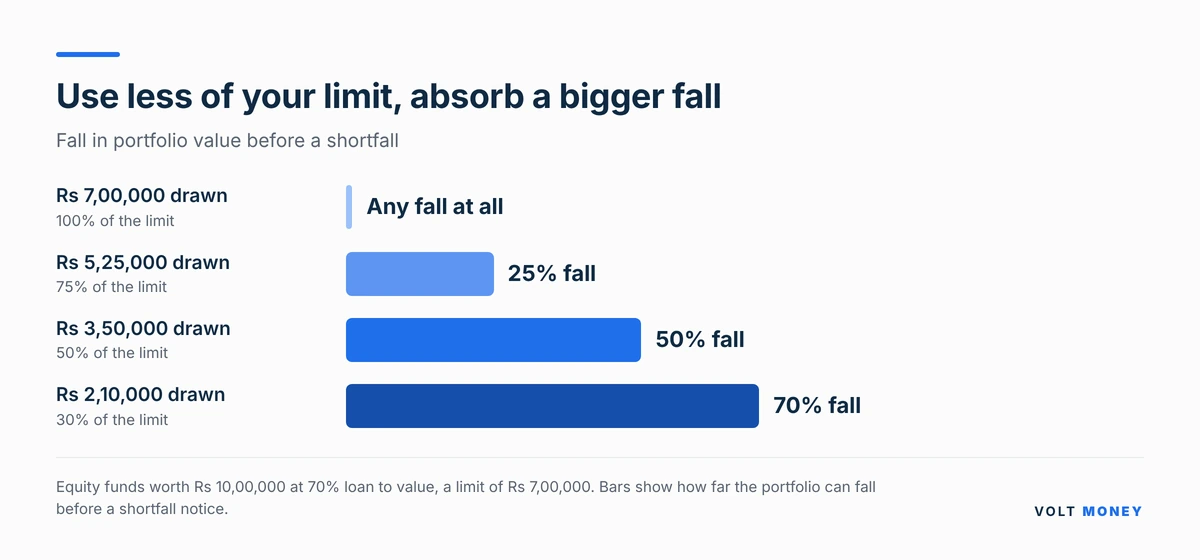
Sharp market falls are rare, but they happen. A borrower at half the limit can absorb a fall of up to half the portfolio's value. A borrower at the full limit gets a call on the first bad day.
Rule 3: keep something in reserve
A margin call is cleared in one of two ways: pledge more units or repay part of the balance. Both need something you have not already used.
Do not pledge every unit you own. Keep some funds unpledged. On Volt Money, additional pledging is instant, so spare units can be brought in within minutes if needed.
Keep your emergency fund separate. A credit line is not a replacement for three to six months of expenses in cash or a liquid fund. It is the layer after that.
Rule 4: pay the interest every month
Interest is debited from the bank account you linked when you opened the loan. Keep that account funded. Unpaid interest attracts penal charges, is reported to credit bureaus, and makes the balance harder to clear.
Paying on time is also the simplest answer to how to improve a CIBIL score. A secured line with a clean repayment record helps your credit history. A missed interest payment hurts it, and since July 2026 lenders report to bureaus four times a month, so it shows quickly.
Rule 5: set your own repayment schedule
There is no fixed EMI on the principal. That is useful when cash flow is uneven. It is also how a three-month loan becomes a three-year one.
The cost of drifting, on Rs 2,00,000 at 9.99%*:
| Repaid after | Interest paid |
|---|---|
| 90 days | About Rs 4,930 |
| 1 year | About Rs 19,980 |
| 3 years | About Rs 59,940 |
The rate did not change. Only time did. Set a standing instruction for a monthly part-payment, or tie repayment to specific dates such as salary credit or bonus month. There are zero foreclosure charges, so every early rupee saves interest.
Starting rate. Your rate depends on your portfolio and profile.
Rule 6: do not borrow to invest or trade
Borrowing against funds to buy more funds, shares or derivatives is leverage. If the market falls, your new purchase loses value and your collateral loses value at the same moment, and a margin call arrives when you are least able to meet it.
A return above 9.99% is possible in equities. It is not reliable over the one or two years a loan should run, and the interest is due whatever the market does.
Rule 7: choose what you pledge
- Pledge diversified funds before sector or small-cap funds. Their value swings less, so your limit is steadier.
- Use debt and liquid funds where you have them. They carry 85% loan to value and barely move.
- Leave alone any fund you plan to redeem soon. A lien blocks redemption and switching.
- Keep your SIPs running. Pledging does not stop them.
- ELSS units in their 3-year lock-in cannot be pledged at all.
Rule 8: read the Key Facts Statement
Before your first withdrawal you accept a Key Facts Statement and a loan agreement. Find four things in them:
- The annual percentage rate, which includes fees.
- The lender's name.
- Penal charges and what triggers them.
- How long you have to clear a shortfall before units can be redeemed.
The regulatory background is in RBI guidelines for loans against mutual funds and shares.
Rule 9: release what you no longer need
Repaying does not unpledge your units by itself. The lien stays so the credit line remains available for the full 6 years. That is convenient if you expect to borrow again.
If you do not, ask for the units to be unpledged. It is instant and free of charge. Units that are free can be redeemed, switched or rebalanced, and an unused limit is no longer a temptation.
One more piece of housekeeping: tell your family the loan exists, and keep your fund nominations current.
A responsible borrower and a careless one
Two people each hold Rs 10,00,000 in equity funds and get a Rs 7,00,000 limit. Each needs Rs 3,00,000.
Asha draws Rs 3,00,000 for her daughter's college fee, due two and a half months before her bonus. She pays interest monthly and repays in full on day 75. Interest: about Rs 6,160. The market fell 12% in between. Her limit dropped to Rs 6,16,000, still double what she owed. She unpledges after repaying.
Vikram draws Rs 3,00,000 for a holiday, then Rs 2,50,000 for a phone and furniture, then Rs 1,50,000 to buy more of a small-cap fund. He is at Rs 7,00,000, his full limit, with no repayment date. The same 12% fall cuts his limit to Rs 6,16,000. He has a shortfall of Rs 84,000, no spare units, and interest of about Rs 5,830 a month. To clear the shortfall he reaches for a credit card.
Same product, same rate, same market. The difference is rules 1, 2, 5 and 6.
Warning signs you are heading for a debt trap
- You have drawn more than 75% of your limit.
- The balance has not fallen in six months.
- You are drawing from the line to pay its own interest, or to pay other EMIs.
- You do not know your current outstanding without looking it up.
- A 15% market fall would cause a shortfall you could not cover.
If two of these are true, stop drawing and make a repayment plan this week. If repayment is already difficult, read what happens if you cannot repay a loan against mutual funds and speak to the lender early. Selling some units yourself, on your terms, is usually better than a forced redemption.
When not to use a loan against mutual funds
- You need the money for ten years or more. A home loan top-up or a loan against property suits long tenures better.
- You have no repayment source. Selling part of the portfolio is the cleaner answer.
- The portfolio is your only safety net and it is small.
- You already struggle with other debt.
A fuller list of downsides is in disadvantages of a loan against mutual funds.
What makes responsible use easier on Volt Money
- Pay only for what you use. Interest only on the utilized amount, only for the duration used, calculated daily.
- Zero foreclosure charges. Nothing discourages early repayment.
- Instant additional pledging to restore headroom, and instant unpledging, free of charge, when you are done.
- High limits that let you stay low. 70% loan to value on equity funds, an industry first and the industry's highest, and 85% on liquid and debt funds, across over 9,000 approved funds. A higher limit means the same borrowing uses a smaller share of it.
- A fully digital account. Instant eligibility check and pledging, loan account opened in under 10 minutes, and instant withdrawals, 24/7.
- No minimum credit score and no income proof are required. The eligibility check is a soft bureau check, so it leaves no mark on your score.
Important notes
- This article is for educational purposes only and is not financial advice.
- Mutual fund investments are subject to market risk. The value of pledged units can rise and fall, and a fall can mean you are asked to add units or repay part of the balance.
- Past market falls are mentioned for illustration and do not predict future movements.
- Interest rates, loan to value limits, fees and eligibility depend on your portfolio and profile. Your final terms are set out in the Key Facts Statement and the loan agreement you accept before drawdown.
Know your limit, then plan to use half of it.
Check your credit limit on Volt Money. Free, takes 15 seconds.
Your loan is made by an RBI-regulated lending partner, a bank or NBFC, named in the Key Facts Statement and the loan agreement you accept before drawdown.


