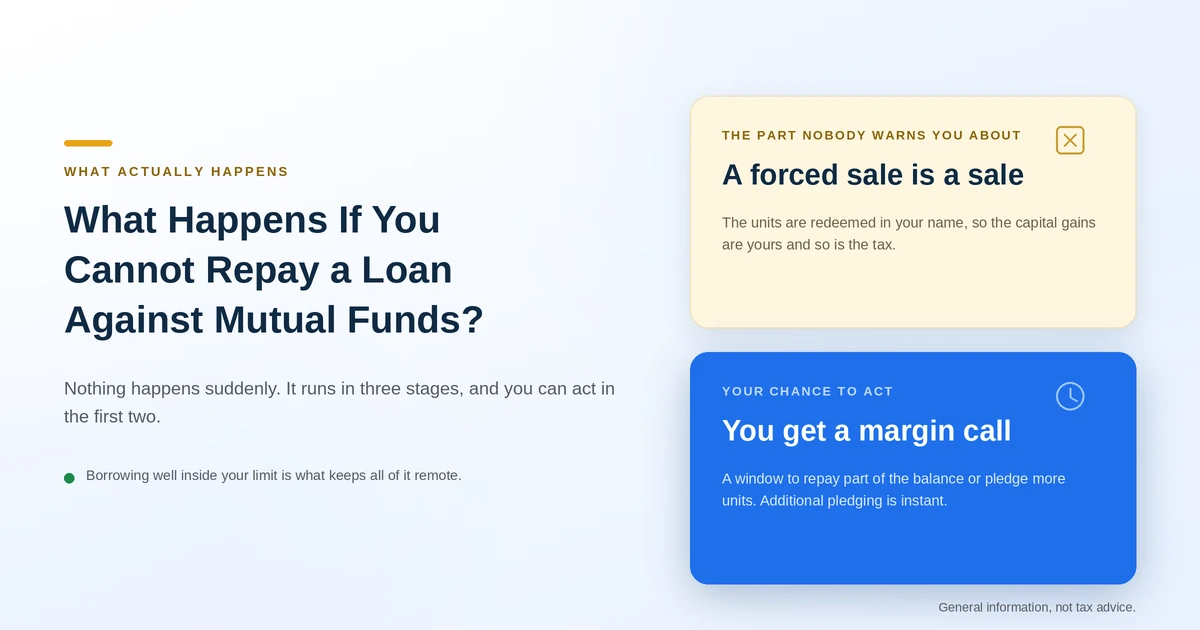
The part that surprises people: a forced sale is still a sale, so it can trigger capital gains tax in your hands.
Most articles about borrowing against your investments stop at the good part. This one is about the bad part, because it is the thing worth understanding before you draw, not after.
It happens in stages, not all at once
A loan against mutual funds does not go from fine to forced sale in a single step. There are three stages, and you have room to act in the first two.
Stage 1: your limit falls
Pledged units are revalued daily against the latest NAV. When the market falls, your sanctioned limit falls with them. Nothing is required of you at this point, and nothing happens, as long as your drawn balance stays comfortably below the new limit.
This is the stage most borrowers never notice, and it is also the stage where the outcome is already being decided. If you drew a small fraction of your limit, a falling market simply eats into headroom you were not using. If you drew close to the ceiling, the same fall starts a clock.
Stage 2: the margin call
If your drawn balance approaches the agreed LTV on the revalued collateral, the lender asks you to restore the cushion. You have two straightforward ways to do it:
- Repay part of what you have drawn: bringing the balance back below the limit
- Pledge more units: which lifts the collateral value rather than reducing the debt. On Volt Money additional pledging is instant, which matters when you are working to a deadline
You get a window to do this. The exact length is set out in the loan agreement and the Key Facts Statement you accepted when the account opened, so it is worth knowing your own before you need it rather than reading it under pressure.
A margin call is not a default. It is a request, and meeting it ends the matter with no lasting consequence.
Stage 3: the lender can sell pledged units
If you do neither within the window, the lender can invoke the pledge and sell enough of your pledged units to bring the loan back within limit. Three things about that are worth stating plainly.
- How much gets sold: Only as much as is needed to close the shortfall. It is not a liquidation of everything you hold, and unpledged units are not touched.
- At what price: At the market price on the day. That day is usually a falling one, because a falling market is what caused the situation, so the units go at a poor price.
- How it happens: The lien is enforced by the depository or the registrar on the lender's instruction. You do not get to choose which units go.
This is the outcome the whole product is designed to help you avoid, because selling in a falling market is exactly what borrowing instead of redeeming was supposed to prevent.
The part nobody warns you about: a forced sale is still a taxable sale
Check your credit limit on Volt Money. Free, takes 15 seconds.
Check your limit →If the lender sells your pledged units, that is a redemption in your name. The capital gains are yours, and so is the tax on them, in the year the sale happens.
So a forced sale costs you three times over. You sold at a bad price. You realised gains you were not planning to realise, and owe tax on them. And you lost the compounding on units you intended to keep. Not selling was the entire point of the loan, and a margin call you do not meet undoes it completely.
The tax treatment of a redemption does not change because someone else initiated it. Capital gains tax on mutual funds sets out the rates that would apply.
What it does to your credit record
There is no minimum credit score and no CIBIL check to obtain a loan against mutual funds on Volt Money, because the loan is secured against your units. That is about getting the facility, not about what happens afterwards.
Your repayment conduct on the facility can be reported like any other credit account. A default serious enough for a lender to invoke the pledge is a serious event on any record, and it is the kind of thing that shows up when you next apply for credit elsewhere. Borrowing well inside your limit is what keeps that remote.
Volt Money is a platform, and the rates and limits shown are provided by its RBI-regulated lending partners.
How far your funds can fall before a call
Ritu pledges Rs 10 lakh of equity funds. At 45% LTV her limit is Rs 4.5 lakh. What happens next depends entirely on how much of it she uses.
| If she draws | Her collateral can fall to | That is a fall of | What it takes |
|---|---|---|---|
| Rs 4.2 lakh | Rs 9.33 lakh | about 7% | one bad fortnight |
| Rs 3.2 lakh | Rs 7.11 lakh | about 29% | a serious correction |
| Rs 2 lakh | Rs 4.44 lakh | about 56% | a market event, not a market week |
Same fund, same LTV, same lender. The only variable is the draw. This is why the single most useful habit in borrowing against equity is to treat your limit as a ceiling you stay well under, rather than a target.
How to avoid all of this
- Draw well inside your limit. Everything above is a function of that one decision.
- Keep some of your portfolio unpledged, so you have units available to add if you are asked.
- Know your window before you need it. It is in the loan agreement and the Key Facts Statement.
- Act on the margin call rather than waiting to see whether the market recovers. Additional pledging is instant, so meeting it can take minutes.
- Repay early if the need has passed. There are zero foreclosure charges, so there is nothing stopping you clearing the balance the moment you no longer need it.
What if you simply want out?
Repaying in full and closing the facility is always available, at any point in the 6-year term, with no foreclosure charge. Note that repaying does not automatically release the lien, because the facility is a credit line you can draw from again. Units are unpledged when you request it, and on Volt Money that is instant and free of charge.
If you are weighing whether to take one of these at all, the disadvantages of a loan against mutual funds covers the full picture, and how LTV and margin calls work explains how the limit is calculated in the first place.
Want to see your limit before you decide how much to draw?
Check your credit limit on Volt Money. Free, takes 15 seconds. Check your credit limit