The rules for borrowing against financial assets changed more in the past year than in the decade before it. This guide sets out what is in force in October 2026, in plain language, and what it means when you pledge your units.
Who regulates what
Three bodies are involved in a loan against mutual funds, and it helps to know which does what.
| Body | What it controls |
|---|---|
| RBI | The lender: banks and NBFCs. Loan to value limits, disclosure, fair practices, digital lending and credit bureau reporting |
| SEBI | The mutual fund: fund houses, registrars and the rules on nomination and transmission |
| Registrars (CAMS and KFintech, also reachable through MFCentral) | The lien itself: recording it against your units and removing it |
A platform such as Volt Money is not the lender. Your loan is made by an RBI-regulated lending partner, a bank or NBFC, which is named in the Key Facts Statement and the loan agreement. See is Volt Money safe.
RBI guidelines for banks: the 2026 rules
Check your credit limit on Volt Money. Free, takes 15 seconds.
Check your limit →RBI rewrote its rules on bank lending against financial assets in 2026. The amended Commercial Banks (Credit Facilities) Directions took effect from 1 July 2026. Loans sanctioned earlier continue on their original terms until maturity.
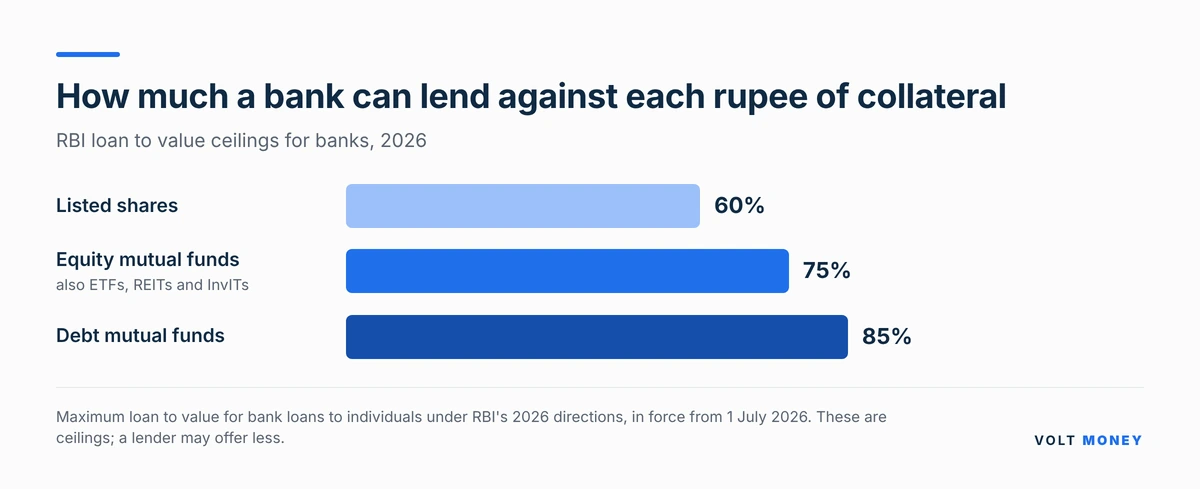
Loan to value ratio ceilings for individuals
| Collateral | Maximum LTV at banks |
|---|---|
| Listed shares | 60% |
| Equity and other non-debt mutual funds, ETFs, REITs and InvITs | 75% |
| Debt mutual funds | 85% |
Other points in the bank rules:
- Valuation. Collateral is valued at the lower of the previous day's NAV or price and the six-month average.
- Overall cap. An individual can borrow up to Rs 1 crore across the banking system against shares, equity funds and similar securities. The earlier limit on loans against shares was Rs 20 lakh. Debt mutual funds sit outside this cap; banks set their own limits for them.
- Share purchase finance. Within that, up to Rs 25 lakh can fund purchases in the secondary market. Financing for IPOs, follow-on offers and ESOPs is capped at Rs 25 lakh per person with a 25% margin from the borrower.
- Lock-ins. Banks cannot lend against securities that are under any lock-in.
- End use. Banks are expected to monitor what the money is used for.
RBI guidelines for NBFCs
NBFCs are governed by RBI's NBFC (Credit Facilities) Directions, 2025.
- 50% LTV on listed shares. NBFCs with assets of Rs 100 crore or more must keep a loan to value ratio of 50% when lending against listed shares.
- Seven working days. A shortfall caused by a fall in share prices must be made good within seven working days.
- Approved securities. For capital market loans above Rs 5 lakh, only Group 1 securities are accepted as collateral.
The 50% rule is written for listed shares. Mutual fund units are not named in it, so the loan to value ratio on fund units is set by each NBFC's own board-approved policy. This is why LTV on the same equity fund differs from lender to lender, and why loans against funds are often available at a higher LTV than loans against individual shares. A diversified fund is less volatile than a single stock.
The LTV ratio and the seven-day rule, with numbers
LTV is the loan outstanding divided by the current value of the collateral. It is checked continuously, not only on the day you borrow.
Meera pledges equity funds worth Rs 10,00,000. Her lender's LTV is 70%, so her limit is Rs 7,00,000. She draws Rs 6,00,000.
| Event | Portfolio value | Limit at 70% | Drawn | Position |
|---|---|---|---|---|
| Day she borrows | Rs 10,00,000 | Rs 7,00,000 | Rs 6,00,000 | Rs 1,00,000 of headroom |
| Market falls 10% | Rs 9,00,000 | Rs 6,30,000 | Rs 6,00,000 | Rs 30,000 of headroom |
| Market falls 20% | Rs 8,00,000 | Rs 5,60,000 | Rs 6,00,000 | Shortfall of Rs 40,000 |
At a 20% fall she receives a shortfall notice, often called a margin call. She can clear it in either of two ways:
- Repay Rs 40,000. The drawn amount falls to Rs 5,60,000.
- Pledge more units. She needs additional equity units worth about Rs 57,150, because 70% of that is Rs 40,000.
If she does neither within the time her lender allows, the lender can redeem enough pledged units to close the gap. The exact timeline is in her loan agreement. RBI's reference period is seven working days, for bank loans against shares and mutual funds and for NBFC loans against listed shares.
Had she drawn Rs 3,50,000, half her limit, the portfolio would need to fall 50% before any shortfall arose.
The Key Facts Statement
Since 1 October 2024, every retail and MSME loan from a bank or NBFC must come with a Key Facts Statement, or KFS, before you accept the loan. It is a standard, one-look summary containing:
- The annual percentage rate (APR), which folds interest and fees into a single yearly figure.
- Every fee and charge, including processing fees and penal charges.
- The repayment terms.
- The name of the lender and how to raise a grievance.
A charge that is not in the KFS cannot be levied without your explicit consent. On Volt Money you accept the KFS and the loan agreement as a step before your first withdrawal. Read both.
Digital lending rules
Most loans against mutual funds are now taken through an app or website, so RBI's digital lending rules apply:
- Money moves directly. The loan is disbursed from the lender straight to your own bank account, and repayments go straight back to the lender. A platform does not hold your money in between.
- Cooling-off period. You have a window of at least one day to exit a digital loan by repaying the principal and the proportionate cost, without a penalty.
- KFS before disbursal. As above.
- Named lender and grievance officer. You must be told who the lender is and whom to contact.
Charges RBI restricts
- No penal interest. For new loans since 1 April 2024, and for all loans since mid-2024, a lender can levy a penal charge for a default but cannot add it to the interest rate or charge interest on it.
- No prepayment charge on floating-rate personal borrowing. For loans sanctioned or renewed from 1 January 2026, lenders cannot charge individuals for prepaying a floating-rate loan taken for non-business purposes, and must allow prepayment without a minimum lock-in.
Credit bureau reporting
A loan against mutual funds is a credit facility and appears in your credit report. From 1 July 2026, lenders report to credit bureaus four times a month, so a missed payment shows up within days, and so does a repayment.
Checking your eligibility is different from borrowing. On Volt Money, no minimum credit score and no income proof are required. The eligibility check is a soft bureau check, so it leaves no mark on your score.
Rules that come from SEBI and the fund registrars
Lien marking. The lender sends a lien request to the registrar. You approve it with an OTP. From then, those units cannot be redeemed or switched until the lien is removed. They stay in your name and keep growing. See lien marking in mutual funds.
Only the lender can release the lien. The registrar removes it on the lender's instruction. On Volt Money, unpledging is instant and free of charge once you request it.
ELSS. Tax-saving fund units cannot be pledged during the 3-year lock-in.
Demat units. Funds held in a demat account are pledged through the depository instead of the registrar.
What the rules mean for you: a borrower's checklist
- Find the lender's name. It must be a bank or an RBI-registered NBFC, and it must appear in the KFS.
- Read the APR, not just the rate. The APR includes fees.
- Check the LTV for your fund type and decide how far below the limit you will stay.
- Find the shortfall timeline in the loan agreement.
- Look for penal charges and the conditions that trigger them.
- Confirm foreclosure terms.
- Make sure money comes from and goes to the lender directly.
How Volt Money's loan against mutual funds fits these rules
- Loans from Rs 10,000 up to Rs 5 crore against over 9,000 approved funds.
- 70% loan to value on equity funds and 85% on liquid and debt funds.
- A 6-year credit line. Interest only on the utilized amount, only for the duration used, calculated daily. Repay the withdrawn amount any time within 6 years.
- A fully digital journey: instant eligibility check and pledging, loan account opened in under 10 minutes, KYC by OTP through DigiLocker, and instant withdrawals, 24/7, to your own bank account.
- Instant additional pledging if you need more headroom, and instant unpledging, free of charge.
- Interest starts at 9.99% p.a.* The processing fee starts from Rs 999, and there are zero foreclosure charges.
Starting rate. Your rate depends on your portfolio and profile.
Important notes
- This article is for educational purposes only and is not legal or financial advice. It summarises RBI directions as understood in October 2026. Regulations change; the lender's Key Facts Statement and loan agreement set out the terms that apply to you.
- Regulatory LTV ceilings are maximums. A lender may offer less.
- Mutual fund investments are subject to market risk. The value of pledged units can rise and fall, and a fall can mean you are asked to add units or repay part of the balance.
- Interest rates, loan to value limits, fees and eligibility depend on your portfolio and profile.
See what your portfolio supports.
Check your credit limit on Volt Money. Free, takes 15 seconds.
Your loan is made by an RBI-regulated lending partner, a bank or NBFC, named in the Key Facts Statement and the loan agreement you accept before drawdown.