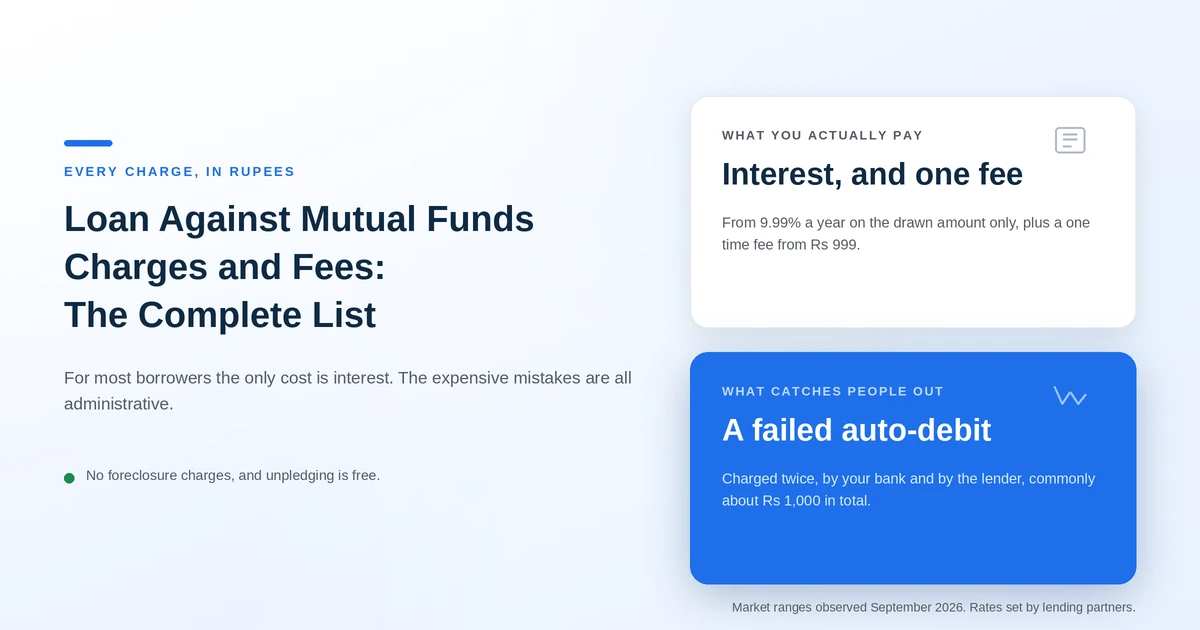
The charges that catch people out sit on the monthly interest auto-debit. If it fails you are charged twice, by your own bank and by the lender, commonly around Rs 1,000 between them, and penal charges run on the overdue amount until it is cleared.
Every charge on a loan against mutual funds
| When | Charge | What the market does | Volt Money |
|---|---|---|---|
| Checking eligibility | Nothing | Free at every serious lender | Free, and it is a soft bureau check, so it leaves no mark on your score |
| At sanction | Processing fee | Commonly Rs 999, or 1% of the loan subject to a cap, plus 18% GST | From Rs 999, one time |
| At sanction | Stamp duty on the agreement | A few hundred rupees, set by the state, not the lender | Per the Key Facts Statement |
| At sanction | Pledge or lien marking | Nil on units held in statement form. Small per-security charges on demat units | Instant. Volt charges nothing to pledge; depository per-security charges apply on demat units |
| Every month | Interest | Charged on the drawn balance, not the sanctioned limit, if the lender runs a true line | From 9.99% p.a.*, calculated daily on the withdrawn amount only |
| Every month | The NACH auto-debit itself | No charge for a debit that succeeds | No charge for a debit that succeeds |
| If a debit fails | Your bank's return charge | Rs 250 to Rs 550 per instance | Set by your bank, not by Volt |
| If a debit fails | The lender's bounce charge | Rs 500 to Rs 1,200 per instance | Per the Key Facts Statement |
| While overdue | Penal charges | A charge on the overdue amount. Penal interest is no longer permitted on loans | Per the Key Facts Statement |
| Any time | Repaying early | Nil on a credit line | Zero foreclosure charges |
| Any time | Releasing your units | Some lenders charge around Rs 500 plus tax per request | Instant unpledging, free |
| Yearly | Renewal or line maintenance | Some lenders charge an annual renewal fee of about Rs 999 | Per the Key Facts Statement |
| Only on default | Invocation, collection and legal costs | Rs 2,000 to Rs 5,000 a head at some lenders, or at actuals | Per the Key Facts Statement |
Starting rate. Your rate depends on your portfolio and profile.
Interest, and why it is usually the only cost you pay
Check your credit limit on Volt Money. Free, takes 15 seconds.
Check your limit →Interest on a credit line is not charged the way interest on a loan is charged. There is no EMI schedule and no amortisation table. The lender looks at what you owe at the end of each day, applies one day's interest to that number, and bills you the total once a month.
Two consequences follow, and both of them save money.
- You pay only on what you draw. A sanctioned limit you have not touched costs nothing. Interest is on the utilised amount, not the sanction.
- You pay only for the days you use. Repay on the ninth day and you have paid nine days of interest, not a month of it. A personal loan would have charged you the full month.
The arithmetic, on a sanctioned limit of Rs 7,00,000:
| What you do | What you owe interest on | Interest at 9.99% p.a. |
|---|---|---|
| Draw nothing all year | Rs 0 | Rs 0 |
| Draw Rs 2,00,000 and hold it for 30 days | Rs 2,00,000 for 30 days | About Rs 1,642 |
| Draw Rs 2,00,000 and repay after 9 days | Rs 2,00,000 for 9 days | About Rs 493 |
| Draw Rs 2,00,000 and hold it for a full year | Rs 2,00,000 for 365 days | Rs 19,980 |
A personal loan for the same Rs 2,00,000 at 18% p.a. would cost about Rs 6,030 in interest over three months, and most lenders will not write a personal loan for a duration that short at all. Personal loan rates in India run from roughly 10% to 24% p.a., with most borrowers landing between 12% and 18%.
The one-time processing fee
This is the setup fee for opening the loan account. It is charged once, at sanction, not every time you withdraw. At Volt Money it starts at Rs 999.
Read the structure, not just the number. A fee quoted as a percentage of the sanctioned limit behaves very differently from a flat fee, and which one is cheaper flips depending on the size of your line. A fee of 1% subject to a cap of about Rs 5,000 beats a flat Rs 999 on a small line and loses badly on a large one.
Processing fees attract 18% GST. A Rs 999 fee costs Rs 1,179 all in.
What the NACH mandate is and what it collects
NACH stands for National Automated Clearing House. It is the system, run by NPCI, that lets an organisation collect a recurring payment from your bank account automatically. A mandate is the standing permission you give for those debits, capped at an amount and a validity you agree to up front. eNACH is the same thing registered online with net banking, a debit card or Aadhaar, usually live within a working day, against several days for a paper mandate.
On a loan against mutual funds the mandate is not collecting an EMI, because there isn't one. It collects the monthly interest on whatever you have drawn. That is the whole job. If you have drawn nothing, there is nothing to collect and the mandate sits idle.
Registering a mandate is generally free. ICICI Bank, to take one bank that publishes its schedule, lists ECS and NACH setup charges as nil and one-time physical mandate authorisation charges as nil. Where a bank does charge for registration or verification it is usually a small one-off in the region of Rs 50 to Rs 200 plus GST.
The distinction that trips people up
A NACH mandate charge is a charge for setting up or servicing the instruction.
A NACH return charge is a penalty for a debit that failed.
They are unrelated, they are usually levied by different parties, and only the second one is expensive. Most people searching for NACH mandate charges have actually been hit by the second.
What a failed auto-debit really costs
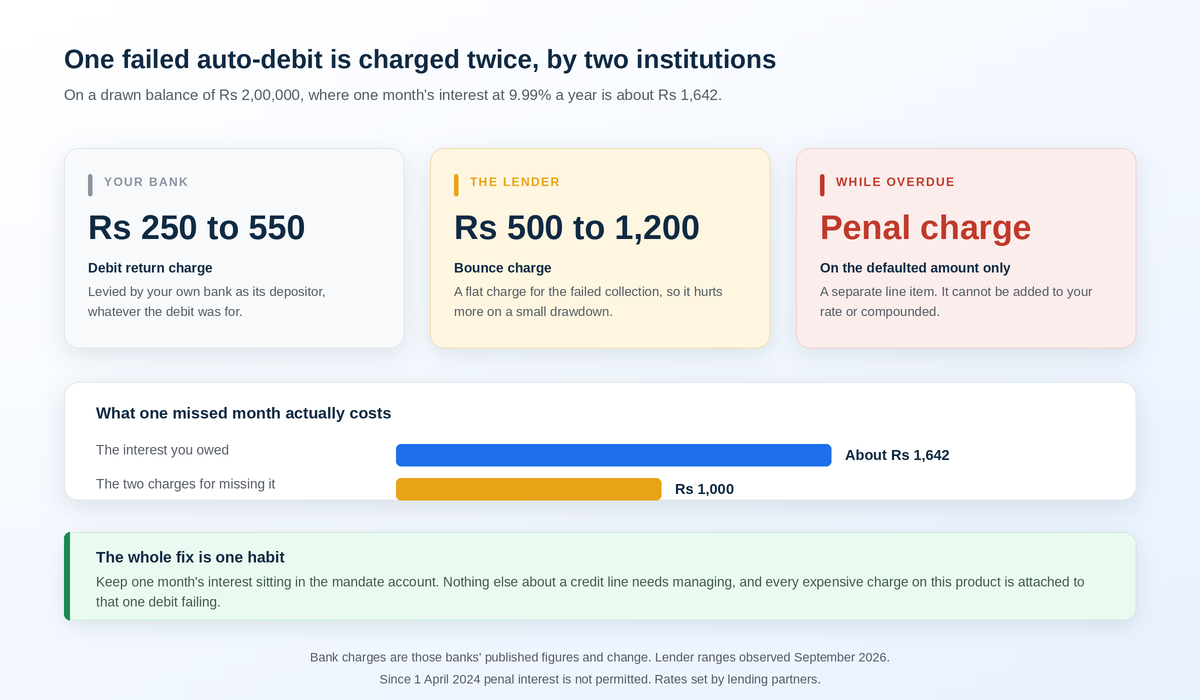
This is the part no ranking page states plainly, so here it is. A single failed monthly debit is charged twice, by two different institutions, for two different reasons.
Your own bank charges you for returning the debit.
This is a fee your bank levies on you as its depositor. It has nothing to do with the lender. Published figures from the banks' own schedules:
| Bank | ECS / NACH debit return charge | Source |
|---|---|---|
| ICICI Bank | Rs 500 per instance for financial reasons, and no more than three instances a month are recovered for the same mandate (w.e.f. 1 May 2024) | Bank's own service charges schedule |
| Bank of Baroda | Around Rs 150 to Rs 750 per failed transaction, exclusive of GST | Bank's own customer article |
Two things worth noticing. ICICI caps recovery at three instances a month for the same mandate, the kind of detail that only appears in the schedule itself. And these are savings account charges, so they apply whether the failed debit was a loan, a SIP or an insurance premium. Other large banks publish figures in broadly the same territory, but the spread is wider than it looks, so check your own bank's schedule rather than a comparison table.
The lender charges you a bounce charge.
Separately, the lender levies its own charge for the failed collection. Across the loan against mutual funds and loan against securities market this runs from about Rs 500 to about Rs 1,200 per instance. It is a flat charge, not a percentage, so it hurts far more on a small drawdown than a large one.
Put together, on a real drawdown:
| Line | Amount |
|---|---|
| Drawn balance | Rs 2,00,000 |
| One month's interest at 9.99% p.a. | About Rs 1,642 |
| Your bank's return charge, say | Rs 500 |
| The lender's bounce charge, say | Rs 500 |
| Total cost of one bounced debit | Rs 1,000, on top of the interest you still owe |
A thousand rupees to miss a payment of Rs 1,642. That is the real economics of this product, and it is why the single most valuable habit on a credit line is keeping one month's interest sitting in the mandate account. Nothing else about the loan needs managing.
Penal charges, and the RBI rule that changed them
If the overdue amount stays overdue, penal charges start. These are governed by an RBI instruction that most published articles predate, and it is worth knowing because it gives you specific things to check.
In its Fair Lending Practice instruction of 18 August 2023, clarified on 29 December 2023 and in force for new loans from 1 April 2024, with existing loans switched over by 30 June 2024, the RBI abolished penal interest for regulated lenders. The operative rules are these:
- No penal interest. A penalty must be levied as a penal charge, a separate line item. It cannot be levied as penal interest added to the rate of interest on your loan.
- No capitalization. The lender cannot charge interest on a penal charge. The penalty cannot start compounding.
- Only on the defaulted amount. A penal charge applies to the defaulted amount, not to your whole outstanding balance.
- It must be in your KFS. The quantum and the reason must appear in the loan agreement, the sanction letter and the Key Facts Statement. A schedule buried on a website is not enough. A charge that does not appear in your KFS cannot be levied without your explicit consent, so if one shows up unannounced you are entitled to ask what you agreed to.
- Uniform, and not a revenue line. Penal charges cannot be higher for an individual borrower than for a company for the same breach, and they cannot be used as a revenue tool. Lenders must book them as other income, not interest income.
One thing the RBI did not prohibit, and this is the part people misread: the lender may still charge ordinary interest at your contracted rate on an unpaid amount. What it cannot do is dress that up as a higher rate or add a penal percentage on top of your rate.
Penal charges do not attract GST
Because a penal charge is compensation for a breach of contract rather than payment for a service, the CBIC clarified on 28 January 2025, following the 55th GST Council meeting, that no GST is payable on penal charges levied by banks and NBFCs in line with the RBI's 2023 instruction.
Ordinary fees are a different matter and do carry 18% GST: the processing fee, renewal fees, pledge charges. A return charge your own bank levies on you as its depositor is that bank's own call, so check how it appears on your statement.
Pledge and unpledge charges
What it costs to put your units under lien, and to get them out again, depends on how you hold them.
- Units held in statement form (SOA). Nothing is charged to mark the lien. The instruction goes through the registrar, CAMS, KFintech or MFCentral, and is authorised with an OTP.
- Units held in demat. The depositories levy small per-security charges to create and release a pledge, typically a few tens of rupees per security per leg. On a portfolio of a dozen holdings that adds up, which is a reason to pledge fewer, larger holdings rather than everything you own. Those charges are the same on any loan against demat mutual funds, because they are levied by CDSL and NSDL rather than by the lender.
Getting your units back is where lenders differ most. Some charge around Rs 500 plus tax for a release request. At Volt Money unpledging is instant and free, and so is pledging more units, which matters more than it sounds. It means adjusting your collateral is not a decision with a price attached to it.
Charges you should not be paying at all
- Foreclosure and prepayment charges. There are none on a credit line at Volt Money. Repay whenever you like within the six years.
- Checking your limit. Free, and it is a soft bureau check, so it does not mark your score.
- GST on interest. Interest is exempt. Only the fees are taxed.
Worth knowing even though it does not apply to a credit line: from 1 January 2026 the RBI's Pre-payment Charges on Loans Directions, 2025 bar lenders from charging pre-payment or foreclosure fees on floating rate loans taken by individuals for non-business purposes, on any loan sanctioned or renewed from that date. There is no lock-in period and it does not matter where the money came from. If you are carrying an older loan elsewhere, that rule is worth checking.
Default charges: invocation, collection and legal costs
If a loan goes into default and the lender has to act, a further set of charges exists. You will find them at the bottom of any schedule of charges. Across this market they look like invocation charges of a couple of thousand rupees, and collection or legal costs of several thousand or at actuals, on top of the stamp duty and depository fees of actually selling the units.
The reason to read them is not that you expect to pay for them. It is that a lender's default charges tell you how the product is really priced, and a schedule that hides them is telling you something too.
What a full year of borrowing costs: a worked example
Rahul has Rs 12,00,000 in equity mutual funds. At 45% LTV his sanctioned line is Rs 5,40,000. He draws Rs 3,00,000 in April for his daughter's admission fees, repays Rs 1,00,000 in September and clears the rest in March. He never misses an interest debit.
| Item | Working | Cost |
|---|---|---|
| Processing fee | One time, Rs 999 plus 18% GST | Rs 1,179 |
| Interest, April to September | Rs 3,00,000 for about 150 days at 9.99% | About Rs 12,316 |
| Interest, September to March | Rs 2,00,000 for about 180 days at 9.99% | About Rs 9,853 |
| Foreclosure charge on clearing early | Zero foreclosure charges | Rs 0 |
| Unpledging the units afterwards | Instant unpledging, free | Rs 0 |
| Total cost of borrowing across the year | About Rs 23,350 |
Now change one thing. Rahul's salary lands late in August and the interest debit bounces. His bank charges Rs 500 and the lender charges Rs 500. One month's inattention costs him about twelve days of interest on the whole Rs 3,00,000.
That is the honest summary of charges on this product. The headline numbers are small and predictable, and the expensive mistakes are all administrative.
Interest only on what you use, from 9.99% p.a.
Check your credit limit on Volt Money. Free, takes 15 seconds. Check your credit limit
How to read any lender's schedule of charges in two minutes
- Find the bounce charge and the penal charge. These are the two numbers that decide what a bad month costs, and they belong in your Key Facts Statement, not in a PDF you have to hunt for. You should be able to read both before you accept the loan, not after a debit has failed.
- Check whether interest is on the drawn amount or the sanctioned limit. This is the biggest single difference between a real credit line and a term loan wearing one as a costume.
- Look for an annual renewal or maintenance fee. Some lenders charge one every year the line stays open, whether or not you drew anything.
- Check what it costs to get your units back. Release charges are easy to miss and you will pay them exactly when you least want to.
- Read the default block at the bottom. Invocation, collection and legal charges. Not because you expect to pay them, but because they tell you how the lender thinks.
- Confirm all of it appears in your Key Facts Statement. Under the RBI's rules a charge that is not disclosed in the sanction letter, loan agreement or KFS cannot be levied without your explicit consent.
Important notes
- This article is for educational purposes only and is not financial advice.
- Third-party bank charges cited here are those banks' own published figures, taken from their schedules of charges as at September 2026. They change. Confirm the current number in your own bank's schedule of charges before relying on it.
- Charges levied by other lenders are given as market ranges observed on published schedules of charges in September 2026, not as any particular lender's current pricing.
- Mutual fund investments are subject to market risk. The value of pledged units can rise and fall, and a fall can mean you are asked to add units or repay part of the balance.
- Interest rates, loan to value limits, fees and eligibility depend on your portfolio and profile. Your final terms are set out in the Key Facts Statement and the loan agreement you accept before drawdown, which also name the lending partner.
Your loan is made by an RBI-regulated lending partner, a bank or NBFC, named in the Key Facts Statement and the loan agreement you accept before drawdown.