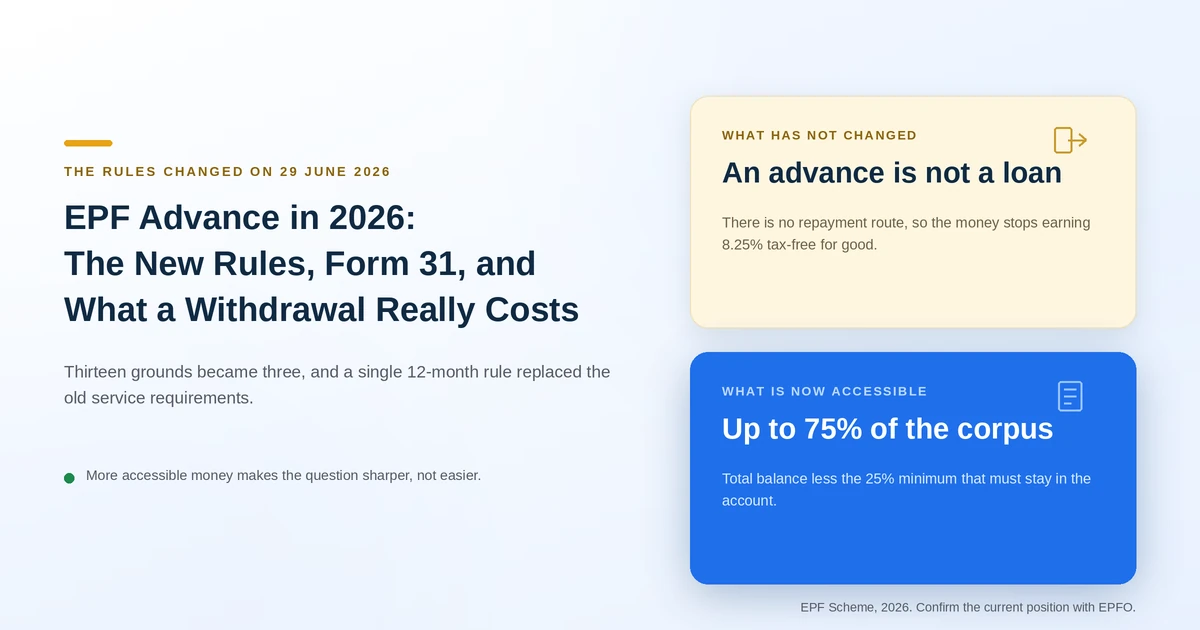
You can now access up to your eligible member balance, which is your total balance less a minimum 25% that must remain in the account. In practice that means up to 75% of the corpus, employer share included, while you are still in service.
That is a lot more accessible money than before, which makes the question sharper rather than easier. An EPF advance is not a loan. It cannot be repaid, and the money stops earning 8.25% tax-free for the rest of your working life. For a short, repayable need, borrowing against another asset usually costs a fraction of what the withdrawal costs.
These rules changed on 29 June 2026
If you have looked into an EPF advance before, the framework you know is probably the older one: 13 separate grounds, different service requirements for illness, marriage, education and housing, and limits expressed as a number of months of basic wages plus dearness allowance.
That framework was replaced on 29 June 2026, when the EPF Scheme, 2026 was published in the Gazette of India (G.S.R. 525(E)). It applies immediately, with no transition period for existing members.
What changed on 29 June 2026
Check your credit limit on Volt Money. Free, takes 15 seconds.
Check your limit →| Feature | Before (EPF Scheme, 1952) | Now (EPF Scheme, 2026) |
|---|---|---|
| Grounds for withdrawal | 13 separate grounds, each with its own conditions | Three categories: Essential Needs, Housing Needs, Special Circumstances |
| Minimum service | Varied by ground, from none to 10 years | A single 12-month membership requirement across all categories |
| How much | Capped as months of basic wages plus DA, or a share of the employee contribution | Up to the eligible member balance: total balance less a 25% minimum that must stay in |
| Whose contribution | Several grounds were limited to the employee's share | The eligible balance includes both employee and employer contributions with interest |
| Documentation | Purpose-specific proof for most grounds | Largely self-declared, enabling auto-settlement of eligible claims |
| Frequency | Effectively once or twice for most grounds | Capped per category, and all counters reset from the commencement of the 2026 scheme |
The three withdrawal categories
Essential Needs. Illness, education and marriage. Education claims are permitted up to 10 times and marriage up to 5 times over the life of the account. Illness is not capped by frequency.
Housing Needs. Purchase or construction of a house, purchase of a residential plot, repayment of a home loan, and renovation or improvement. Permitted up to 5 times.
Special Circumstances. Natural calamities, unemployment and other situations notified by the Central Board of Trustees. Permitted up to twice a year, and no reason or documentation is required.
All of those frequency counters reset afresh for every member from the date the 2026 scheme commenced, so past withdrawals under the old scheme do not count against you.
Eligible member balance: the number that decides how much you get
This is the mechanism that replaced the old months-of-wages formulas, and it is simpler than what it replaced.
- Minimum balance. 25% of the total contributions to your credit, employee share and employer share with interest, up to the date of withdrawal. This must remain in the account after any partial withdrawal.
- Eligible member balance. Total balance less that 25%. This is what you can draw.
On an EPF corpus of Rs 8,00,000, the minimum balance is Rs 2,00,000 and the eligible member balance is Rs 6,00,000. The minimum withdrawal is Rs 1,000. On job loss, 75% is available on verified unemployment, with the remaining balance accessible after 12 months of continuous unemployment.
Is Form 31 still the way to claim?
Yes. Form 31 remains the advance or partial withdrawal claim on the EPFO member portal, and the process is unchanged in shape even though the underlying rules are not.
- Log in at the EPFO member portal with your UAN and password.
- Go to Online Services, then Claim. Form 31 is the advance or partial withdrawal option, distinct from Form 19 for final settlement and Form 10C for the pension component.
- Confirm your bank account. Enter the last four digits of the account seeded against your UAN for verification.
- Select the purpose and amount, then submit with Aadhaar OTP authentication.
- Track the claim. The scheme requires complete claims to be settled within 20 days, with penal interest at 12% per annum if EPFO delays without cause. In practice, fully KYC-compliant online claims settle far faster, and claims inside the Rs 5 lakh auto-settlement ceiling clear in days.
Your KYC has to be complete for any of this to work: Aadhaar linked and verified against the UAN, PAN seeded, and bank account verified by the employer.
Why Form 31 claims get rejected
Most rejections are clerical rather than substantive, and all of them are fixable before you file. Checking these takes a few minutes and saves a rejection cycle.
- Bank account not verified, or an IFSC that has changed after a bank merger. The commonest one. The account must be seeded against your UAN and approved by your employer, and the IFSC must match the branch currently holding it.
- Name mismatch between Aadhaar and the UAN. Your name on the UAN has to match your Aadhaar exactly, including initials and their placement. A mismatch fails the OTP authentication step.
- The wrong withdrawal reason selected. Selecting the wrong purpose against what your service record supports gets the claim returned. Pick the category that matches the reason you can evidence.
- Service history gaps. If your date of joining or date of exit is wrong or missing with a previous employer, the membership calculation fails. Get the employer to correct it first.
- Unmerged previous accounts. Old balances that were never transferred are not counted, and claiming against them fails. Transfer first, then claim.
EPFO 3.0, UPI and the PF ATM card: what is actually live
Instant PF withdrawal through UPI or from an ATM has had plenty of coverage. It is worth separating what has shipped from what has been announced, because the gap is wide.
- Live. Auto-settlement now runs up to Rs 5 lakh without manual review, and most claims no longer need employer attestation. This is the change that actually moved settlement times, and it is why a clean claim can clear in days rather than weeks.
- Announced, not yet live. Withdrawal through UPI and a dedicated PF ATM card. The Labour Minister confirmed UPI-based withdrawal had been tested successfully, and rollout was expected through mid-2026, but as at the time of writing both were still awaiting final operational guidelines, so neither is something you can use to fund a need this month.
If instant access is the reason you are considering a withdrawal at all, that is worth knowing before you plan around it. A credit line you already hold pays out today; a facility awaiting operational guidelines does not.
The tax rule that catches people
An EPF withdrawal is tax-free once you have five years of continuous service. Withdraw before that and the amount becomes taxable, and TDS applies at 10% where PAN is seeded and the amount crosses Rs 50,000. Service with different employers counts as continuous if the balance was properly transferred rather than settled, which is a good reason to transfer rather than withdraw when you change jobs.
The declaration form changed this year too. If your income is below the taxable limit and you want to avoid TDS on the withdrawal, the form is now Form 121, which replaced Forms 15G and 15H from 1 April 2026. The old split by age is gone: one declaration now covers everyone, and it has to be filed before you submit the withdrawal claim rather than afterwards.
What the withdrawal actually costs
EPF paid 8.25% for FY 2025-26, the third consecutive year at that rate, and it is tax-free after five years of service. There is no retail product that matches that combination. Money taken out of it does not come back, because an EPF advance has no repayment mechanism.
The arithmetic on a Rs 6,00,000 withdrawal
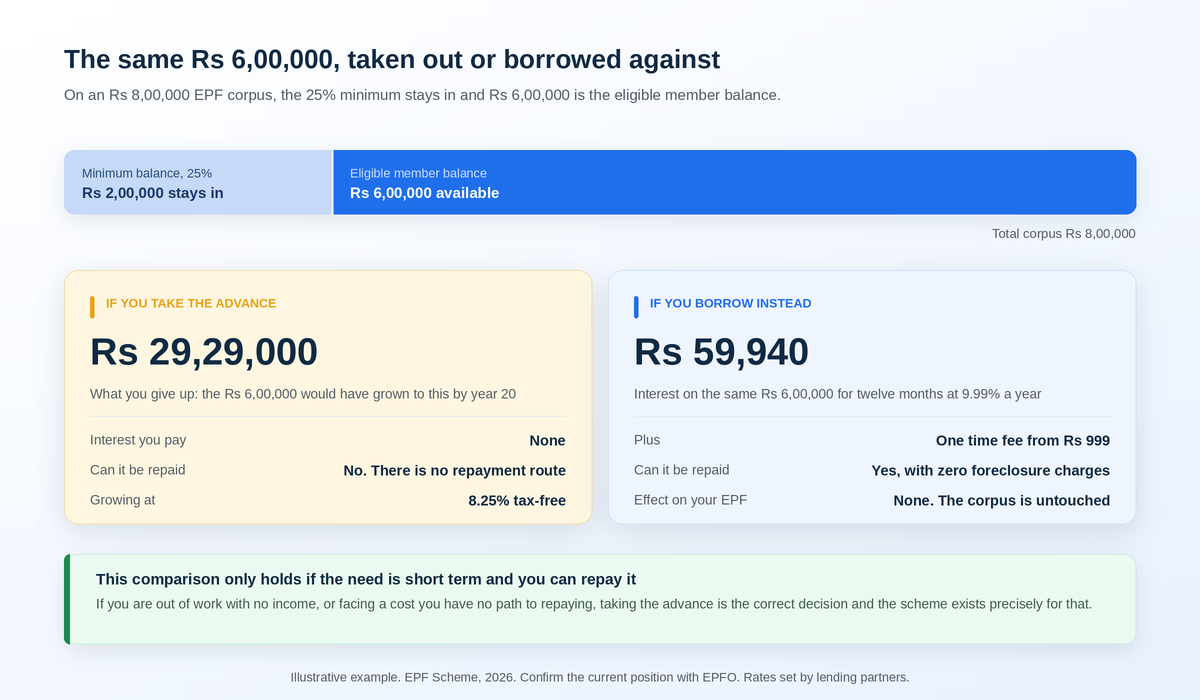
Left in the account, Rs 6,00,000 compounding at 8.25% for 20 years becomes roughly Rs 29,29,000.
Borrowing the same Rs 6,00,000 against mutual funds at 9.99% p.a.* for 12 months costs about Rs 59,940 in interest, plus a one-time setup fee from Rs 999 to open the line.
Roughly Rs 60,000 of interest to protect roughly Rs 29,00,000 of retirement corpus, if the need is genuinely short term and you can repay it.
That comparison only holds if the requirement is short term and repayable. If you are out of work with no income, or facing a medical cost you have no path to repaying, taking the advance is the correct decision and the scheme exists precisely for that. The comparison matters for the large middle case: a real but temporary shortfall, where an advance is simply the most visible option rather than the cheapest one.
Starting rate. Your rate depends on your portfolio and profile.
A loan against mutual funds leaves your EPF untouched
A loan against mutual funds pledges your units rather than redeeming them. A lien is recorded, a credit line opens against the collateral, and the units stay invested and keep growing throughout.
| Feature | EPF advance | Loan against mutual funds (Volt Money) |
|---|---|---|
| What it is | A permanent withdrawal. There is no repayment route | A 6-year credit line. Draw, repay, redraw |
| Eligibility | 12 months of EPF membership, one of three categories | Eligible mutual fund units. No purpose test |
| How much | Up to the eligible member balance, 75% of the corpus | 45% of equity funds, 85% of liquid and debt. Rs 10,000 to Rs 5 crore |
| Cost | No interest, but the money stops earning 8.25% tax-free permanently | From 9.99% p.a.*, charged daily on the drawn amount only |
| Effect on retirement | Permanent reduction in the corpus and in interest earned on it | None. The EPF corpus is untouched |
| Tax | Taxable if withdrawn before five years of continuous service | Borrowing is not a taxable event and triggers no capital gains |
| Speed | Online Form 31 claim, settled within the scheme's 20-day limit or sooner | Account opened in under 10 minutes. Withdrawals instant, 24/7 |
| Credit check | Not applicable | No minimum credit score, no income proof. Soft check only, no mark on your score |
| Fees | None | From Rs 999 one time. Zero foreclosure charges |
Which one to choose
Take the EPF advance when you have no income, no repayment path, or the need is permanent. This is what the scheme is for, and you should use it without guilt.
Borrow instead when the requirement is short term, you can see the repayment, and you hold mutual funds you would otherwise have to sell. The interest is a small fraction of the compounding you protect.
Do not sell the funds to avoid both. Redemption proceeds take 2 to 5 business days to reach your bank, you trigger capital gains tax, and you are out of the market from the day you sell.
The full comparison of borrowing versus selling runs the numbers.
A gold loan is the other option most households reach for before touching a retirement corpus, and for a short requirement it deserves the same comparison: tenure, loan to value and what happens if you cannot repay are where it differs from a credit line against your funds.
What you take on by borrowing instead
Your EPF balance cannot fall. Pledged mutual fund units can, and the amount you are allowed to borrow moves with them. If a fall pushes what you have drawn above that limit, you are asked to add units or repay part of the balance, at no charge either way. Leave it unanswered and the lender can sell pledged units to settle the difference. Borrowing a fraction of what you are offered rather than all of it is what keeps this theoretical. How a loan against mutual funds works covers the pledge, the limit and the mechanics in full.
Important notes
- This article is for educational purposes only and is not financial advice.
- EPF advance categories, limits and tax treatment are set by the Employees Provident Funds Scheme, 2026 and can change. Confirm the current position with EPFO.
- Mutual fund investments are subject to market risk. The value of pledged units can rise and fall, and a fall can mean you are asked to add units or repay part of the balance, as described above.
- Interest rates, loan to value limits, fees and eligibility depend on your portfolio and profile. Your final terms are set out in the Key Facts Statement and the loan agreement you accept before drawdown, which also name the lending partner.
Before you file Form 31, see what your portfolio can cover
Check your credit limit on Volt Money. Free, takes 15 seconds. Check your credit limit
Your loan is made by an RBI-regulated lending partner, a bank or NBFC, named in the Key Facts Statement and the loan agreement you accept before drawdown.