Most people find out how their mutual funds are held only when they go looking for a loan against them. Then comes the worry: my units are not in my demat account, so am I locked out?
You are not. Both holding formats can be pledged, and for you as a borrower almost nothing else changes. Here is what the two formats are, how the pledge works in each case, and the handful of things that genuinely differ.
What demat and SOA actually mean
A mutual fund unit is a record of ownership. That record can live in one of two places.
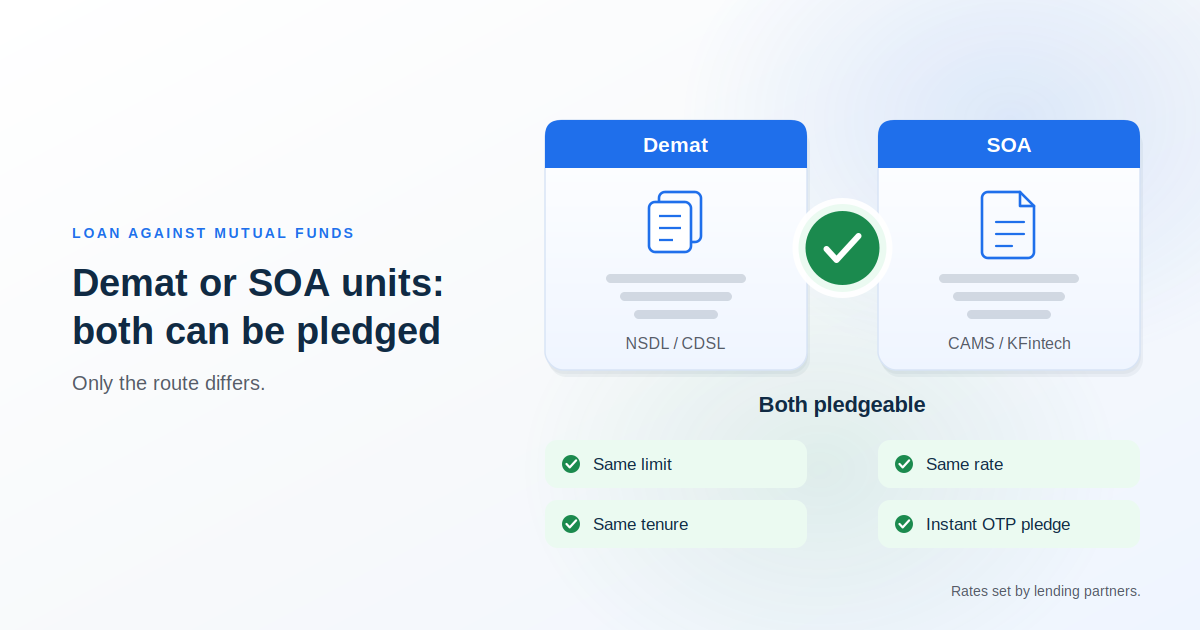
- Demat form holds your units in the same electronic account as your shares, run by a depository (NSDL or CDSL) through your broker. One account, one statement, everything together.
- SOA form holds your units directly with the fund house, through its registrar and transfer agent. You get a Statement of Account instead of a depository holding. This is how most direct and app-based investments are held.
Neither is better as an investment. Returns, NAV and taxation are identical. The difference is purely administrative, and it only shows up in operations like pledging.
Can you pledge both demat and SOA mutual funds? Yes
Check your credit limit on Volt Money. Free, takes 15 seconds.
Check your limit →This is the point most articles get wrong, so it is worth stating plainly: SOA units are pledgeable. You do not need to convert them to demat to borrow against them.
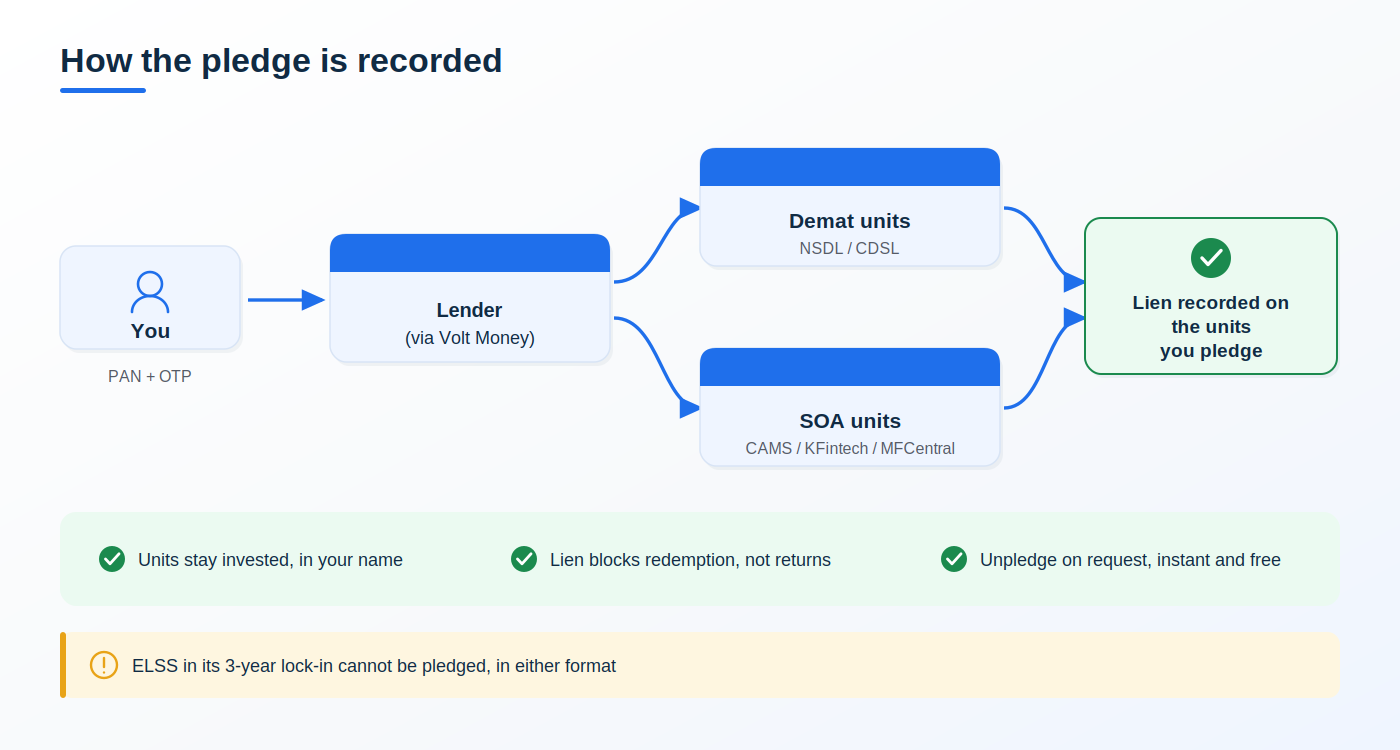
What changes is who records the lien. For demat units the depository does it. For SOA units the registrar does it. India has two mutual fund registrars, CAMS and KFintech, and between them they service the large majority of Indian mutual fund folios. MFCentral is the common platform the two of them run jointly, which is where a lot of investors actually see and manage their holdings. Volt Money works with both registrars and through MFCentral, with over 9,000 approved funds on the list.
It is worth knowing that some lenders do not accept SOA units at all. Several broker-linked platforms lend only against holdings sitting in a demat account with them, which quietly excludes most direct and app-based investors. If a lender has told you your units are ineligible, that was their constraint rather than a rule about your units.
Whichever route applies to you, the lien is recorded against the specific units you pledge. It does not move them, sell them, or touch the rest of your folio.
Demat vs SOA mutual funds: how the two routes compare
| What it is | Demat units | SOA units |
|---|---|---|
| Where the units sit | Your demat account, via NSDL or CDSL | With the fund house, via CAMS or KFintech |
| Who records the lien | The depository | The registrar (RTA) |
| What you approve it with | OTP on your registered mobile | OTP on your registered mobile |
| Pledging speed on Volt | Instant | Instant |
| Do units stay invested | Yes, they keep tracking the market | Yes, they keep tracking the market |
| Can you continue SIPs | Yes, on unpledged and new folios | Yes, on unpledged and new folios |
| Can you redeem while pledged | No, the lien blocks redemption and switches | No, the lien blocks redemption and switches |
| Unpledging | Instant and free, on request | Instant and free, on request |
| Supported by Volt Money | Yes | Yes |
Who can apply
Eligibility for a loan against mutual funds is narrower than most people expect on documents and wider than they expect on credit history.
- You are a resident Indian, aged 18 or above
- You hold mutual fund units in either demat or SOA form, both are accepted
- The schemes you want to pledge are on the approved list, which runs to over 9,000 funds
- Your holdings are worth at least enough to support the Rs 10,000 minimum loan, which is the lowest entry point in the category by some distance
- No minimum credit score and no CIBIL check, because the loan is secured against your units
ELSS units inside their three-year lock-in are the one category that cannot be pledged, in either format.
What the application looks like
The whole thing runs on a PAN number and an OTP, in either holding format. You check your limit, complete OTP-based KYC through DigiLocker, add a bank account, pledge the schemes you choose, and accept the Key Facts Statement and loan agreement. The loan account opens in under 10 minutes, and withdrawals after that are instant and available 24 hours a day, including weekends. That is worth checking against alternatives, because several lenders in this category restrict pledging or approval to business hours.
The step-by-step version, including what the lien does and how to release it, is in lien marking on mutual funds, and how to pledge.
What does not change, whichever format you hold
Once the lien is recorded, the loan behaves identically. Your LTV, your rate, your tenure and your loan range are all set by what you pledge, never by how it is held. The format of your holding does not affect:
- Your limit: the same LTV bands apply in both formats, with no adjustment for how the units are held
- Your cost: the same rate, the same one-time processing fee, interest charged only on what you actually withdraw, and zero foreclosure charges whenever you clear the balance
- Your terms: the tenure and the loan range are identical on both routes
- Your access to the money: withdrawals are instant and available 24/7 in both formats, once the pledge is recorded
- Your investing: existing SIPs keep running and you can start new ones. A lien sits on the specific units you pledged; it does not freeze your folio or your relationship with the fund house.
- Your market exposure: pledged units keep moving with the market in both formats, which cuts both ways
Volt Money is a platform, and the rates and limits shown are provided by its RBI-regulated lending partners.
The numbers behind those bands, how your limit is calculated across a mixed portfolio, what happens to it when markets move and what your options are if you get a margin call are all covered in how LTV works in a loan against mutual funds.
Rs 8 lakh pledged, demat and SOA side by side
Priya holds Rs 8 lakh in equity funds as SOA units with two fund houses. Her friend Arjun holds the same Rs 8 lakh in equity funds, but in his demat account. Both apply through Volt Money.
Both check eligibility with just a PAN number and see a limit in about 15 seconds. Both complete OTP-based KYC through DigiLocker, add a bank account, and pledge. Priya's pledge is recorded by the registrar, Arjun's by the depository. Both loan accounts open in under 10 minutes.
At 45% LTV, both see a limit of Rs 3.6 lakh. Both draw Rs 2 lakh. At 9.99% a year, each pays roughly Rs 1,665 in interest for a full month on the Rs 2 lakh drawn, plus a one-time processing fee from Rs 999, and nothing on the Rs 1.6 lakh they left untouched. The holding format made no difference to a single number.
Do you need to convert SOA units to demat?
For borrowing, no. Conversion is a separate decision about how you prefer to hold and track investments, and it takes time and paperwork with the fund house. If your reason for converting is purely to unlock a loan, you can skip it.
One genuine exception is ELSS. Tax-saving ELSS units cannot be pledged during the 3-year statutory lock-in, and that rule is enforced at the registrar regardless of whether you hold them in demat or SOA form.
More on pledging ELSS units in our guide to loan against ELSS mutual funds.
What happens if your funds fall while pledged
Your limit is tied to the market value of the units you pledge, in both formats. If those funds fall far enough that your drawn balance gets close to the agreed LTV, the lender will ask you to restore the cushion by repaying part of the balance or pledging more units. If you do not, the lender can invoke the pledge and sell enough units to bring the loan back within limit, at whatever the market price is that day. None of that changes between demat and SOA.
The protection is to draw well inside your limit, so an ordinary market dip passes without any action from you.
Not sure which of your funds are eligible?
Check your credit limit on Volt Money. Free, takes 15 seconds. Check your credit limit