Two investors with Rs 10 lakh in mutual funds can get very different loan limits. The reason is almost always LTV, and it turns on what kind of funds they hold.
What LTV for a loan against mutual funds actually means
LTV is a simple ratio. Take the current market value of the units you pledge, apply a percentage, and that is your limit. Pledge Rs 10 lakh of equity funds at 45% LTV and your sanctioned limit is Rs 4.5 lakh.
The gap left over, the Rs 5.5 lakh in that example, is the haircut. It is not a fee and you do not pay it. It is the cushion the lender keeps between what you owe and what the collateral is worth, so that an ordinary market fall does not leave the loan under-secured before anyone has time to act.
LTV is also a limit, not a disbursal. You do not receive Rs 4.5 lakh, and you are not charged for Rs 4.5 lakh. It is a ceiling on a credit line you draw from as needed, and interest applies only to the amount you actually withdraw, for only as long as you hold it.
Why equity and debt get different numbers
Check your credit limit on Volt Money. Free, takes 15 seconds.
Check your limit →The gap comes down to how much the collateral moves. A liquid or debt fund's NAV changes slowly and in small steps. An equity fund's NAV can fall sharply in a bad month.
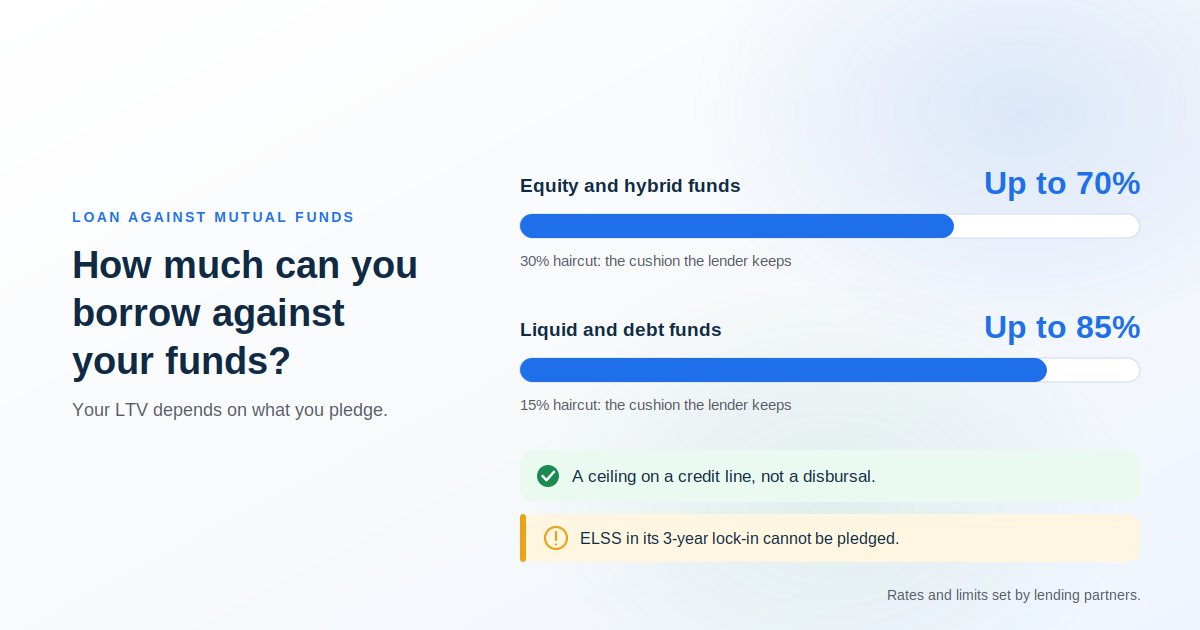
A lender lending against a volatile asset keeps a wider cushion between the loan and the collateral value, so that an ordinary market fall does not leave the loan under-secured. Less volatile collateral needs a smaller cushion, so it supports a higher LTV. That is the whole logic, and it is the logic the regulator applies too: the RBI framework that governs bank lending against securities sets a lower ceiling for listed shares than for mutual fund units, and a higher one again for debt.
| Fund type | LTV on Volt Money | Why |
|---|---|---|
| Equity funds | Up to 45% | NAV can move sharply, so a wider cushion is held. |
| Hybrid funds | Up to 45% | Carry equity exposure, so treated on the equity side. |
| Liquid and debt funds | Up to 85% | NAV is far more stable, so a smaller cushion is needed. |
| ELSS within 3-year lock-in | Not pledgeable | A statutory lock-in, enforced at the registrar. Nothing to do with LTV. |
Across a mixed portfolio your limit is a blend of the two rates, weighted by what you pledge. A portfolio weighted heavily to liquid and debt funds can approach 85% of holdings; an all-equity portfolio will sit near 45%.
If you would rather read your number off a table than work it out, this is what the two bands look like across a range of portfolio sizes.
| If you pledge | Equity or hybrid funds, at 45% | Liquid and debt funds, at 85% |
|---|---|---|
| Rs 50,000 | Rs 22,500 | Rs 42,500 |
| Rs 1 lakh | Rs 45,000 | Rs 85,000 |
| Rs 5 lakh | Rs 2.25 lakh | Rs 4.25 lakh |
| Rs 10 lakh | Rs 4.5 lakh | Rs 8.5 lakh |
| Rs 25 lakh | Rs 11.25 lakh | Rs 21.25 lakh |
| Rs 50 lakh | Rs 22.5 lakh | Rs 42.5 lakh |
Those are ceilings on what you can draw, not amounts you receive or pay interest on.
Volt Money is a platform, and the rates and limits shown are provided by its RBI-regulated lending partners.
Your LTV does not depend on whether the units are held in demat or SOA form. Both formats are pledgeable and both get the same numbers, as set out in our guide to loan against demat and SOA mutual funds.
Why the highest LTV on offer is not the one you want
You will see higher numbers advertised. It is worth understanding what a higher LTV actually buys you, because it is not more money in any meaningful sense. It is the same money with less room to breathe.
Take Rs 10 lakh in equity funds and a Rs 3.5 lakh draw. At 45% LTV, your collateral can fall to about Rs 7.8 lakh before you are called, a drop of roughly 22%. On a 90% LTV facility the same Rs 3.5 lakh draw would not be called until the collateral touched Rs 3.9 lakh, which sounds better until you notice that nobody draws Rs 3.5 lakh against a Rs 9 lakh limit. Draw Rs 8 lakh instead, which is what the higher limit is for, and a fall of barely 11% brings the call.
The higher the LTV you use, the sooner an ordinary market week turns into a phone call and a deadline. Lenders are not shy about this: at least one well-known lender deliberately holds its share-backed LTV in the mid-40s and says publicly that it does so to stop borrowers getting alerts every time the market twitches.
So the question to ask is not who offers the biggest percentage. It is what you intend to draw, and how much of a fall you want to sit through without doing anything.
What you can and cannot use the money for
A loan against securities is not open-ended credit. RBI rules bar borrowers from using the proceeds for capital market investment, which covers buying shares, subscribing to IPOs or rights issues, and margin trading. The restriction is set out in the loan agreement and Key Facts Statement you accept when your account opens.
For everything else the money is yours to use. Medical bills, business working capital, a wedding, a property deposit, consolidating a costlier debt. There is no end-use documentation to submit.
Rs 12 lakh across equity and liquid fund: the blended limit
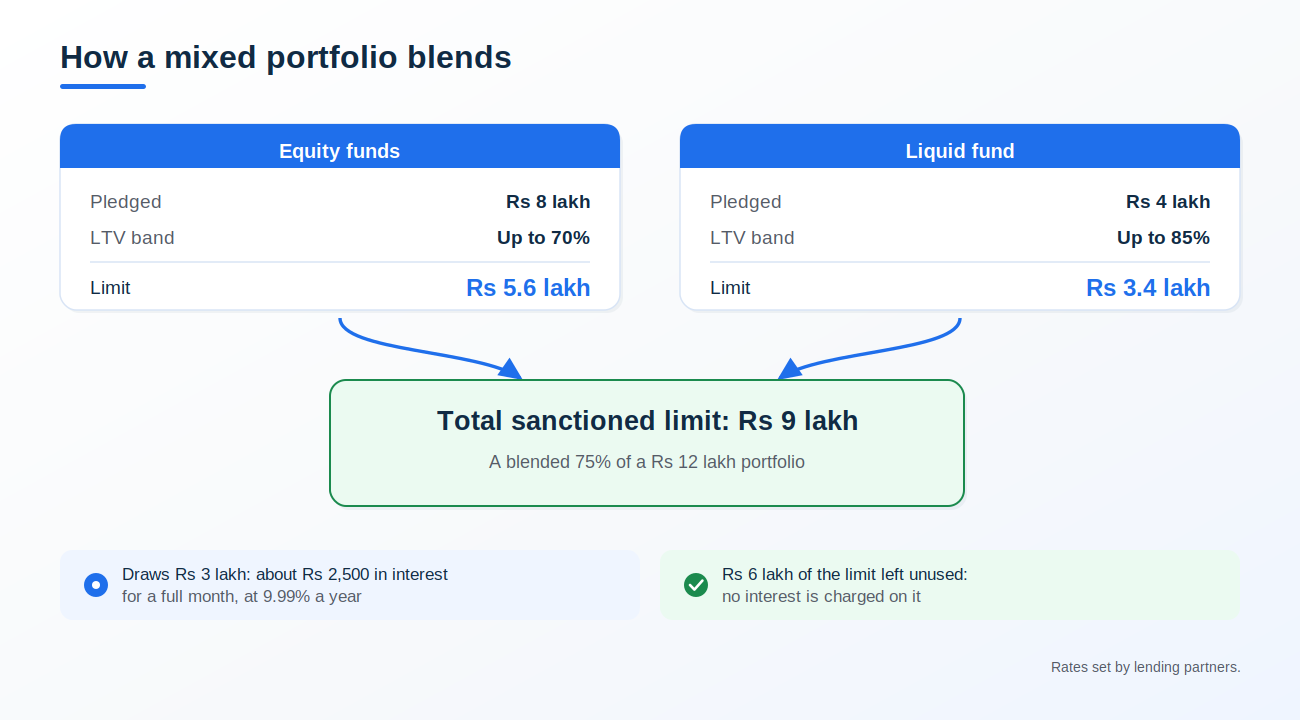
Rahul holds Rs 12 lakh in mutual funds: Rs 8 lakh in equity funds and Rs 4 lakh in a liquid fund. He pledges all of it.
- Equity: Rs 8 lakh at 45% gives Rs 3.6 lakh
- Liquid: Rs 4 lakh at 85% gives Rs 3.4 lakh
- Total sanctioned limit: Rs 7 lakh, a blended 58% of his Rs 12 lakh portfolio
Rahul needs Rs 3 lakh for a medical bill. He withdraws exactly that and leaves Rs 4 lakh of his limit unused. At 9.99% a year, a full month on Rs 3 lakh costs him about Rs 2,500, plus a one-time processing fee from Rs 999. He pays nothing on the unused Rs 4 lakh, and there are zero foreclosure charges when he repays.
Had he sold the units instead, three things would have happened. The money would have taken 2 to 5 business days to reach his bank. He would have realised capital gains and owed tax on them in the year of sale. And he would have given up any recovery in those funds, including the compounding on the Rs 3 lakh he never actually needed to liquidate, because a medical bill is a temporary need and the sale would have been permanent.
Compare borrowing against your funds with selling them.
For a smaller, shorter borrowing the comparison worth running is against a credit card rather than against selling. Credit card against mutual funds sets out where each one wins.
And if you also hold a fixed deposit, that is the other collateral worth weighing. Loan against FD vs loan against mutual funds compares the two on cost and on what each one leaves your money doing.
What happens to your limit when markets move
Pledged units are revalued daily against the latest available NAV. Your limit is therefore not a number fixed on the day you signed: it moves every business day, up when your funds rise and down when they fall. Nothing is required of you while your drawn balance stays comfortably below it.
If your funds fall far enough that your drawn balance gets close to the agreed LTV, the lender asks you to restore the cushion. This is a margin call.
You have two straightforward ways to handle it: repay part of what you have drawn, or pledge additional units to lift the collateral value. Additional pledging on Volt Money is instant, which matters when you are working to a deadline.
If you do neither within the window the lender specifies, the lender can invoke the pledge and sell enough of your units to bring the loan back within limit. That sale happens at the market price on the day, which is usually a falling market, so it is the outcome worth planning around rather than reacting to.
The practical protection is not to borrow to the ceiling. Drawing well inside your limit leaves room for an ordinary market dip to pass without any action from you. This is the single most useful habit in borrowing against equity.
A margin call is the main thing that can go wrong with this product. It is set out in full, alongside the other drawbacks, in the disadvantages of a loan against mutual funds.
How to increase your limit
- Pledge more units: adds collateral and lifts your limit straight away
- Pledge a different mix: a portfolio weighted to liquid and debt funds supports a higher blended LTV
- Let the market work: your limit reflects current NAV, so a rising market raises it without you doing anything
If part of your portfolio is in individual stocks, the LTV you get on those is materially lower.
See your actual limit before you decide anything
Check your credit limit on Volt Money. Free, takes 15 seconds. Check your credit limit