Almost everything written about loans against mutual funds is written by someone selling one. We sell one too, so here is the honest version, written the way we would want it written if we were the ones borrowing.
1. A market fall can force your hand
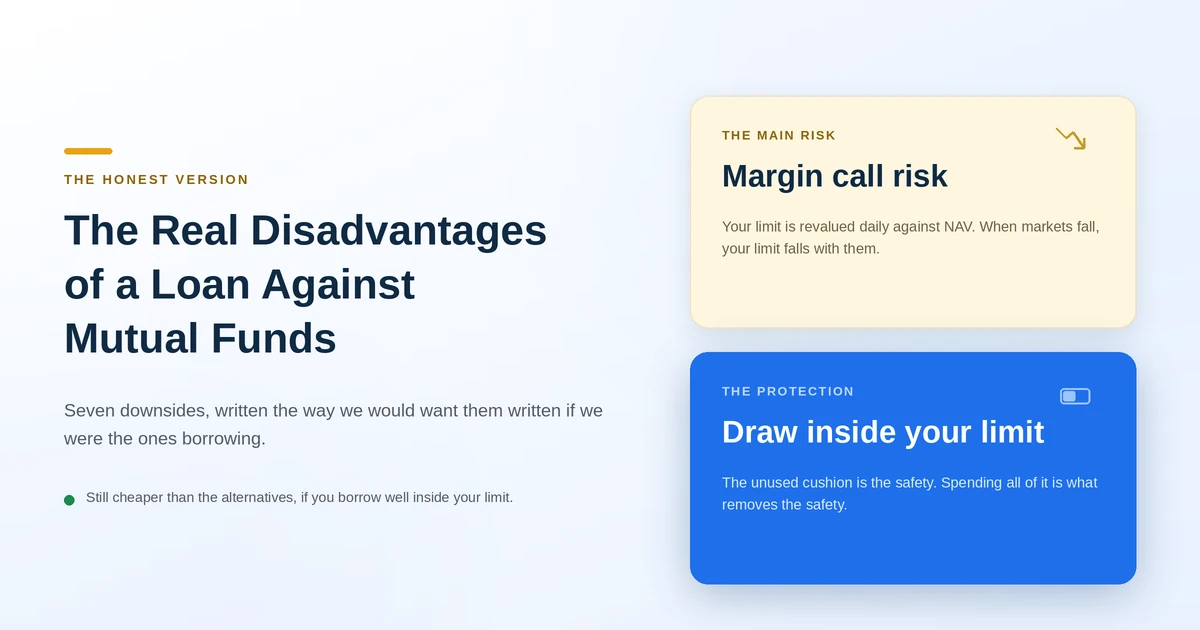
This is the real one, and everything else is secondary to it. Your limit is tied to the market value of the units you pledged, and it is revalued daily against the latest NAV. When markets fall, your limit falls with them.
If your drawn balance gets close to the agreed LTV, the lender asks you to restore the cushion, by repaying part of the balance or pledging more units. If you do neither within the window given, the lender can invoke the pledge and sell enough units to bring the loan back within limit, at whatever the market price is that day. That day is usually a bad one, because the whole situation was caused by prices falling.
So the cost of over-borrowing is not just interest. It is being made to sell at the bottom, which is the exact outcome the loan was meant to help you avoid.
The protection is simple and unglamorous: draw well inside your limit. How LTV and margin calls work shows how much room different draw sizes leave you.
2. The lien blocks redemption and switching
Check your credit limit on Volt Money. Free, takes 15 seconds.
Check your limit →While units are pledged you cannot redeem them or switch them to another scheme. If you were planning to rebalance, exit a fund that has gone off the boil, or move money between schemes, pledged units are not available for any of that until the lien is released.
Unpledging on Volt Money is instant and free, so this is a manageable constraint rather than a trap. But it is a constraint, and it is worth pledging the units you are least likely to want to move.
3. You stay exposed to the market while owing money
Pledged units keep tracking the market, which is normally the entire argument for borrowing instead of selling. It cuts both ways. If your funds fall 20%, you have absorbed that fall and you still owe every rupee you drew.
Selling would have crystallised the loss but ended the exposure. Borrowing keeps the exposure alive on both sides. That is a genuinely better deal over most time horizons, and it is not a free lunch.
4. Not everything you hold is eligible
- ELSS units cannot be pledged during the three-year statutory lock-in. That is enforced at the registrar and there is no way around it.
- The scheme has to be on the approved list. Volt Money covers over 9,000 funds, which is wide, but it is not every scheme in existence.
- Equity and liquid or debt funds get different LTVs, so a portfolio weighted to equity supports a smaller limit than the same value held in debt.
5. It is debt, and it behaves like debt
Interest accrues daily on what you have drawn. On Volt Money that starts at 9.99% a year and is charged only on the amount withdrawn, for only the days you hold it, which is about as gentle as borrowing gets. It is still a cost, and a credit line that sits available for six years is easy to keep dipping into.
The flexibility that makes the product good is the same flexibility that lets a small borrowing quietly become a permanent one. There are zero foreclosure charges, so there is nothing stopping you clearing it early other than the decision to do so.
6. You cannot use the money to invest
RBI rules bar loan-against-securities proceeds from capital market investment. You cannot draw on the line to buy shares, subscribe to an IPO, or fund margin trading. The restriction is set out in the loan agreement and Key Facts Statement you accept when the account opens.
For most borrowers this is irrelevant. If your plan was to borrow cheaply against your portfolio in order to buy more of it, this product does not permit that.
7. Your repayment conduct still matters
There is no minimum credit score and no CIBIL check to obtain the loan, because it is secured against your units. That is a genuine advantage and it is not the same as the loan being invisible. Repayment conduct on the facility can be reported like any other credit account, and a default serious enough for the lender to invoke the pledge is a serious event on any record.
Where a loan against mutual funds still wins
Set against the alternatives, the disadvantages above are mostly the price of a much better deal.
| If you instead | What it costs you |
|---|---|
| Sell the units | 2 to 5 business days to reach your bank, capital gains realised and taxed, and the compounding on money you may only have needed temporarily |
| Revolve a credit card balance | Commonly 36% to 45% a year, plus GST on the interest |
| Take an unsecured personal loan | Commonly 14% to 30% a year, with fixed EMIs and often a foreclosure charge, and rarely offered for under 12 months |
| Borrow against a fixed deposit instead | Usually a lower rate, but capped at the deposit and your money stays locked at the deposit's return |
| Take a loan against mutual funds | From 9.99% a year on the drawn amount only, no foreclosure charge, and your units stay invested |
Volt Money is a platform, and the rates and limits shown are provided by its RBI-regulated lending partners.
The fixed deposit line is the closest alternative and deserves its own comparison. Loan against FD vs loan against mutual funds runs the numbers on both.
How much you draw decides how much risk you take
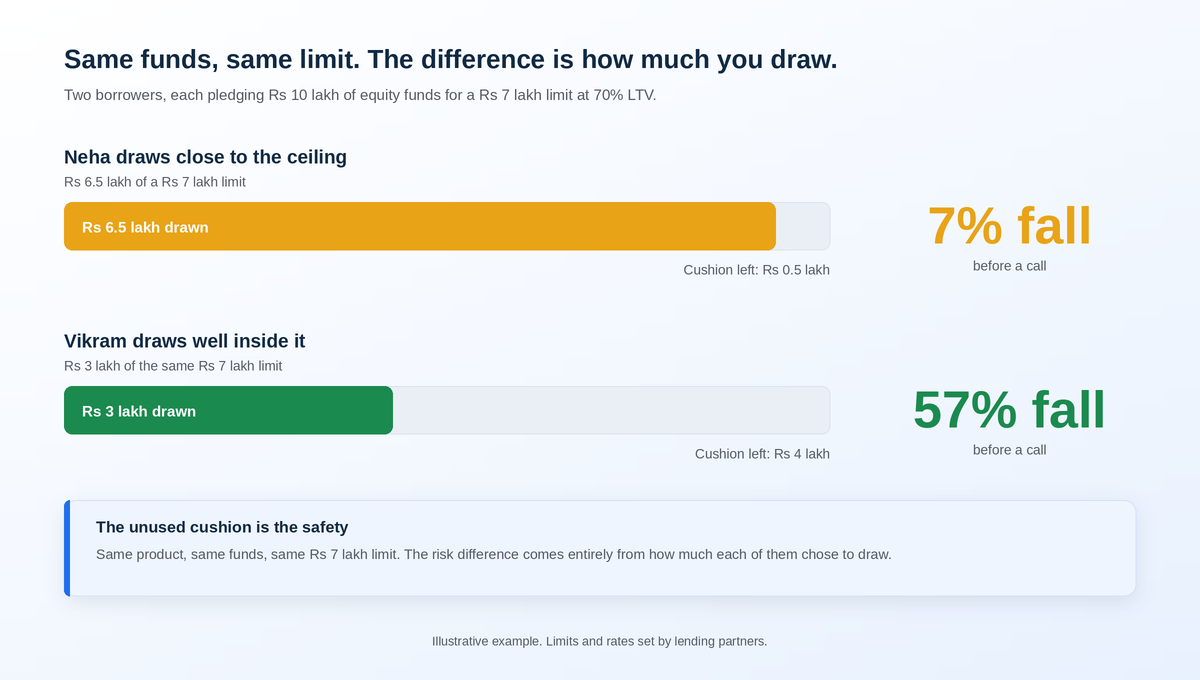
Two borrowers each pledge Rs 10 lakh of equity funds, giving each a Rs 4.5 lakh limit at 45% LTV.
- Neha draws Rs 4.2 lakh, close to the ceiling. That collateral only has to fall about 7% before a call arrives. An ordinary bad fortnight does it.
- Vikram draws Rs 2 lakh. That collateral can fall about 56% before anyone gets in touch. That is not an ordinary market event.
Same product, same LTV, same funds. The difference in risk is entirely a function of how much each of them chose to draw. That is the single most useful thing to understand before taking one of these loans.
Who should probably not take one
- Anyone who would need to draw close to the full limit to cover the need. The cushion is the safety, and spending it removes the safety.
- Anyone whose only holdings are ELSS units still inside the lock-in.
- Anyone planning to use the money for capital market investment, which the rules do not permit.
- Anyone who expects to need to redeem or switch those specific units shortly. Unpledging is instant and free, but it is an extra step to remember.
Want to see your limit before deciding anything?
Check your credit limit on Volt Money. Free, takes 15 seconds. Check your credit limit