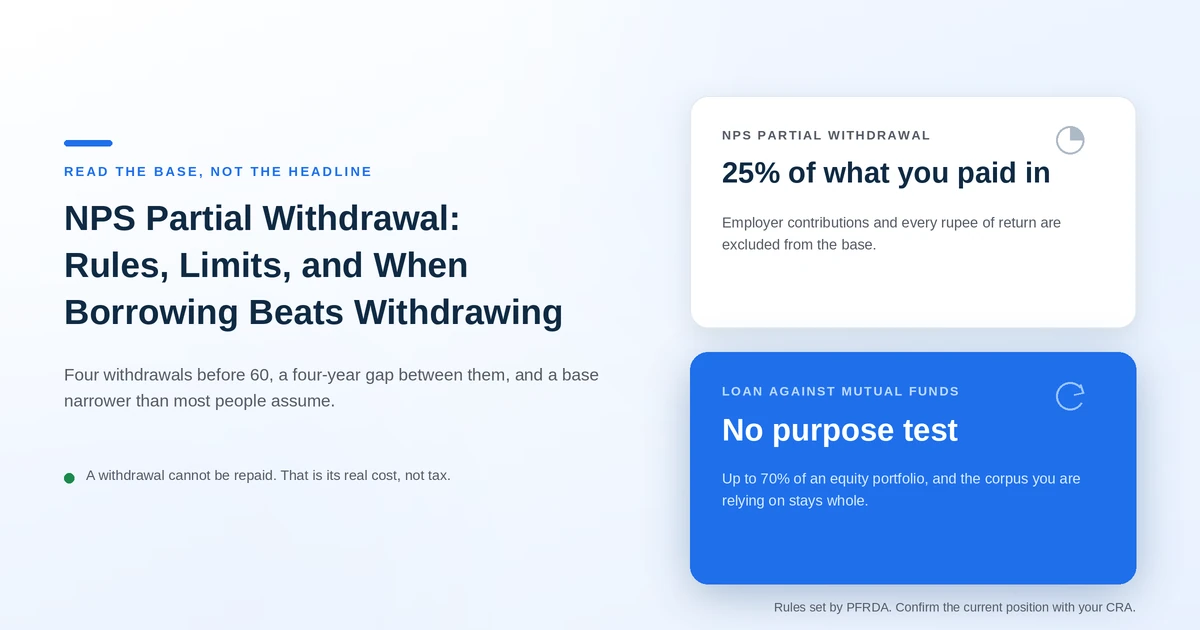
The base is narrower than most people assume. It is 25% of what you contributed, not 25% of the corpus. Employer contributions and every rupee of investment return are excluded. On a Rs 12 lakh corpus built from Rs 8 lakh of your own contributions, the maximum is Rs 2 lakh.
If the amount is short, or your reason is not on the list, borrowing against another asset is often the cleaner route. A loan against mutual funds lends up to 45% of an equity portfolio, with no purpose test and no permanent hole in your retirement corpus.
Three things decide whether NPS partial withdrawal is of any use to you, and all three are easy to get wrong. The limit is a quarter of your own contributions, not a quarter of your corpus. The number of withdrawals moved from three to four in the December 2025 amendment, with a four-year gap attached. And the new route for borrowing against an NPS balance is notified but not yet operational. Each is dealt with below.
What this page covers, and what it does not
This page is about partial withdrawal from a Tier I account while you are still contributing.
The December 2025 amendment changed a good deal more than that: the lump sum available at exit, the annuity share, the exit age, and the rules for premature exit. Those belong to a different question and a different page.
One point from it is worth carrying across, because it is the thing most likely to catch a subscriber out. The pension regulator and the Income Tax Act are no longer aligned. PFRDA now permits a non-government subscriber to take up to 80% of the corpus as a lump sum at exit, with the annuity share cut to 20%. The Act still exempts only 60%, under section 10(12A). Nothing has yet been amended to cover the extra 20%, so on the current reading that slice is taxable at your slab rate. The 80% option does not apply to government subscribers. Confirm the position with your CRA or a tax adviser before planning an exit around it, because this one may well move.
NPS partial withdrawal rules, in one table
Check your credit limit on Volt Money. Free, takes 15 seconds.
Check your limit →| Rule | What applies |
|---|---|
| Minimum time in NPS | Three years from the date of joining |
| Account type | Tier I only. Tier II has no restrictions and is freely withdrawable |
| Maximum per withdrawal | 25% of the subscriber's own contributions to that account |
| What the base excludes | Employer contributions and all investment returns |
| Number of times | Four before age 60, up from three under the earlier rules |
| Gap between withdrawals | A minimum of four years between two partial withdrawals |
| After age 60 | Permitted with a minimum gap of three years, if you continue the account |
| Purpose | Restricted to a defined list. See below |
| Tax | Exempt up to 25% of your own contributions under section 10(12B) |
| Process | Request through your CRA, routed via your nodal office or point of presence |
The 25% is of your contributions, not your corpus
This is the single most common misunderstanding about NPS partial withdrawal, and it always works against the subscriber.
Take a subscriber with a Rs 12,00,000 NPS corpus. Rs 8,00,000 came from their own contributions, Rs 1,50,000 from the employer, and Rs 2,50,000 is accumulated return.
The withdrawal ceiling is 25% of Rs 8,00,000, which is Rs 2,00,000. Not 25% of Rs 12,00,000. The accessible share of the actual corpus is closer to 17%.
What you are allowed to withdraw for
NPS partial withdrawal is purpose-bound. The permitted grounds under the current regulations are:
- Higher education of your children, including legally adopted children.
- Marriage of your children.
- Purchase or construction of a residential house or flat, in your own name or jointly with your spouse. Not permitted if you already own a residential house other than ancestral property.
- Medical treatment or hospitalisation of yourself, your spouse, your children or your parents. The 2025 amendment widened this from a named list of specified illnesses to medical treatment generally.
- Medical and incidental expenses arising from your disability or incapacitation.
- Settling a financial obligation taken from a regulated financial institution against a lien or charge marked on your NPS account.
Two grounds that used to be on this list, skill development and setting up your own venture, were dropped in the 2025 amendment. If you were counting on either, they are no longer available.
Borrowing against your NPS balance: notified, not yet live
The amendment referred to throughout this article is the PFRDA (Exits and Withdrawals under the NPS) (Amendment) Regulations, notified in December 2025. It also opened a door that did not exist before. A regulated financial institution can mark a lien or charge on part of your NPS corpus and lend against it, using up to 25% of your own contributions as collateral. The money stays invested and keeps earning while the lien sits on the account.
It is worth being precise about the state of this, because a framework being notified is not the same as the facility being available. The three things still have to happen before a subscriber can actually borrow this way. PFRDA has to issue the detailed operational guidelines it said would follow separately. The record-keeping agencies have to build the lien-marking process. And lenders have to onboard it. None of those had visibly happened at the time of writing. Treat it as a route that is coming, check with your CRA before planning around it, and note the date on this page.
The mechanics, though, are the same mechanics a loan against mutual funds has used for years: pledge the asset, borrow against it, leave it invested. That is the comparison worth making.
| Feature | NPS partial withdrawal | The new NPS lien-loan route | Loan against mutual funds |
|---|---|---|---|
| Status | Live | Notified. Operational guidelines awaited, few lenders participating | Live |
| What happens to the money | Leaves the corpus permanently | Stays invested under a lien | Stays invested under a lien |
| How much | 25% of your own contributions | Up to 25% of your own contributions as collateral | 45% of equity fund value, 85% of liquid and debt |
| Cost | No interest. The compounding is the cost | Set by the lender. Not yet published | From 9.99% p.a.*, on the drawn amount only |
| Purpose test | Restricted list | Set by the lender | None |
| Frequency | Four times before 60, four-year gap | Not yet specified | Draw, repay and redraw inside a 6-year line |
| Reversible | No | Yes, on repayment | Yes, on repayment |
The middle column is the one to watch. If it arrives as described, it will be the first time an NPS subscriber can raise money without permanently shrinking the corpus. Until the guidelines and the lenders are actually there, the right column is the version of that idea you can use today, and it works on an asset you are not relying on for your pension.
What a partial withdrawal actually costs you
The tax treatment is genuinely good. Up to 25% of your own contributions is exempt under section 10(12B), so the withdrawal is not taxed. The cost is elsewhere, and it is the same cost every retirement withdrawal carries: the money stops compounding, permanently, and unlike a loan there is no mechanism to put it back.
Rs 2,00,000 withdrawn at age 38 is not Rs 2,00,000. Left in a scheme returning 10% a year, it would be worth about Rs 16,28,000 by age 60. That is the number to weigh against the interest cost of borrowing the same amount for a few months.
A loan against mutual funds keeps your NPS corpus intact
If you hold mutual funds, they solve most of what NPS partial withdrawal does not.
| Feature | NPS partial withdrawal | Loan against mutual funds (Volt Money) |
|---|---|---|
| Eligibility wait | Three years in NPS | None |
| How much | 25% of your own contributions only | 45% of equity fund value, 85% of liquid and debt. Rs 10,000 to Rs 5 crore |
| Purpose | Restricted list. Education, marriage, first home, medical, disability, lien settlement | No purpose test |
| How often | Four times before 60, four-year gap | Draw, repay and redraw freely inside a 6-year credit line |
| Cost | No interest, but the money stops compounding for good | From 9.99% p.a.*, on the drawn amount only, for the days used |
| Does the asset keep working | No. It is removed from the corpus | Yes. Units stay invested and keep growing |
| Reversible | No | Yes. Repay and the money is back at work |
| Speed | CRA request routed through the nodal office or point of presence | Account opened in under 10 minutes, withdrawals instant, 24/7 |
A Rs 5,00,000 bill against a Rs 2,00,000 ceiling

Meera, 38, needs Rs 5,00,000 for her mother's cancer treatment, and expects to repay over about nine months. Her reason sits squarely on the permitted list, so this is not a case of NPS refusing her. It is a case of NPS not reaching far enough.
NPS route. She has been in NPS for nine years, with a corpus of Rs 12,00,000 of which Rs 8,00,000 is her own contributions. Her ceiling is 25% of that Rs 8,00,000, so Rs 2,00,000. It covers two fifths of the bill. It also spends one of her four lifetime withdrawals and locks her out of the next for four years, which matters when the reason for withdrawing is an illness that may recur.
Mutual fund route. She holds Rs 12,00,000 in equity funds. At 45% that is a Rs 5,40,000 limit, so the full Rs 5,00,000 is available at once. Over 270 days at 9.99%* the interest is about Rs 36,949. Opening the line carries a one-time setup fee from Rs 999, charged once rather than per drawdown. Her NPS is untouched, her four withdrawals are still there, and she can draw again on the same line if the treatment runs longer.
About Rs 37,000 in interest, against the roughly Rs 16,28,000 that the Rs 2,00,000 would have grown to by the time she turns 60. Borrowing costs more in cash today and far less in retirement, and it is the only one of the two that covers the actual bill.
Starting rate. Your rate depends on your portfolio and profile.
How to make a partial withdrawal, if it is still the right call
- Confirm eligibility. Three years in NPS, a permitted purpose, and four years since your last partial withdrawal.
- Raise the request with your CRA. Protean or KFintech, through the CRA portal or your point of presence.
- Declare the purpose. Most grounds are handled by self-declaration. Medical grounds may still require supporting documents.
- Authorisation. The request is routed to your nodal office or point of presence for verification before the amount is released to your registered bank account.
The market risk a withdrawal does not have
Taking money out of NPS exposes you to nothing further once it is out. Borrowing does, because your limit tracks the value of the units you have pledged. If markets fall far enough, you will be asked to top up: pledge more units, or repay part of the balance. Do neither and the lender can sell pledged units to cover the difference. The way to stay clear of it is simple enough, which is not to draw the whole limit. Leave headroom and an ordinary market fall never reaches you. How a loan against mutual funds works covers the pledge, the limit and the mechanics in full.
Important notes
- This article is for educational purposes only and is not financial advice.
- NPS withdrawal limits, permitted purposes and tax treatment are set by PFRDA and the Income Tax Act and can change. Confirm the current position with your CRA before you act.
- Mutual fund investments are subject to market risk. The value of pledged units can rise and fall, and a fall can mean you are asked to add units or repay part of the balance, as described above.
- Interest rates, loan to value limits, fees and eligibility depend on your portfolio and profile. Your final terms are set out in the Key Facts Statement and the loan agreement you accept before drawdown, which also name the lending partner.
Check your limit before you touch your retirement corpus
Check your credit limit on Volt Money. Free, takes 15 seconds. Check your credit limit
Your loan is made by an RBI-regulated lending partner, a bank or NBFC, named in the Key Facts Statement and the loan agreement you accept before drawdown.