Looking for whether you can buy mutual funds using a credit card? You cannot. SEBI requires a traceable source of funds, so AMCs do not accept card payments for mutual fund purchases. There is a fuller answer in the FAQ at the end.
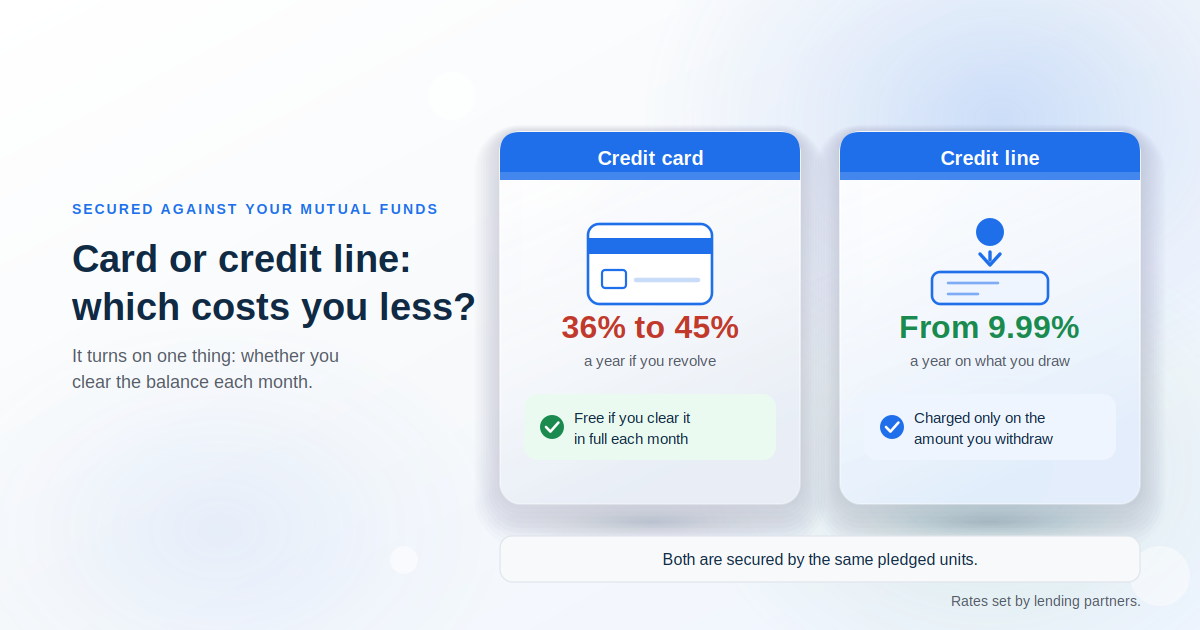
Both of the products compared here let you keep your investments and borrow against them. They differ in how you spend the money, and in what it costs you if you do not clear the balance quickly.
What each one is
A secured credit card against mutual funds works like any credit card. Your fund units are pledged, and that pledge backs a spending limit on a card. You use it at merchants, you get a monthly bill, and you either pay in full or revolve the balance.
A loan against mutual funds is a credit line. The same pledge produces a limit, but you withdraw cash from it into your bank account, in whatever amount you need, whenever you need it. On Volt Money withdrawals are instant and available 24/7, including weekends, which is not universal: several lenders in this category restrict pledging or withdrawal to business hours.
Where the cost difference shows up
Check your credit limit on Volt Money. Free, takes 15 seconds.
Check your limit →If you clear a credit card bill in full every month, the card is effectively free credit for that period. That is genuinely useful and no loan competes with it.
The moment you revolve a balance, the picture changes sharply. Revolved credit card balances in India commonly carry 36% to 45% a year, interest typically starts from the transaction date rather than the bill date once you stop paying in full, and the interest itself attracts GST.
A loan against mutual funds starts at 9.99% a year on Volt Money, charged only on the amount you have withdrawn and only for the days you hold it.
Volt Money is a platform, and the rates and limits shown are provided by its RBI-regulated lending partners.
Credit card against mutual funds vs a secured credit line
| Feature | Credit card against mutual funds | Loan against mutual funds (Volt Money) |
|---|---|---|
| How you access it | Card spending at merchants | Cash into your bank account, instantly, 24/7 |
| Typical cost if revolved | Commonly 36% to 45% a year, plus GST on interest | From 9.99% a year |
| Cost if cleared monthly | Effectively nil, aside from any annual fee | Interest only for the days drawn |
| Interest charged on | Revolved balance, often from transaction date | Only the amount withdrawn, calculated daily |
| Upfront fee | Usually a joining or annual fee | Processing fee from Rs 999 |
| Minimum | Card limit floor set by the issuer | Loans from Rs 10,000 |
| Good for | Everyday spends you clear in full | Larger or longer needs, and cash requirements |
| Cash withdrawal | Usually expensive, with a separate fee | The normal way it works, no extra fee |
| Credit score | Usually assessed | No minimum credit score or CIBIL check |
| Tenure | Revolving, no end date | 6-year credit line, repay any time |
| Foreclosure charges | Not applicable | Zero |
What about a loan on your credit card?
Revolving a balance is not the only way to borrow on a card, and it is the most expensive one. Most issuers offer two other routes, and it is worth knowing where each lands before comparing any of them to a credit line.
| How you borrow on a card | What it typically costs | Worth knowing |
|---|---|---|
| Revolving the balance | Commonly 36% to 45% a year, plus GST on the interest | Interest runs from the transaction date, and new spends stop getting an interest-free period until the balance is cleared. |
| Converting a purchase to EMI | Commonly 13% to 22% a year, plus a one-time processing fee | Much cheaper than revolving, but it can only restructure a purchase you have already made, and the converted amount stays blocked against your card limit. |
| Taking cash on the card | The revolving rate, plus a cash advance fee of around 2.5% | Interest starts the day you withdraw. There is no interest-free period on cash at all. |
| A credit line against your funds | From 9.99% a year, on the amount drawn only | Cash into your bank account, no separate fee for taking it as cash, and your card limit stays free for what cards are good at. |
The EMI route is the one worth taking seriously, because it is genuinely far cheaper than revolving. It still sits above a secured credit line at every point in that range, and it cannot give you cash. It restructures a purchase you have already put on the card.
Rs 2 lakh over four months: card vs credit line
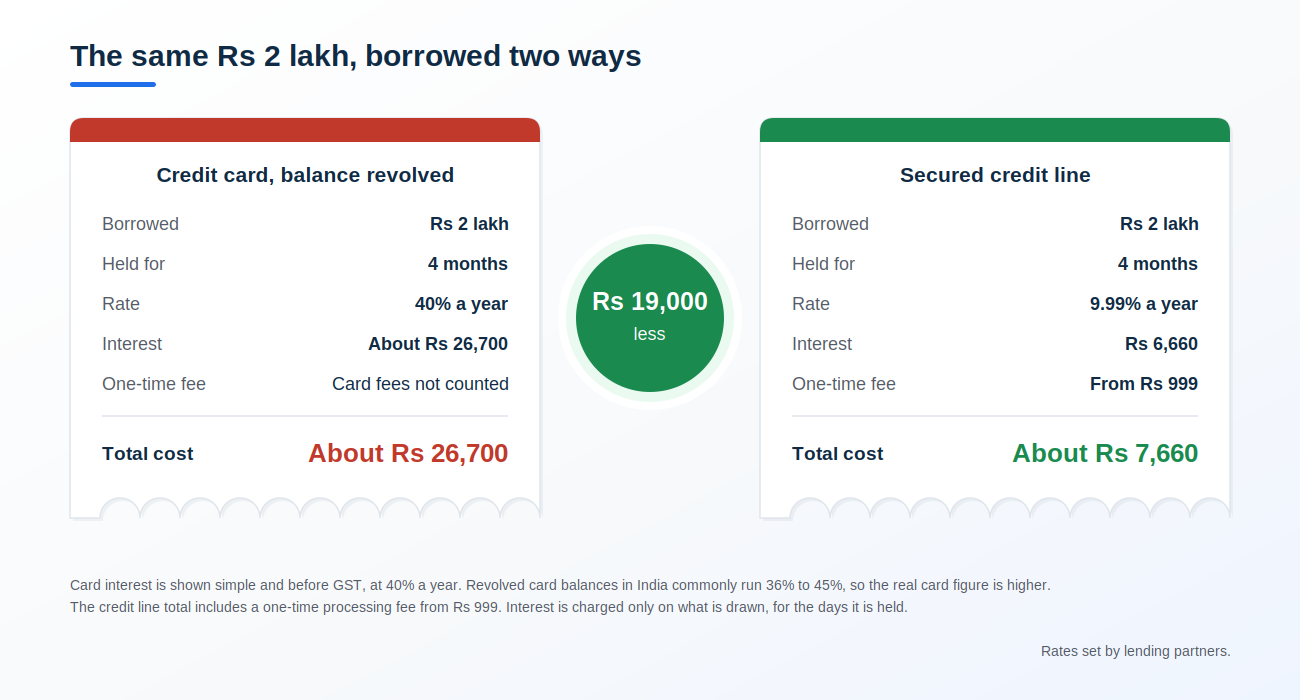
Sanjay needs Rs 2 lakh for a home repair and expects to repay it over four months. He has Rs 6 lakh in equity mutual funds.
- On a card at 40% a year, revolving Rs 2 lakh for four months costs him roughly Rs 26,700 in interest. That figure is conservative: card interest is usually compounded monthly and GST applies on top, so the real number is higher.
- On a Volt Money credit line at 9.99% a year, the same Rs 2 lakh over four months costs roughly Rs 6,660 in interest, plus a one-time processing fee from Rs 999. Call it about Rs 7,660 all in.
The difference is roughly Rs 19,000 on a single four-month borrowing, on the same collateral. The card wins only if he can clear the whole Rs 2 lakh inside one billing cycle.
There is also a practical point. A home repair often needs cash for a contractor, not a card swipe. The credit line pays into his bank account.
Already carrying a card balance?
The comparison changes if the card debt already exists. At that point the question is not which to borrow on. It is whether to move what you already owe.
A balance of Rs 3 lakh revolving at 40% a year costs about Rs 10,000 a month in interest alone, before you repay a rupee of the principal. Drawing the same Rs 3 lakh from a credit line at 9.99% and clearing the card costs about Rs 2,500 a month. That is roughly Rs 7,500 a month back in your hands, on the same money: you have not borrowed more, you have moved where you owe it.
Clearing the card in full also restarts its interest-free period, which paying the minimum amount due never does. Once any balance carries forward, every new purchase accrues interest from the transaction date, so the minimum payment keeps the account in good standing while the underlying debt barely moves.
The trade you are making is real: an unsecured debt becomes a secured one. A card issuer has no claim on your investments. A lender on a credit line can sell pledged units if you have drawn close to your limit and the market falls. Consolidating onto a line you then run to the ceiling swaps one problem for another, which is an argument for leaving headroom, not for staying on the card.
What the credit line asks of you in return
A card secured by mutual funds and a credit line secured by mutual funds both put your units behind the borrowing, so both carry the same underlying risk: if the market falls far enough while you are drawn down, the lender can ask you to restore the cushion, and can sell pledged units if you do not.
The larger your drawn balance relative to your limit, the sooner that happens. How LTV and margin calls work covers how much headroom to leave yourself.
One restriction applies to the credit line that does not apply to a card. RBI rules bar loan-against-securities proceeds from being used for capital market investment, so you cannot draw on the line to buy shares, subscribe to an IPO, or fund margin trading. Everything else is open, with no end-use documentation.
Which should you use
- Use the card for everyday spends you will clear in full each month
- Use the credit line for anything you will carry for more than a billing cycle, anything that needs actual cash, and anything large enough that the rate difference matters
- Use neither to the ceiling, because a fully drawn secured limit is what turns an ordinary market dip into a margin call
They are not mutually exclusive. Plenty of people keep a card for convenience and a secured credit line for the occasions when they need real money at a sane rate.
If you are weighing this against an unsecured option instead, the comparison with a personal loan covers rates of 14% to 30% a year and why a secured line usually wins.
And if you hold a fixed deposit as well as funds, loan against FD vs loan against mutual funds covers which collateral to pledge first.
See what your funds already qualify for
Check your credit limit on Volt Money. Free, takes 15 seconds. Check your credit limit